
Norton Couloir
Gully·Tibet
The Norton Couloir, also known as the Great Couloir, is a prominent and steep gully situated on the north face of Mount Everest in Tibet. It was named after Edward F. Norton, who ascended a portion of it during a 1924 expedition. The couloir has since served as a significant route for notable mountaineering achievements, including Reinhold Messner's solo ascent without supplemental oxygen in 1980.
Key Facts
- ›Located on the north face of Mount Everest in Tibet.
- ›Named after Edward F. Norton, who reached a high altitude in it in 1924.
- ›Lies east of Mount Everest's pyramidal peak, extending to within 150 meters of the summit.
- ›Reinhold Messner used it for his historic 1980 solo ascent without supplemental oxygen.
- ›An Australian expedition established a new route through it in 1984.
- ›Marco Siffredi made the first snowboard descent of Everest via the Norton Couloir in 2001.
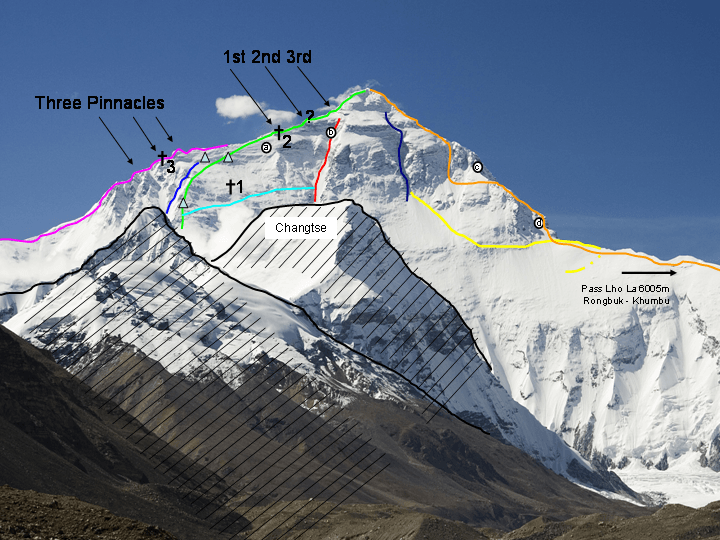
Great Couloir
Glacial Erosion, Wind Erosion
Steep Gully On North Face, Second Step
About Norton Couloir
The Norton Couloir, also referred to as the Great Couloir, is a formidable and steep gully located on the north face of Mount Everest in Tibet. Positioned to the east of the mountain's pyramidal peak, it ascends to within approximately 150 meters of the summit, presenting a significant challenge to mountaineers.
Naming and Early Ascents
The couloir bears the name of Edward F. Norton, the leader of the 1924 British expedition. Norton reached a substantial altitude of about 8,572.8 meters (28,126 ft) within this gully during a summit attempt on June 4, 1924. By traversing the north face and entering the couloir, he aimed to avoid the exposed and windswept ridge. His ascent into the couloir marked the beginning of its association with major climbing feats.
Notable Mountaineering Achievements
The Norton Couloir has been the stage for several historic mountaineering accomplishments. In 1980, Reinhold Messner achieved one of the most remarkable feats in climbing history by ascending the couloir solo and without the use of supplemental oxygen. Inspired by Norton's 1924 climb, Messner utilized the gully to bypass a dangerous ridge, including the formidable 'Second Step,' solidifying the couloir's reputation as a route for ultimate challenges.
Later Expeditions and Records
Further climbs through the Norton Couloir include an expedition by Australians in 1984, who established a new route. Tim Macartney-Snape and Greg Mortimer reached the summit via this route on October 2, without bottled oxygen, becoming the first Australians to do so. In 2001, French snowboarder Marco Siffredi made history by completing the first snowboard descent of Mount Everest, using the Norton Couloir as his descent path. He tragically died the following year while attempting a new descent via the adjacent Hornbein Couloir.
Source: Wikipedia ↗
Frequently Asked Questions
What is the Norton Couloir?
The Norton Couloir, also called the Great Couloir, is a steep gully on the north face of Mount Everest in Tibet. It is a significant feature for mountaineers attempting to reach the summit.
Who was Edward F. Norton and why is the couloir named after him?
Edward F. Norton was the lead member of the 1924 British expedition to Mount Everest. He reached a significant altitude within this gully during an unsuccessful summit attempt, and it was subsequently named in his honor.
What are some notable climbs associated with the Norton Couloir?
Reinhold Messner made a historic solo ascent of Everest using the Norton Couloir in 1980, without supplemental oxygen. In 1984, an Australian expedition also climbed a new route through it, with Tim Macartney-Snape and Greg Mortimer reaching the summit without bottled oxygen.
Has the Norton Couloir been used for descents?
Yes, French snowboarder Marco Siffredi achieved the first snowboard descent of Mount Everest in 2001 by utilizing the Norton Couloir. He later died attempting a descent via the Hornbein Couloir.
Where is the Norton Couloir located in relation to the summit of Mount Everest?
The Norton Couloir is situated on the north face of Mount Everest in Tibet, lying east of the summit's pyramidal peak. It extends to within approximately 150 meters of the summit.