
Bassaricyon
Carnivore·Solitary
Bassaricyon, commonly known as olingos, are small arboreal mammals native to the rainforests of Central and South America. These relatives of raccoons are nocturnal and primarily inhabit trees, resembling kinkajous but differing in distinct physical features and evolutionary history. Their taxonomic classification has seen recent revisions with the discovery of new species.
Key Facts
- ›Olingos are small, arboreal mammals found in Central and South American rainforests.
- ›They are nocturnal, meaning they are most active at night.
- ›Bassaricyon are relatives of raccoons but are not closely related to kinkajous, despite superficial similarities.
- ›The genus includes several species, with recent discoveries leading to taxonomic debate.
- ›They inhabit elevations ranging from sea level up to 2,750 meters.
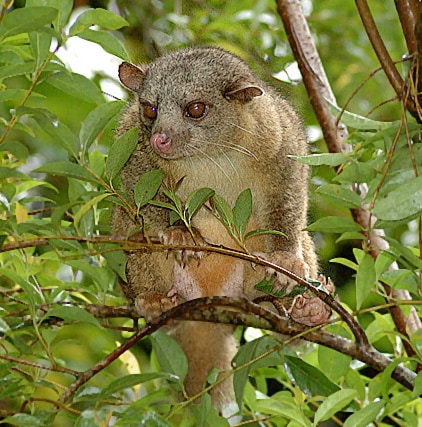
Olingos
Rainforests, Arboreal
Central America, South America
Small Neotropical Procyonids, Resemble Kinkajous In Morphology and Habits, Lack Prehensile Tails, Lack Extrudable Tongues, Possess More Extended Muzzles, Possess Anal Scent Glands
About Bassaricyon
The genus Bassaricyon, commonly known as olingos, comprises small mammals native to the Neotropical rainforests of Central and South America. These creatures are closely related to raccoons and share a rainforest habitat, ranging from Nicaragua down to Peru. Olingos are distinctly arboreal, spending their lives in trees, and are nocturnal, meaning they are primarily active during the night. They inhabit elevations that span from sea level up to approximately 2,750 meters.
Morphology and Evolution
Olingos bear a superficial resemblance to kinkajous, another type of procyonid, in their physical form and daily habits. However, key distinctions exist: olingos lack the prehensile tails and extrudable tongues characteristic of kinkajous. They also present with more elongated muzzles and possess anal scent glands, features that set them apart. Despite these similarities, genetic studies reveal that olingos and kinkajous are not closely related; their resemblances are a product of parallel evolution. The closest living relatives to olingos are actually coatis, with their evolutionary paths diverging around 10.2 million years ago. The diversification within the Bassaricyon genus appears to have begun more recently, approximately 3.5 million years ago, with further splits occurring subsequently.
Species and Taxonomy
The precise number of species within the Bassaricyon genus has been a subject of taxonomic debate. Historically, only the northern olingo (B. gabbii) was widely recognized, often leading to confusion. Recent discoveries, such as that of B. neblina (the olinguito) in 2006, have prompted revisions. Current research, utilizing anatomical, morphometric, and genetic data, suggests the recognition of four distinct olingo species. Olingos are rarely found in zoos and are frequently misidentified as kinkajous.
Source: Wikipedia ↗
Frequently Asked Questions
What are olingos?
Olingos are small, nocturnal mammals belonging to the procyonid family, which also includes raccoons. They are native to the rainforests of Central and South America and are known for their arboreal lifestyle.
What is the difference between an olingo and a kinkajou?
While olingos and kinkajous share some similarities in appearance and habits due to parallel evolution, they are not closely related. Olingos lack prehensile tails and extrudable tongues, possess more extended muzzles, and have anal scent glands, distinguishing them from kinkajous.
How many species of olingos are there?
There is ongoing disagreement among taxonomists regarding the exact number of olingo species. Some classifications recognize up to five species, while others suggest as few as one or two, with recent research identifying distinct species like Bassaricyon neblina.
Where do olingos live?
Olingos are found in the rainforests of Central and South America, with their range extending from Nicaragua south to Peru. They are arboreal, meaning they live in trees, and can be found at various elevations.
What is the evolutionary history of olingos?
Genetic studies indicate that the closest relatives to olingos are coatis, with their divergence estimated to have occurred around 10.2 million years ago. Their evolutionary diversification began in northwestern South America after their ancestors migrated from Central America.