
Atacamatitan
Herbivore·Late Cretaceous·Antofagasta Region, Chile·Quadrupedal
Atacamatitan is a genus of titanosaurian sauropod dinosaur that lived during the Late Cretaceous period in what is now Chile. Its name, meaning "Atacama Desert titan," reflects the region where its fossils were discovered. This dinosaur is considered one of the most complete titanosaurs found in Chile, offering valuable insights into South American sauropod diversity.
Key Facts
- ›Atacamatitan was a titanosaurian sauropod dinosaur.
- ›Its fossils were discovered in the Tolar Formation of Chile.
- ›The genus name "Atacamatitan" means "Atacama Desert titan."
- ›The species name "chilensis" refers to Chile.
- ›It is estimated to have weighed between 8,000 and 16,000 kilograms.
- ›Atacamatitan is one of the most complete titanosaurian remains found in Chile.
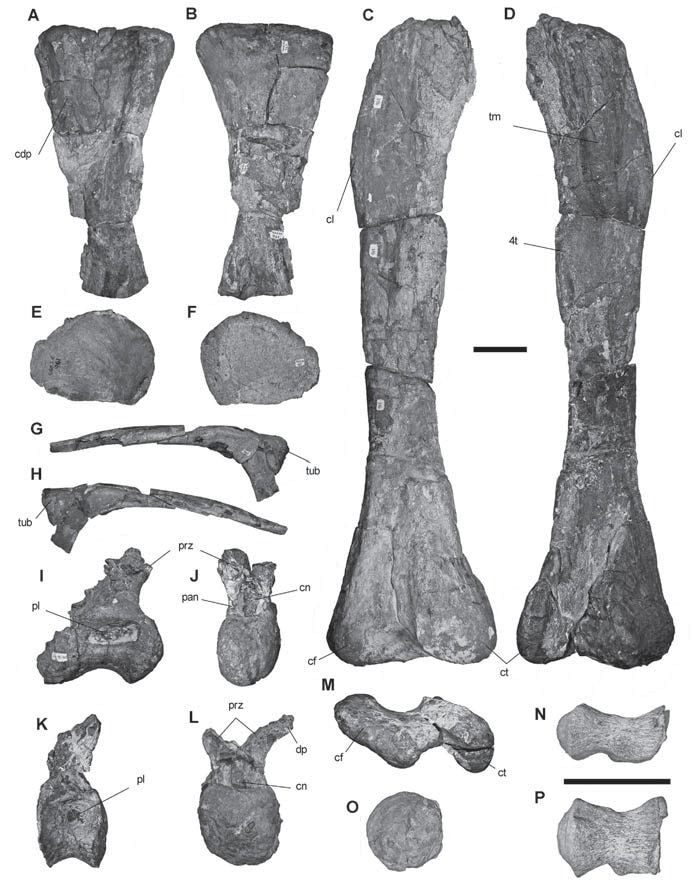
- Estimated weight between 8,000 and 16,000 kg.
- Dorsal vertebrae with rounded and less elongated pleurocoels that do not point posteriorly.
- Dorsal vertebrae with a concave ventral surface.
- Posterior caudal vertebrae with laterally compressed neural spines and a blade-like anterior margin.
- Femur with a gradually reduced proximal end and a well-developed fourth trochanter.
- Right femur measures 1.10 m.
Nemegtosaurus, Rapetosaurus, Titanosaurus, Saltasauridae
Chile
About Atacamatitan
Atacamatitan is a genus of titanosaurian sauropod dinosaurs discovered in Chile, known from the Late Cretaceous Tolar Formation. The name "Atacamatitan" translates to "Atacama Desert titan," a nod to its discovery in the arid Atacama region and its impressive size. The species name, "chilensis," directly references its origin in Chile.
Discovery and Naming
Fossils of Atacamatitan were first uncovered during expeditions in 2000 and 2001 in the Antofagasta Region of Chile, approximately 150 km north of Calama. The holotype, designated SGO-PV-961, was found in a small outcrop near Conchi Viejo and represents a single individual. The geological age of the Tolar Formation is debated, ranging from the Late Cretaceous to the Paleocene, though the presence of Atacamatitan supports a Cretaceous age. The genus and species were formally described by Alexander et al. in 2011, making it one of the most complete titanosaurian specimens recovered from Chile.
Description and Classification
The holotype of Atacamatitan includes a right femur, the proximal part of a humerus, dorsal and caudal vertebrae, ribs, and a possible sternal element. While body size estimates are uncertain, paleontologist Thomas Holtz suggested a weight of 8 to 16 metric tons. Distinctive features include dorsal vertebrae with rounded pleurocoels that do not point backward and a concave ventral surface. The femur is noted for its gracile nature and a gradually reduced proximal end. Originally placed within the Titanosauridae family, later analyses have suggested Atacamatitan belongs to the Lithostrotia, though its fragmentary nature means it is often excluded from detailed cladistic studies.
Significance
Atacamatitan is significant for being one of the most complete titanosaurian dinosaurs found in Chile. Its discovery contributes to understanding the diversity and distribution of these large, herbivorous dinosaurs in South America during the Late Cretaceous.
Source: Wikipedia ↗
Frequently Asked Questions
What does the name Atacamatitan mean?
The name Atacamatitan means "Atacama Desert titan." It combines "Atacama," referencing the desert where its fossils were found, with the Greek word "Titan," signifying its large size.
When did Atacamatitan live?
Atacamatitan lived during the Late Cretaceous period. The geological age of the formation where its fossils were found is uncertain, ranging from the Late Cretaceous to the Paleocene, but the discovery supports a Cretaceous age.
Where were the fossils of Atacamatitan discovered?
The fossils of Atacamatitan were discovered in the Atacama Desert, in the Antofagasta Region of Chile. Specifically, they were found in an outcrop near Conchi Viejo town within the Tolar Formation.
What kind of dinosaur was Atacamatitan?
Atacamatitan was a titanosaurian sauropod. Sauropods were large, long-necked, herbivorous dinosaurs.
What is known about the physical characteristics of Atacamatitan?
The holotype includes a femur, humerus, dorsal and caudal vertebrae, and ribs. Thomas Holtz estimated its weight to be between 8,000 and 16,000 kg. Distinctive features include dorsal vertebrae with rounded pleurocoels and a femur that becomes gradually reduced in width.
How complete is the fossil record of Atacamatitan?
The holotype, SGO-PV-961, represents a single individual and is considered one of the most complete titanosaurian specimens found in Chile. It includes various skeletal elements, though some are fragmented.
Related Dinosaur species

Abditosaurus
Abditosaurus is an extinct genus of titanosaurian sauropod dinosaur that lived during the Late Cretaceous period in what is now Catalonia, Spain. It is known from the most complete titanosaur skeleton ever discovered in Europe, representing a large species that inhabited the Ibero-Armorican Island. Phylogenetic analyses suggest it was related to South American and African saltasaurines, distinguishing it from other European dwarf sauropods.

Acantholipan
Acantholipan is a genus of herbivorous nodosaurid dinosaur discovered in Mexico. It lived during the early Santonian age of the Late Cretaceous period and is known from fragmentary fossils, including a partial skeleton with osteoderms. Acantholipan gonzalezi is the type species, named in honor of paleontologist Arturo Homero González-González.

Acanthopholis
Acanthopholis is a genus of herbivorous ankylosaurian dinosaur belonging to the family Nodosauridae. It lived during the Late Cretaceous Period in England and is characterized by its distinctive armor, including keeled plates and prominent spikes along its neck and shoulders. The genus name translates to "spiny scales."