
Cruxicheiros
Cruxicheiros was a large theropod dinosaur that inhabited England during the Middle Jurassic period, approximately 167 million years ago. Its name, meaning "cross hand," references the "Cross Hands Quarry" where its fossils were discovered. While much of its anatomy remains unknown due to limited fossil evidence, it is classified within the Tetanurae group, which includes well-known theropods like Tyrannosaurus and Spinosaurus.
Key Facts
- ›Lived during the Middle Jurassic period in England.
- ›Its fossils were found in the Cross Hands Quarry, Warwickshire.
- ›The generic name "Cruxicheiros" means "cross hand."
- ›It was a large theropod, with an estimated length of 9 meters (29.5 feet).
- ›Belongs to the dinosaur group Tetanurae, which includes birds.
- ›Its exact position within Tetanurae is uncertain, classified as incertae sedis.
- Large theropod
- Estimated length of 9 meters
- Lower and broader spines along the back
- Differences in leg and hip bones compared to other theropods
Megalosaurus, Spinosaurus, Tyrannosaurus, Allosaurus
England
About Cruxicheiros
What is Cruxicheiros?
Cruxicheiros is a genus of theropod dinosaur that lived during the Middle Jurassic period, approximately 167 million years ago. Its fossils were discovered in England, and the genus name, "Cruxicheiros," translates to "cross hand," a nod to the "Cross Hands Quarry" where the remains were found. The type species, Cruxicheiros newmanorum, was formally described in 2010.
Discovery and Classification
The holotype fossil of Cruxicheiros was unearthed in the early 1960s in the Cross Hands Quarry, Warwickshire. These fossils originate from the Chipping Norton Limestone Formation, dating to the lower Bathonian stage of the Middle Jurassic. The transfer of these previously overlooked fossils to the Warwickshire Museum Service in 2008 prompted their closer examination, leading to their recognition as a distinct genus.
Cruxicheiros is classified as a tetanuran, a broad group of theropod dinosaurs that also includes iconic predators like Tyrannosaurus and Spinosaurus, as well as the ancestors of birds. However, its precise placement within Tetanurae remains uncertain. Cladistic analyses have presented multiple equally probable evolutionary positions for Cruxicheiros, leading to its classification as Tetanurae incertae sedis (of uncertain placement).
Physical Characteristics and Size
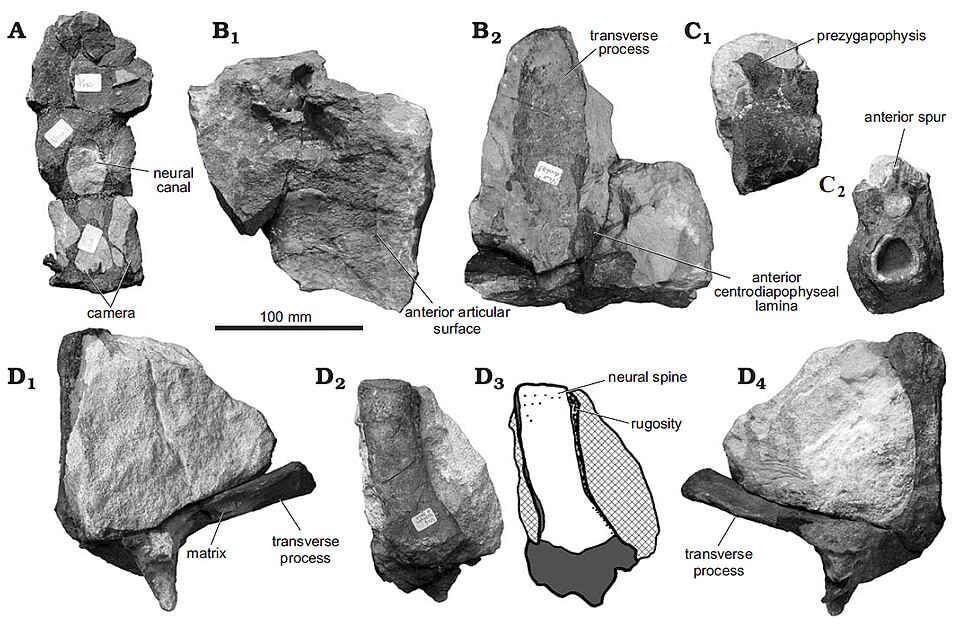
Based on the limited fossil evidence, Cruxicheiros is understood to have been a large theropod. Thomas Holtz estimated its length at approximately 9 meters (29.5 feet). The known material includes a partial right femur, vertebrae, a scapulocoracoid, an ilium, a pubis, and bone fragments. Differences in its leg and hip bones, as well as its lower and broader dorsal spines, distinguish it from other theropods found in the same formations, such as Megalosaurus.
Source: Wikipedia ↗
Frequently Asked Questions
What does Cruxicheiros mean?
The name Cruxicheiros means "cross hand." This name is derived from the Latin word "crux" meaning "cross" and the Greek word "cheir" meaning "hand."
When and where did Cruxicheiros live?
Cruxicheiros lived during the Middle Jurassic period, approximately 167 million years ago. Its fossils were discovered in England, specifically in the Cross Hands Quarry in Warwickshire.
What is known about the physical characteristics of Cruxicheiros?
Cruxicheiros was a large theropod, with an estimated length of about 9 meters (29.5 feet). However, the known fossil material is very limited, providing only a partial view of its anatomy.
What is Cruxicheiros classified as?
Cruxicheiros is classified as a tetanuran, a member of the dinosaur group Tetanurae. This group also includes well-known theropods such as Tyrannosaurus and Spinosaurus, as well as birds.
Why is the classification of Cruxicheiros uncertain?
The exact placement of Cruxicheiros within the Tetanurae group is uncertain. Cladistic analysis has suggested it could be the most basal neotetanuran, the most basal megalosauroid, or the most basal member of Tetanurae itself.
Where were the fossils of Cruxicheiros found?
The holotype and additional fossil material of Cruxicheiros were discovered in the Cross Hands Quarry, near Little Compton, in Warwickshire, England. This quarry is the namesake for the dinosaur's generic name.
Related Dinosaur species

Cetiosauriscus
Cetiosauriscus was a herbivorous sauropod dinosaur that lived in England during the Middle Jurassic period, approximately 166 to 164 million years ago. Characterized by a moderately long tail and forelimbs as long as its hindlimbs, it reached an estimated length of 15 meters and a weight of 4 to 10 tonnes. Its fossils were discovered in the Oxford Clay Formation.

Cetiosaurus
Cetiosaurus, meaning 'whale lizard', is a genus of herbivorous sauropod dinosaur that lived during the Middle Jurassic Period, approximately 171 to 165 million years ago. It is notable for being the first sauropod to have its bones described and is the most complete sauropod discovered in England. Despite its name, originally reflecting a mistaken belief it was a marine creature, Cetiosaurus was a quadrupedal, long-necked land-dweller.

Acanthopholis
Acanthopholis is a genus of herbivorous ankylosaurian dinosaur belonging to the family Nodosauridae. It lived during the Late Cretaceous Period in England and is characterized by its distinctive armor, including keeled plates and prominent spikes along its neck and shoulders. The genus name translates to "spiny scales."