
Dasygnathoides
Carnivore·Late Triassic·Scotland·Unknown
Dasygnathoides is an extinct genus of pseudosuchian that lived during the Late Triassic period in what is now Scotland. Known from limited fossil remains, including a maxilla and pterygoid, its exact classification within pseudosuchians remains uncertain, with some paleontologists considering it a nomen dubium. It is notable for being one of the largest predatory tetrapods discovered from Triassic Scotland.
Key Facts
- ›Lived during the Late Triassic (Carnian) period.
- ›Fossils were discovered in the Lossiemouth Sandstone of Scotland.
- ›Its exact classification within pseudosuchians is indeterminate.
- ›Estimated skull length was around 450 mm, suggesting a total animal length of 3-4 meters.
- ›Possessed posteriorly curved teeth with sharp edges, indicative of a slicing function.
- ›Likely possessed skin armor, based on the identification of an osteoderm.
- Estimated skull length of approximately 450 mm.
- Estimated total body length of 3-4 meters.
- Posteriorly curved teeth with sharp edges.
- Pentagonal interdental plates.
- Possessed osteoderms, indicating skin armor.
Ornithosuchus
Scotland
About Dasygnathoides
Dasygnathoides is an extinct genus of pseudosuchian that lived during the Late Triassic period, specifically the Carnian stage. Its fossils were discovered in the Lossiemouth Sandstone of Scotland, making it one of the significant predatory tetrapods known from Triassic Scotland.
Classification and History
The genus was first established by Thomas Huxley in 1877 based on a maxilla, initially identified as "Dasygnathus." However, this name was already in use for an insect, leading Oskar Kuhn to rename it Dasygnathoides in 1961. For a period, the genus was considered synonymous with Ornithosuchus by Walker in 1964, based on shared features like 'rear forking' on the maxillae and similarities in the pterygoid bones. More recent studies, particularly one in 2016, have re-evaluated this synonymy, suggesting that Dasygnathoides was a distinct and much larger animal, not closely related to Ornithosuchus or other ornithosuchids.
Despite these reassessments, the precise classification of Dasygnathoides within the Pseudosuchia remains problematic. The limited fossil material lacks clear synapomorphies that would link it to any specific family. Consequently, many paleontologists regard Dasygnathoides as a nomen dubium, an indeterminate genus, possibly representing an entirely new, undocumented group of pseudosuchians.
Physical Characteristics and Features
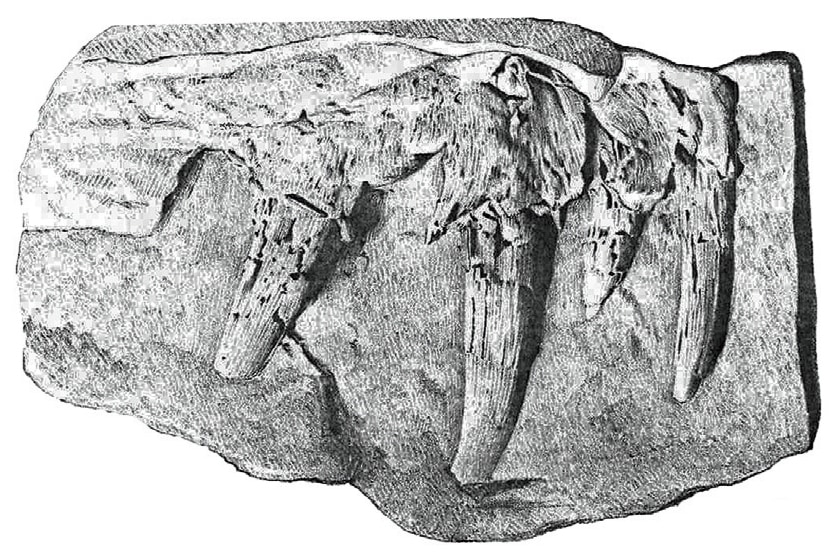
Fossil remains attributed to Dasygnathoides include a right maxilla, a right pterygoid, a partial vertebra, a haemal arch, a phalanx, an articular, and an osteoderm, all believed to originate from the same individual. The maxilla is substantial, measuring 195 mm in length and retaining four teeth. These teeth are posteriorly curved and possess sharp edges, indicating a predatory adaptation for slicing flesh. The maxilla also shows nine interdental plates, suggesting it originally held more teeth.
Estimates based on the maxilla suggest a total skull length of around 450 mm, which is nearly double the size of the largest known Ornithosuchus skull. This implies that the entire animal was likely between 3 and 4 meters in length. The presence of an osteoderm, previously misidentified, strongly suggests that Dasygnathoides possessed skin armor, similar to that seen in Ornithosuchus.
Habitat and Diet
As a large predator from the Late Triassic, Dasygnathoides would have inhabited terrestrial environments. Its diet is inferred to be carnivorous, supported by the blade-like nature of its teeth. It was likely an apex predator within its Scottish ecosystem during the Carnian stage.
Source: Wikipedia ↗
Frequently Asked Questions
What period did Dasygnathoides live in?
Dasygnathoides lived during the Late Triassic period, specifically the Carnian stage. This places it among the earlier large predatory reptiles of the Mesozoic Era.
Where were the fossils of Dasygnathoides found?
The fossils attributed to Dasygnathoides were discovered in the Lossiemouth Sandstone of Scotland. This geological formation has yielded other significant Triassic reptile fossils.
What is known about the diet of Dasygnathoides?
Based on the morphology of its teeth, Dasygnathoides is believed to have been a carnivore. The teeth were posteriorly curved with sharp edges, suggesting they were adapted for slicing flesh rather than just impaling prey.
How large was Dasygnathoides estimated to be?
The estimated skull length for Dasygnathoides was approximately 450 mm. This suggests the entire animal was likely between 3 and 4 meters in length, making it a substantial predator for its time and location.
Why is the classification of Dasygnathoides uncertain?
The fossil material of Dasygnathoides is limited, primarily consisting of a maxilla and pterygoid. This lack of more complete remains has made it difficult to definitively place it within established pseudosuchian groups, leading some to consider it a nomen dubium.
Did Dasygnathoides have any armor?
Evidence suggests that Dasygnathoides may have had skin armor. An osteoderm found with the other remains resembles those of Ornithosuchus and indicates the presence of dermal scutes.
Related Dinosaur species

Buriolestes
Buriolestes is an early sauropodomorph dinosaur from the Late Triassic of Brazil. Despite its carnivorous-looking teeth and skull, it is classified as an early member of the herbivorous sauropodomorph lineage. Its discovery provides insights into the early evolution of dinosaurs and their dietary habits.

Camposaurus
Camposaurus is a small, carnivorous theropod dinosaur from the Late Triassic period of North America, specifically the Norian stage. It is widely considered to be one of the oldest known neotheropod dinosaurs, with its fossil remains discovered in Arizona.

Chindesaurus
Chindesaurus is an extinct genus of basal saurischian dinosaur that lived in the southwestern United States during the Late Triassic period. Known primarily from a partial skeleton discovered in Petrified Forest National Park, Arizona, this bipedal carnivore was roughly the size of a wolf. Its exact classification has been a subject of debate among paleontologists, with various studies suggesting it was a herrerasaurid, a basal saurischian, or a theropod closely related to Tawa.