
Abavorana luctuosa
Abavorana
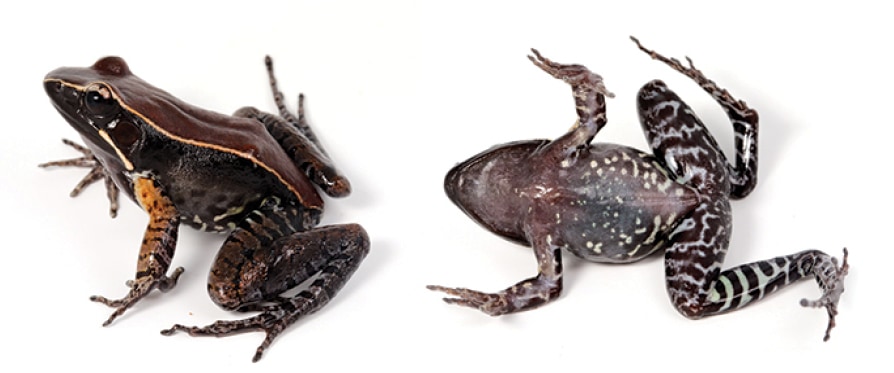
Abavorana luctuosa, also known as the Malaysian frog or mahogany frog, is a species of true frog native to the Malay Peninsula and Borneo. This leaf-litter frog is distinctive for its reddish to chocolate brown coloration, bordered by a narrow cream dorsolateral line.
Key Facts
- ›Found in the Malay Peninsula (Malaysia and southernmost Thailand) and Borneo (Indonesia, Malaysia).
- ›Primarily a leaf-litter frog found in lowland and submontane primary rainforests.
- ›Adults disperse widely through the forest and breed in rain pools.
- ›Characterized by reddish to chocolate brown coloration with a cream dorsolateral line.
- ›Formerly classified in the genus Hylarana.
Malaysian Frog, Mahogany Frog, Purple Frog
Rainforest, Lowland Forest, Submontane Forest
Malaysia, Indonesia, Thailand
- Reddish To Chocolate Brown Coloration
- Narrow Cream Dorsolateral Line From Snout To Vent
About Abavorana luctuosa
Abavorana luctuosa, commonly known as the Malaysian frog, mahogany frog, or purple frog, is a species of true frog found in Southeast Asia. It was previously classified under the genus Hylarana.
Habitat and Distribution
This species inhabits the Malay Peninsula, including Malaysia and the southernmost regions of Thailand, as well as the island of Borneo, which encompasses parts of Indonesia and Malaysia. Abavorana luctuosa is a leaf-litter frog that thrives in lowland and submontane primary rainforests. It can also be found in habitats that have experienced some degree of disturbance.
Physical Characteristics
Adult frogs typically display a coloration ranging from reddish to chocolate brown. A notable identifying feature is a narrow cream dorsolateral line that runs along each side of the body, extending from the tip of the snout to the area above the vent.
Behavior and Reproduction
Abavorana luctuosa are known to disperse widely throughout their forest environment. Their breeding behavior involves congregating in rain pools. Specific details regarding their diet, vocalizations, lifespan, and predators are not extensively documented in available records.
Source: Wikipedia ↗
Frequently Asked Questions
What are the common names for Abavorana luctuosa?
Abavorana luctuosa is commonly known as the Malaysian frog, the mahogany frog, or the purple frog. These names reflect its geographical origin and coloration.
Where is Abavorana luctuosa found?
This frog species inhabits the Malay Peninsula, specifically Malaysia and the southernmost parts of Thailand. It is also found in Borneo, across Indonesian and Malaysian territories.
What is the typical habitat of Abavorana luctuosa?
Abavorana luctuosa is a leaf-litter frog that resides in lowland and submontane primary rainforests. It can also be found in habitats that have undergone some disturbance.
What does Abavorana luctuosa look like?
Adult frogs are typically reddish to chocolate brown in color. They are distinguished by a narrow cream dorsolateral line running along each side, from the tip of the snout to above the vent.
How does Abavorana luctuosa reproduce?
Adult frogs of this species disperse widely within the forest and reproduce in rain pools. Specific details about their breeding cycle are not extensively documented in available records.