
Drygalski Glacier
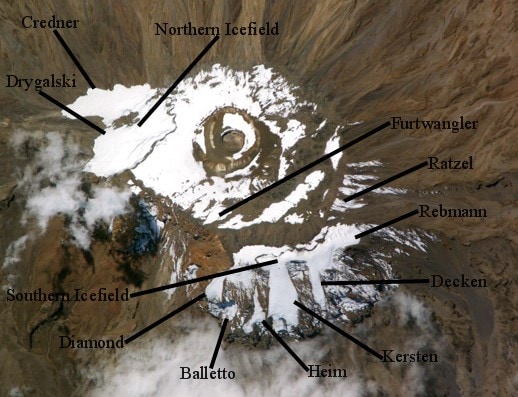
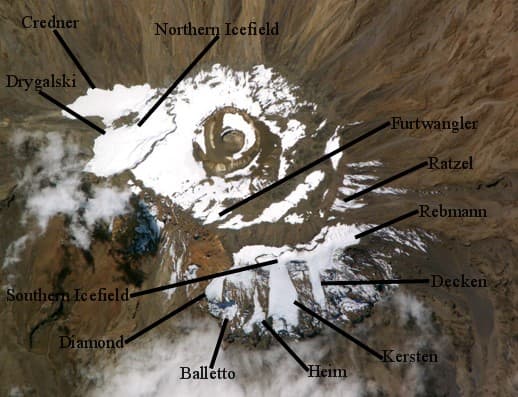
The Drygalski Glacier was a significant ice sheet located on Mount Kilimanjaro in Tanzania, originating near the summit and feeding from the Northern Ice Field. It dates back to the last ice age, approximately 11,700 years ago, and was named after the German explorer Erich von Drygalski. Dramatic melting due to climate change has led to its reported disappearance by 2022, marking a significant loss of glacial ice on Africa's highest peak.
Key Facts
- ›Located on Mount Kilimanjaro in northern Tanzania.
- ›Part of the Northern Ice Field, dating back to the last ice age (approx. 11,700 years ago).
- ›Named after German explorer Erich von Drygalski.
- ›Its terminus once reached an elevation of 4,800 meters.
- ›Reported to have vanished entirely by 2022 due to dramatic retreat.
- ›The ice sheets on Kilimanjaro have been declining steadily since at least 1912.
Known For
- Its dramatic retreat and reported disappearance due to climate change.
- Being one of the major glaciers on Mount Kilimanjaro.
Northern Ice Field
About Drygalski Glacier
The Drygalski Glacier was a substantial ice sheet situated on the upper reaches of Mount Kilimanjaro, Africa's highest mountain, located in northern Tanzania. It was an integral part of the Northern Ice Field near the summit and is understood to have originated during the last ice age, approximately 11,700 years ago. The glacier's terminus once extended down to an elevation of 4,800 meters (15,700 feet).
Discovery and Naming
German geographer Hans Meyer first documented the glaciers of Kilimanjaro, including the Drygalski Glacier, in 1898. He named it in honor of Erich von Drygalski, a fellow German explorer known for his extensive work on Greenland's ice sheets. At the time of its discovery, Meyer mapped twelve distinct glaciers on the mountain, with Drygalski being the central one of three in the Northern Ice Field.
Historical Context and Retreat
The ice fields of Kilimanjaro have a history dating back millennia. Evidence suggests they persisted even through a significant drought period around 4,200 years ago, indicated by a layer of dust found beneath the ice. However, beginning in the early 20th century, a profound and accelerating retreat became evident. Detailed mapping from 1912 onwards, supplemented by photogrammetry, satellite imagery, and aerial surveys in later decades, consistently showed a steady decline in glacial mass.
By the early 21st century, the impact of global climate change had become critically apparent. By 2016, the total ice cover on Kilimanjaro had reduced drastically. The Drygalski Glacier, in particular, had diminished to a mere 0.41 square kilometers (0.16 sq mi) by November 2021. By 2022, reports from local tour operators indicated that the Drygalski Glacier, along with the Arrow Glacier, had vanished entirely, marking a significant loss of glacial ice on the continent.
Source: Wikipedia ↗
Frequently Asked Questions
Where was the Drygalski Glacier located?
The Drygalski Glacier was situated on Mount Kilimanjaro in the Kilimanjaro Region of northern Tanzania. It was found on the northwest slope of the peak, fed by the Northern Ice Field.
When did the Drygalski Glacier form?
The ice fields on Kilimanjaro, including the Drygalski Glacier, formed at least as early as the end of the last ice age, approximately 11,700 years ago. A layer of dust beneath the ice suggests a prolonged drought period around 4,200 years ago during which the glaciers persisted.
Who discovered the Drygalski Glacier?
The Drygalski Glacier was discovered by German geographer Hans Meyer. He first encountered it on August 30, 1898, during his second ascent of Mount Kilimanjaro, naming it after Erich von Drygalski.
What has happened to the Drygalski Glacier over time?
The Drygalski Glacier has experienced dramatic retreat since detailed mapping began in 1912. By 2016, it had almost entirely disappeared, and by 2022, tour operators reported that the glacier, along with the Arrow Glacier, had vanished completely.
Why is the Drygalski Glacier significant?
The Drygalski Glacier was one of the major ice features on Mount Kilimanjaro, Africa's highest peak. Its dramatic disappearance serves as a stark indicator of the impact of climate change on glacial ice in equatorial regions.
Related Glaciers
Arrow Glacier
Arrow Glacier is a small, recently named glacial remnant located on the west slope of Mount Kilimanjaro in Tanzania. It represents a tiny fraction of the icecap that once covered the mountain's summit and is situated at a very high elevation.
Barranco Glacier
Barranco Glacier is a diminishing ice remnant located on the southwest slope of Mount Kilimanjaro in Tanzania. Once known as the Great Barranco Glacier, it is a small vestige of a much larger ice cap that previously covered the mountain's summit. Its current state reflects significant glacial retreat, with only two small, dormant ice bodies remaining.
Credner Glacier
The Credner Glacier is a significant remnant of the ice cap that once covered Mount Kilimanjaro in Tanzania. Located on the northwest slope, it is one of the largest glaciers on the mountain, descending from the Northern Ice Field. Its rapid retreat, driven by its exposed position, presents a concerning indicator of climate change.