
Southernmost glacial mass in Europe
Glacieret·Southern Europe·Europe·Alpine
The "Southernmost glacial mass in Europe" refers to the collection of small glaciers, glacierets, and perennial snow patches found in the highest mountain ranges of southern Europe. These glacial remnants are significant indicators of climate change, as many have disappeared or are rapidly shrinking. They represent the extreme southern limit of glaciation on the continent.
Key Facts
- ›Located in the highest mountains of the Balkan, Apennine, and Iberian peninsulas, and the southern Alps.
- ›Includes small glaciers, glacierets, and perennial firn fields and patches.
- ›Many summer-lasting snow patches exist in ranges like Sierra Nevada and Mount Olympus.
- ›These glacial masses are not characterized by persistent dynamic motion.
- ›They are considered the southernmost persistent glacial features in Europe.
- ›Their existence and state are sensitive indicators of climate change.

Known For
- Being the southernmost glacial masses in Europe
- Sensitivity to climate change
Corral De La Veleta Glacier, Kazania Cirque, Calderone Glacier
About Southernmost glacial mass in Europe
The "Southernmost glacial mass in Europe" refers to the collection of small glaciers, glacierets, and perennial snow patches found in the highest mountain ranges of southern Europe. These glacial remnants are significant indicators of climate change, as many have disappeared or are rapidly shrinking. They represent the extreme southern limit of glaciation on the continent.
Distribution and Characteristics
These features are primarily located in the highest mountains of the Balkan, Apennine, and Iberian peninsulas, as well as in the southernmost ranges of the Alps and on the northwestern slopes of the Greater Caucasus mountains in Russia. Examples include summer-lasting snow patches in the Sierra Nevada (such as the now-disappeared Corral de la Veleta glacier), Mount Olympus, Mount Korab, Rila Mountain, Picos de Europa, and Mount Maglić. However, these formations generally lack the persistent characteristic of dynamic motion typically associated with larger glaciers.
Significance and Climate Change
The existence and state of these southernmost glacial masses are particularly important as sensitive indicators of climate change. Their precarious existence and rapid shrinking underscore the warming trends affecting the European continent. They represent the extreme southern boundary of glaciation, and their disappearance signals significant shifts in regional climate patterns.
Source: Wikipedia ↗
Frequently Asked Questions
Where are the southernmost glacial masses in Europe located?
These glacial masses are primarily found in the highest mountains of the three major southern European peninsulas: the Balkan, Apennine, and Iberian. They are also present in the southernmost ranges of the Alps and on the northwestern slopes of the Greater Caucasus mountains in Russia.
What types of glacial features are considered the southernmost in Europe?
The southernmost glacial features in Europe consist mainly of small glaciers, glacierets, and perennial firn fields and patches. These are often summer-lasting snow patches that persist through the warmer months.
Do these southernmost glaciers show signs of movement?
The available information indicates that none of these southernmost glacial masses exhibit persistent dynamic motion. They are generally small and static, unlike larger, more active glaciers.
Are there any famous examples of these southernmost glacial masses?
Examples of these features include the Corral de la Veleta glacier in Sierra Nevada, the Kazania cirque glacier on Mount Olympus, and the Calderone glacier in Italy's Gran Sasso massif. Many others are listed by latitude in the Pyrenees and the Accursed Mountains.
Why are these southernmost glacial masses important?
These glacial remnants are important because they represent the extreme southern limit of glaciation in Europe. Their precarious existence and rapid shrinking make them sensitive indicators of climate change and warming temperatures.
Related Glaciers

Amalia Glacier
Amalia Glacier, also known as Skua Glacier, is a tidewater glacier situated in Bernardo O'Higgins National Park, Chile. Originating from the Southern Patagonian Ice Field, it is notable for its significant retreat between 1945 and 1986, which was among the most dramatic observed in the region during that period. The glacier also plays a role in shaping the landscape by partially surrounding and eroding the northern flank of the Reclus volcano.
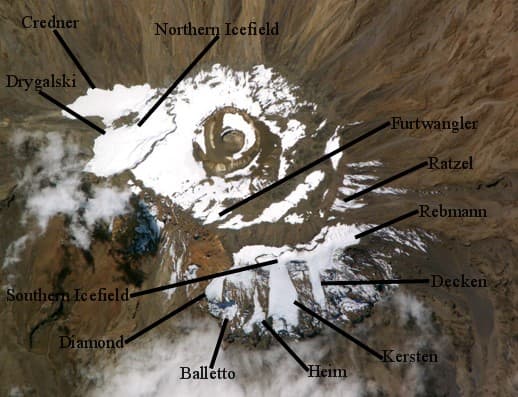
Arrow Glacier
Arrow Glacier is a small, recently named glacial remnant located on the west slope of Mount Kilimanjaro in Tanzania. It represents a tiny fraction of the icecap that once covered the mountain's summit and is situated at a very high elevation.
Barranco Glacier
Barranco Glacier is a diminishing ice remnant located on the southwest slope of Mount Kilimanjaro in Tanzania. Once known as the Great Barranco Glacier, it is a small vestige of a much larger ice cap that previously covered the mountain's summit. Its current state reflects significant glacial retreat, with only two small, dormant ice bodies remaining.