
Acanthodactylus longipes
The long fringe-fingered lizard (Acanthodactylus longipes) is a species of lizard belonging to the Lacertidae family, native to northwestern Africa. It is characterized by its fringe-like scales on its toes, which aid in locomotion on sandy substrates. This oviparous species is found across a wide range of arid and semi-arid environments within the region.
Key Facts
- ›Acanthodactylus longipes is a lizard species in the Lacertidae family.
- ›It is endemic to northwestern Africa, with a wide geographic distribution.
- ›The species is oviparous, meaning it reproduces by laying eggs.
- ›Commonly known as the long fringe-fingered lizard.
- ›Its range includes countries like Algeria, Morocco, and Egypt.

Long Fringe-Fingered Lizard
Algeria, Chad, Egypt, Libya, Mali, Mauritania, Morocco, Niger, Tunisia, Western Sahara
- Characterized By Fringe-Like Scales On Its Toes.
About Acanthodactylus longipes
Long Fringe-Fingered Lizard (Acanthodactylus longipes)
The long fringe-fingered lizard, scientifically classified as Acanthodactylus longipes, is a species of lizard belonging to the family Lacertidae. This species is notable for its adaptation to arid and semi-arid environments and is endemic to the northwestern region of Africa.
Geographic Distribution and Habitat
Acanthodactylus longipes has a broad geographic distribution across northwestern Africa. It can be found in a number of countries within this region, including Algeria, Chad, Egypt, Libya, Mali, Mauritania, Morocco, Niger, Tunisia, and Western Sahara. The habitats these lizards occupy are typically arid and semi-arid landscapes, which are characteristic of the extensive desert and steppe regions within their range.
Reproduction
Regarding its reproductive strategy, Acanthodactylus longipes is oviparous. This means that females of the species reproduce by laying eggs, a common method among many reptile species. Further details on their specific breeding behaviors, such as clutch size or incubation periods, are not extensively documented in the provided information.
Taxonomy and Nomenclature
The species is scientifically known as Acanthodactylus longipes. It is also commonly referred to as the long fringe-fingered lizard, a name that likely derives from a distinctive physical characteristic, possibly related to the scales on its toes which aid in movement across sandy terrain. Historical taxonomic references indicate it was described as a new variety, Acanthodactylus scutellatus Var. longipes, by Boulenger in 1918, and later revised within the genus Acanthodactylus by Salvador in 1982.
Source: Wikipedia ↗
Frequently Asked Questions
What is the scientific name for the long fringe-fingered lizard?
The scientific name for the long fringe-fingered lizard is Acanthodactylus longipes. This binomial nomenclature identifies it within the scientific classification of species.
Where is Acanthodactylus longipes found geographically?
Acanthodactylus longipes is found across northwestern Africa. Its geographic range includes countries such as Algeria, Chad, Egypt, Libya, Mali, Mauritania, Morocco, Niger, Tunisia, and Western Sahara.
How does Acanthodactylus longipes reproduce?
Acanthodactylus longipes is oviparous. This means that females of the species lay eggs as their method of reproduction.
What is the common name for Acanthodactylus longipes?
The common name for Acanthodactylus longipes is the long fringe-fingered lizard. This name likely refers to a distinctive physical characteristic of the species.
Related Lizards
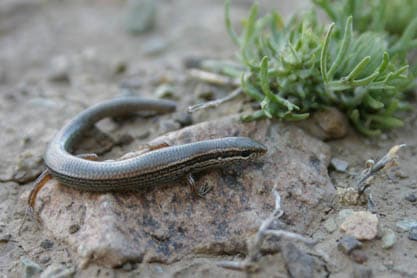
Ablepharus pannonicus
The Asian snake-eyed skink (Ablepharus pannonicus) is a species of skink native to a wide range across Asia and parts of the Middle East. It is characterized by its snake-like appearance and is found in diverse arid and semi-arid environments.
Asian snake-eyed skink
The Asian snake-eyed skink (Ablepharus pannonicus) is a species of skink native to a wide range across Western and Central Asia, as well as parts of the Middle East. It is characterized by its small size and its distribution across various arid and semi-arid environments.

Aspidoscelis scalaris
Aspidoscelis scalaris, also known as the rusty-rumped whiptail, is a species of teiid lizard native to Mexico and Texas in the United States. Its distinctive coloration and habitat preferences define its presence in arid and semi-arid regions.