
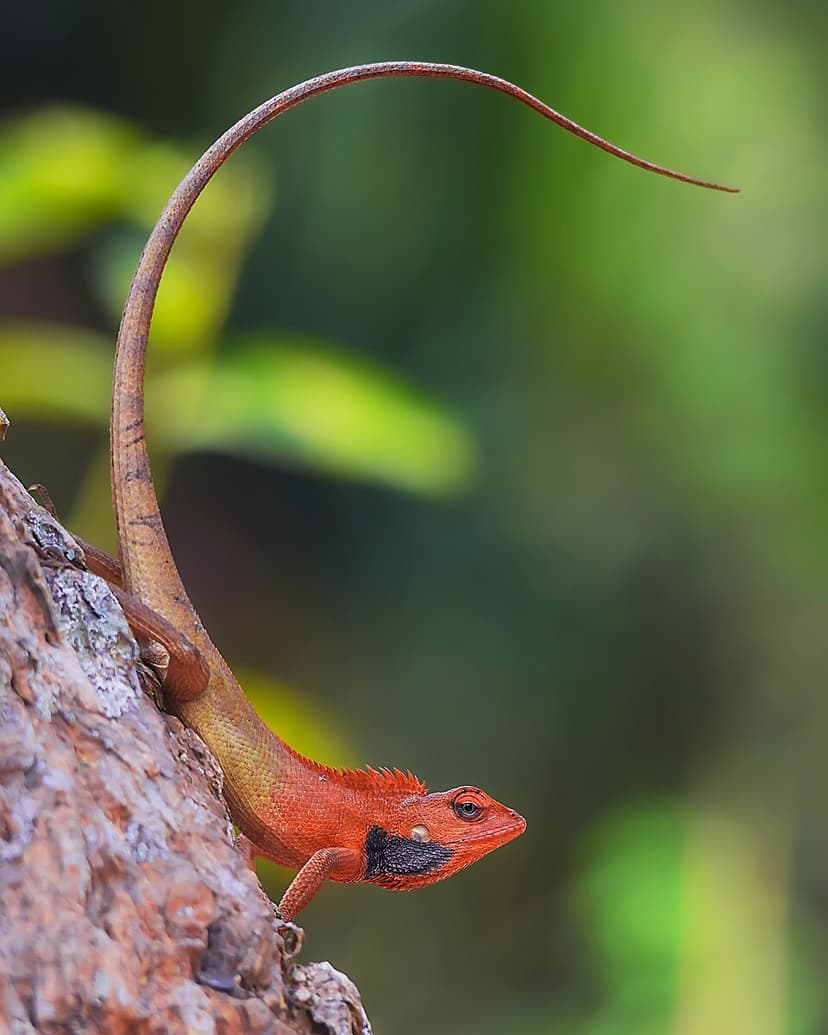
Black-lipped forest lizard (Calotes nigrilabris)
The Black-lipped forest lizard (Calotes nigrilabris), also known as the black-cheek lizard, is an agamid species found only in Sri Lanka. It is easily distinguished from similar species by a black bar on its mouth, unlike the white or orange bars seen in others. This largely arboreal lizard inhabits tree trunks, hedges, and shrubs in submontane and montane regions, where it actively hunts insects and worms during the day.
Key Facts
- ›Endemic to Sri Lanka, found at elevations of 1,000 meters and above.
- ›Distinctive black bar on the mouth, differentiating it from similar species.
- ›Largely arboreal, inhabiting trees, hedges, and shrubs.
- ›Hunts insects and worms during daylight hours.
- ›Lays up to 4 eggs, with hatchlings emerging after approximately two months of incubation.
- ›Adult males have noticeably swollen cheeks.

Black-Cheek Lizard, Kalu Kopul Katussa
Sri Lanka
Submontane, Montane, Tree Trunks, Hedges, Shrubs, Gorse Bushes, Rhododendron Leaves
- Head Is Approximately One and A Half Times Its Width.
- Features A Row of Spines Above and At the Back of the Tympanum.
- Adult Males Possess Swollen Cheeks.
- Gular Sacs Are Not Developed.
- Mid-Body Scale Rows Range From 42 To 50.
- Ventral Scales Are Larger Than Dorsal Scales.
- Dorsum Is Green, Either Unpatterned Or With Black-Edged, Cream Transverse Bars Or Eye-Like Spots.
- Head Exhibits Black Markings.
- Venter Is Pale Green.
Insects, Worms, Bees
Largely Arboreal, Hunts For Insects and Worms By Day, Active During Daylight Hours
About Black-lipped forest lizard (Calotes nigrilabris)
What is the Black-lipped Forest Lizard?
The Black-lipped forest lizard, scientifically known as Calotes nigrilabris and also referred to as the black-cheek lizard, is a species of agamid lizard native to Sri Lanka. It is readily distinguishable from similar species by the presence of a distinctive black bar across its mouth, contrasting with the white or orange bars found on related lizards. The species is known in Sinhalese as "Kalu Kopul Katussa."
Habitat and Distribution
This lizard is primarily found in the submontane and montane regions of Sri Lanka, typically at elevations exceeding 1,000 meters (3,300 ft). It is a tolerably common inhabitant of various localities, including Nuwara Eliya, Horton Plains National Park, and Hakgala Strict Nature Reserve. The Black-lipped forest lizard is largely arboreal, preferring to dwell on tree trunks, within hedges, and among shrubs.
Description and Ecology
The head of the Black-lipped forest lizard is about one and a half times its width, and it possesses a row of spines above and behind the tympanum. Adult males are characterized by swollen cheeks. While gular sacs are not developed, the mid-body scale rows number between 42 and 50, with ventral scales being larger than dorsal ones. The lizard's dorsum is typically green, either unpatterned or adorned with black-edged, cream transverse bars or eye-like spots, and its head often displays black markings. The venter is pale green. This species is diurnal, actively hunting for insects and worms during the day. In environments like Horton Plains, they have been observed residing on gorse bushes and rhododendron leaves to catch insect prey, particularly bees attracted to the flowers.
Reproduction
The Black-lipped forest lizard reproduces by laying eggs. Females can lay up to four eggs, measuring between 17–23 mm in length and 10–13 mm in width. Hatchlings emerge with a mean snout-to-vent length (SVL) of 35–50 mm. There appear to be two breeding seasons annually, occurring from November to December and again from February to March. Hatchlings are typically observed following the egg-laying periods, after an incubation phase of approximately two months.
Source: Wikipedia ↗
Frequently Asked Questions
How can the Black-lipped forest lizard be identified?
The Black-lipped forest lizard, or black-cheek lizard, is easily identified by a black bar present on its mouth. This feature distinguishes it from other similar species that may have white or orange bars.
Where is the Black-lipped forest lizard found?
This species is endemic to Sri Lanka and is typically found in submontane and montane regions at elevations of 1,000 meters (3,300 ft) and above. It is common in areas like Nuwara Eliya, Horton Plains National Park, and Hakgala Strict Nature Reserve.
What is the habitat of the Black-lipped forest lizard?
The Black-lipped forest lizard is largely arboreal, meaning it spends most of its time in trees. It inhabits tree trunks, hedges, and shrubs, often found on gorse bushes and rhododendron leaves in its natural environment.
What does the Black-lipped forest lizard eat?
This lizard is diurnal and hunts for its food during the day. Its diet consists primarily of insects and worms, and it has been observed hunting bees attracted to flowers in its habitat.
How does the Black-lipped forest lizard reproduce?
The Black-lipped forest lizard lays up to four eggs, which measure between 17–23 mm in length and 10–13 mm in width. Hatchlings emerge after an incubation period of approximately two months, with breeding seasons occurring from November–December and February to March.
Are adult males of this species different in appearance?
Yes, adult male Black-lipped forest lizards can be distinguished by their noticeably swollen cheeks. Otherwise, their physical description is similar to females, though specific details on sexual dimorphism beyond cheek swelling are not extensively detailed.
Related Lizards

Lankascincus taprobanensis
Lankascincus taprobanensis, commonly known as the Ceylon tree skink or smooth Lanka skink, is a species endemic to Sri Lanka. This stout-bodied lizard is distinguished by its coloration, which ranges from gray to reddish brown or olive, with each scale featuring a dark median spot and a lateral stripe. It inhabits montane regions, being the only skink found at higher elevations.
Munindradasa's Lanka skink
Munindradasa's Lanka skink, also known as the Ceylon tree skink or smooth Lanka skink, is a stout-bodied lizard endemic to Sri Lanka. It is characterized by its distinctive scale patterns, a brownish-black lateral stripe, and a lemon-yellow venter. This species inhabits montane regions, being the only skink found at the highest elevations in Sri Lanka.
Calotes versicolor
The Oriental garden lizard, scientifically known as Calotes versicolor, is a widely distributed agamid lizard recognized for its striking color-changing abilities, particularly in males during the breeding season. Primarily an insectivore, it inhabits a variety of environments across Indo-Malaya and has been introduced to other regions. Its distinctive features include a dorsal crest, a bright red throat in breeding males, and the ability to move its eyes independently.