
Calumma guibei
Calumma guibei, commonly known as Guibé's chameleon, is a species of chameleon native to the forests of northern Madagascar. This lizard is distinguished by a soft dermal rostral appendage, which is more pronounced in males. It inhabits forest environments at elevations between 1,000 and 2,250 meters.
Key Facts
- ›Endemic to northern Madagascar.
- ›Characterized by a soft dermal rostral appendage, longer in males.
- ›Inhabits forests at elevations of 1,000–2,250 meters.
- ›Oviparous, meaning it lays eggs.
- ›Average snout-to-vent length is approximately 5 cm.
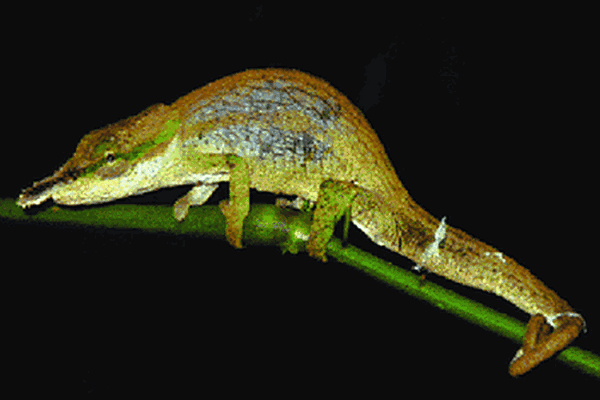
Guibé's Chameleon
Madagascar
- Has A Soft Dermal Rostral Appendage, Longer In Males Than In Females.
- Average Snout-To-Vent Length of About 5 cm .
About Calumma guibei
Calumma guibei: Guibé's Chameleon
Calumma guibei, commonly known as Guibé's chameleon, is a species of chameleon that is endemic to the island of Madagascar. This small lizard is part of the Chamaeleonidae family and is named in honor of the French herpetologist Jean Guibé.
Habitat and Distribution
Guibé's chameleon is found exclusively in northern Madagascar. Its preferred natural habitat consists of forests, where it can be found at elevations ranging from 1,000 to 2,250 meters (approximately 3,280 to 7,380 feet) above sea level. The type locality for this species is Mt. Tsaratanana, recorded at an elevation of 1,800 meters.
Physical Characteristics
A distinguishing feature of Calumma guibei is its soft dermal rostral appendage, a projection from its snout. This appendage is notably longer in males than in females, a common sexual dimorphism in some chameleon species. The average snout-to-vent length for Calumma guibei is approximately 5 centimeters (2.0 inches).
Reproduction
Calumma guibei reproduces through oviparity, meaning that females lay eggs. Further details regarding their reproductive cycle, such as clutch size or incubation period, are not extensively documented in available records.
Source: Wikipedia ↗
Frequently Asked Questions
What is Calumma guibei?
Calumma guibei, also known as Guibé's chameleon, is a species of chameleon that is native to Madagascar. It belongs to the family Chamaeleonidae.
Where can Calumma guibei be found?
This species is found in northern Madagascar, with its type locality being Mt. Tsaratanana at an elevation of 1,800 meters. They prefer forest habitats.
What are the physical characteristics of Calumma guibei?
Calumma guibei has an average snout-to-vent length of about 5 cm. A notable feature is its soft dermal rostral appendage, which is more prominent in males than in females.
How does Calumma guibei reproduce?
Calumma guibei is oviparous, which means that it reproduces by laying eggs.
What is the habitat of Guibé's chameleon?
Guibé's chameleon prefers natural forest habitats. They are typically found at elevations ranging from 1,000 to 2,250 meters above sea level.
Related Lizards

Aaron Bauer's house gecko
Aaron Bauer's house gecko is a species of lizard found in the Western Ghats of Maharashtra, India. It is notable for its relatively large size within its genus, reaching up to 13 cm in snout-to-vent length. This species prefers rocky outcrops within forested areas as its natural habitat.

Adolfus jacksoni
Adolfus jacksoni, also known as Jackson's forest lizard, is a species of lizard belonging to the Lacertidae family, native to East Africa. It prefers forest habitats at significant altitudes and exhibits diurnal and semi-arboreal behaviors. This oviparous species lays clutches of three to five eggs, and communal nesting sites have been observed.

Agama
Agama are a genus of small to moderate-sized, long-tailed lizards native to Africa, particularly sub-Saharan regions. Known for their insectivorous diet and ability to adapt to various habitats, including human settlements, they display striking color changes based on mood and gender. These diurnal reptiles are characterized by powerful hind legs for swift movement and are recognized by their common names, some referencing their head-bobbing displays.