
Deraniyagala's day gecko
Cnemaspis podihuna, also known as Deraniyagala's day gecko or dwarf day gecko, is a diurnal gecko species endemic to Sri Lanka. It inhabits arid regions and is found on tree boles and buttresses. Distinctive features include enlarged median sub-caudal scales and a brown dorsum with dark transverse markings.
Key Facts
- ›Endemic to Sri Lanka.
- ›Found in arid regions of the east and other provinces.
- ›Inhabits tree boles and buttresses.
- ›Dorsum is brown with four dark transverse markings.
- ›Reproduction occurs year-round, laying 2 small eggs at a time.
- ›Median sub-caudal scales are enlarged.

Deraniyagala's Day Gecko, Dwarf Day Gecko
Sri Lanka
- Short Snout.
- Dorsal Scales With Smooth Granules.
- Median Sub-Caudals Are Enlarged.
- Ventrals Smooth.
- Glandular Scales Separate 4-5 Pre-Anal Pores and 3-6 Femoral Pores On Each Side.
- Dorsum Brown With Four Dark Transverse Markings.
- Unknown, But Likely Insectivorous Given Typical Gecko Diets.
Diurnal., Found In Boles and Buttresses of Trees.
About Deraniyagala's day gecko
Deraniyagala's day gecko, scientifically known as Cnemaspis podihuna, is a small, diurnal gecko species endemic to the island of Sri Lanka. It is also referred to as the dwarf day gecko. This species is characterized by its specific habitat preferences and distinct physical features.
Habitat and Distribution
This gecko is primarily found in the arid regions of eastern Sri Lanka. Its known range includes Lahugala Kitulana National Park in the Eastern Province, with more recent sightings extending to Koslanda, Badulla, Pallegama, Mathugama, Buttala, and across the Central, Uva, and Western Provinces. Deraniyagala's day gecko typically resides on the boles and buttresses of trees, indicating an arboreal lifestyle within its environment.
Physical Characteristics
Physically, Deraniyagala's day gecko possesses a short snout. Its dorsal scales are granular and smooth, while its ventral scales are smooth. A notable feature is the enlargement of the median sub-caudal scales. Glandular scales are present, separating between four to five pre-anal pores and three to six femoral pores on each side of the body. The dorsum of the gecko is brown, marked with four distinctive dark transverse bands.
Reproduction
Reproduction in Deraniyagala's day gecko occurs year-round. Females typically lay two small eggs at a time, usually found hidden under loose tree bark. The nesting behavior is not communal, with each female nesting independently.
Source: Wikipedia ↗
Frequently Asked Questions
What is another name for Cnemaspis podihuna?
Cnemaspis podihuna is also commonly known as Deraniyagala's day gecko or the dwarf day gecko.
Where is Deraniyagala's day gecko found?
This gecko species is found only in Sri Lanka, inhabiting arid regions of the east and has also been recorded in the Central, Uva, and Western Provinces.
What kind of habitat does Deraniyagala's day gecko prefer?
Deraniyagala's day gecko is found in the boles and buttresses of trees, typically in arid regions.
What does Deraniyagala's day gecko look like?
It has a short snout, smooth ventral scales, and enlarged median sub-caudal scales. The dorsum is brown and features four dark transverse markings.
How does Deraniyagala's day gecko reproduce?
Reproduction occurs throughout the year. Typically, two small eggs are laid at a time under loose tree bark. Nesting is not a communal activity.
Related Lizards
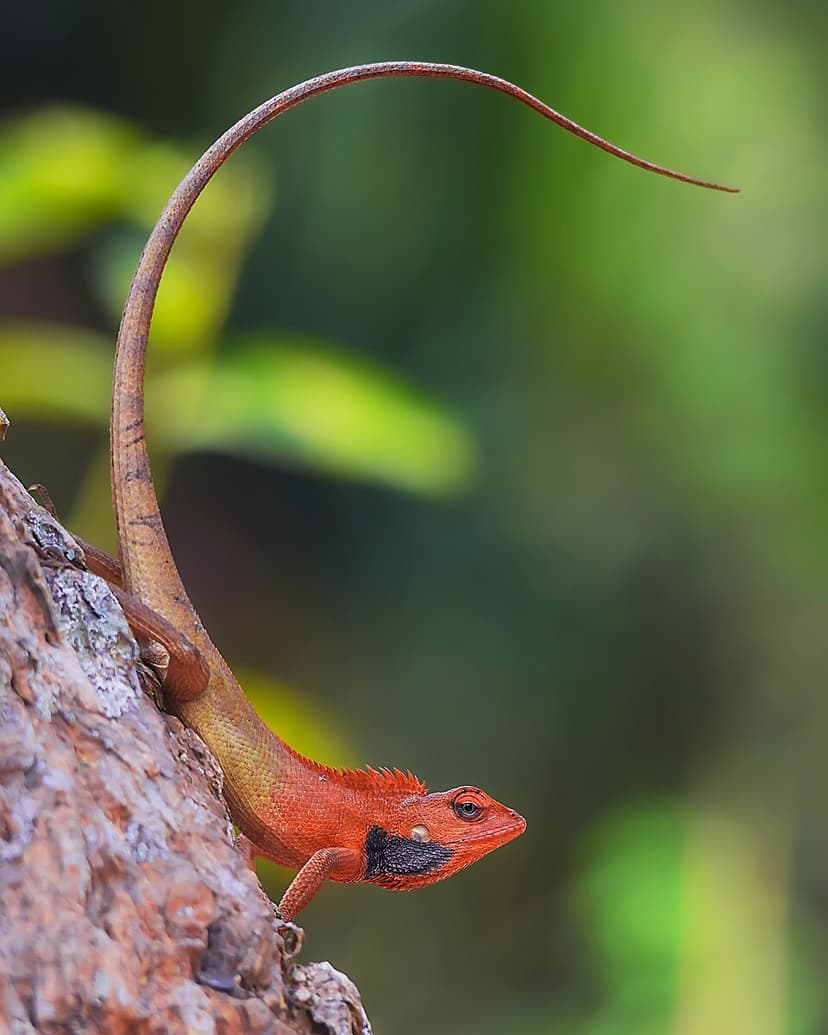
Calotes versicolor
The Oriental garden lizard, scientifically known as Calotes versicolor, is a widely distributed agamid lizard recognized for its striking color-changing abilities, particularly in males during the breeding season. Primarily an insectivore, it inhabits a variety of environments across Indo-Malaya and has been introduced to other regions. Its distinctive features include a dorsal crest, a bright red throat in breeding males, and the ability to move its eyes independently.

Chamaeleo
Chamaeleo is a genus of chameleons known for their slow movement, independently movable eyes, color-changing abilities, long tongues, and prehensile tails. Primarily found in sub-Saharan Africa, with some species extending into northern Africa, southern Europe, and southern Asia, they are predominantly arboreal, inhabiting trees and bushes. Males are typically larger and more vibrantly colored than females.

Chamaeleo chamaeleon
The common chameleon, also known as the Mediterranean chameleon, is a lizard species native to the Mediterranean Basin and areas around the Red Sea. It is notable for being the only chameleon species with a natural range extending into Europe. These chameleons are insectivorous, possess a unique ability to change color in response to stimuli, and are typically solitary, arboreal creatures.