
Desert monitor
The desert monitor (Varanus griseus) is a large carnivorous lizard found across North Africa and Central and South Asia. It exhibits varied coloration from light brown to grey and can reach up to 2 meters in length. Known for its adaptability, the desert monitor inhabits arid and semi-arid regions, preying on a wide range of vertebrates and invertebrates.
Key Facts
- ›Carnivorous diet including vertebrates, invertebrates, and carrion.
- ›Can grow up to 2 meters in total length, with adults averaging around 1 meter.
- ›Undergoes periods of molting, shedding its skin multiple times a year.
- ›Possesses venom that can cause nausea, vomiting, and muscle pain in humans.
- ›Hibernates for extended periods, typically from September to April.
- ›Males are generally larger and more robust than females.

Grey Monitor, Caspian Monitor, Indian Desert Monitor
North Africa, Central Asia, South Asia, Jordan, Turkey, Morocco, Algeria, Tunisia, Libya, Egypt, Israel, Syria, Lebanon, Iraq, Oman, Turkmenistan, Kazakhstan, Uzbekistan, Tajikistan, Kyrgyzstan, Western Sahara, Mauritania, Palestine, Mali, Niger, Chad, Sudan, Afghanistan, Iran, Pakistan, India
Desert, Arid Regions, Semi-Arid Regions, Barren Areas With Sand and/Or Clay Soils, Wooded Areas
- Body Coloration Varies From Light Brown and Yellow To Grey.
- Average Length of About 1 Meter, With Potential To Reach Almost 2 Meters Total Body Length.
- May Display Horizontal Bands On Backs Or Tails, and Yellow Spots On Backs.
- Juveniles Are Brightly Colored Orange With Distinctive Bands, Which May Be Lost With Maturity.
- Nostrils Are Slits Located Farther Back On the Snout, Closer To the Eyes.
- Males Are Generally Larger and More Robust Than Females.
- Undergo Molting To Shed Outer Skin For Growth, A Process That Can Take Months.
- Skin Is Adapted To Desert Environments.
- Subspecies Exhibit Variations In Banding Patterns and Scale Row Counts.
Vertebrates, Invertebrates, Mice, Eggs, Fish, Small Mammals, Reptiles, Birds, Amphibians, Insects, Other Invertebrates, Carrion
- Carnivorous Hunting Behavior.
- Periods of Hibernation .
- Most Active Between May and July.
- Seek Shelter In Burrows During the Hottest Parts of the Day.
- Excellent Swimmers and Divers.
- Aggressive Defense When Body Temperature Is Low.
- Can Tolerate Relatively Cold Temperatures.
- Males Are Generally More Active Than Females.
- Habitat Loss
- Commercial Trade
- Hunting
- Vehicle Collisions
- Trapping In Wells
- Deliberate Killing Due To Negative Attitudes and Superstitions
- Raiding Hen Houses
- Use In Alternative Medicine
About Desert monitor
The desert monitor, scientifically known as Varanus griseus, is a formidable reptile native to the arid and semi-arid regions of North Africa and Central and South Asia. This species is a large carnivorous lizard, recognized for its adaptability and its significant role in its ecosystem. With a varied coloration ranging from light brown and yellow to grey, and the potential to grow up to two meters in length, the desert monitor is an impressive inhabitant of its harsh environments.
Description and Distribution
Desert monitors typically measure around one meter in length, though some individuals can reach nearly two meters. Their physical appearance can include horizontal bands and yellow spots, with juveniles displaying brighter orange coloration. Males are distinguished from females by their larger and more robust build. These lizards are well-adapted to their desert habitats, exhibiting excellent swimming and diving capabilities, often utilizing roads for basking or scavenging, which unfortunately leads to frequent vehicle collisions. Their range is extensive, encompassing countries such as Morocco, Egypt, Iran, Pakistan, and parts of India, with their type locality being Dardsha on the Caspian Sea coast.
Biology and Behavior
The life cycle of the desert monitor is marked by extended periods of hibernation, typically from September to April, with peak activity occurring between May and July. They are ectothermic, meaning their behavior and physiology are heavily influenced by external temperatures, with their running speed directly proportional to their body temperature within a certain range. When threatened and at low body temperatures, they can become aggressive rather than fleeing. Reproduction occurs between May and July, with females laying clutches of 10 to 20 eggs, which incubate for approximately 120 days. In the wild, their lifespan generally does not exceed eight years, although they can live longer in captivity under specific conditions.
Diet and Venom
As carnivores, desert monitors consume a diverse diet that includes small mammals, birds, reptiles, amphibians, insects, and invertebrates. They are opportunistic feeders and will also scavenge carrion. A significant aspect of their biology is their venom, which, similar to that of snakes, possesses neurotoxic properties that can paralyze prey. In humans, a bite can lead to symptoms such as nausea, vomiting, muscle pain, and breathing difficulties, though inflammation is notably absent. The venom also contains enzymes that aid in digestion and can affect blood clotting.
Conservation and Threats
The desert monitor faces numerous threats, including habitat loss due to agricultural development, and significant pressure from the commercial skin trade, leading to some populations being severely depleted. They are listed under Appendix I of CITES, prohibiting international commercial trade. In many regions, they lack legal protection from hunting. Beyond trade and habitat issues, they are also threatened by vehicle collisions, accidental entrapment in wells, and deliberate killing stemming from local superstitions and practical concerns like raiding poultry. Despite these challenges, successful captive breeding has been achieved, offering a potential avenue for conservation efforts.
Source: Wikipedia ↗
Frequently Asked Questions
What is the scientific name for the desert monitor?
The scientific name for the desert monitor is Varanus griseus. This binomial nomenclature is used to classify the species within the scientific community.
What is the typical size of a desert monitor?
Desert monitors typically reach an average length of about 1 meter, but they are capable of growing to total body lengths of almost 2 meters. Their final size is influenced by factors such as food availability and environmental conditions.
What does a desert monitor eat?
Desert monitors are carnivores with a broad diet. They feed on a variety of prey including mice, eggs, fish, small mammals, other reptiles like snakes and tortoises, birds, amphibians, insects, and other invertebrates such as snails and scorpions. They will also consume carrion if the opportunity arises.
Where are desert monitors found?
The desert monitor has a wide geographic distribution, found throughout North Africa and Central and South Asia. Specific countries include Jordan, Turkey, Morocco, Egypt, Iran, Pakistan, and parts of India, among others.
Are desert monitors venomous?
Yes, desert monitors are venomous. While once thought to be solely due to oral bacteria, recent studies indicate the presence of venom glands in their lower jaws. Envenomation can cause symptoms in humans such as nausea, vomiting, and muscle pain.
How long do desert monitors live?
The typical lifespan of desert monitors in the wild does not usually exceed around 8 years for both males and females. In captivity, with specific environmental requirements met, they have been documented to live for over 17 years, though they rarely become docile.
When are desert monitors most active?
Desert monitors become most active between May and July, following their hibernation period which typically lasts from September to April. During the hot middle of the day, they tend to stay in their burrows and emerge to search for food.
Related Lizards

Varanus griseus
The desert monitor (Varanus griseus) is a large carnivorous lizard found across North Africa and Central and South Asia, known for its adaptability to arid environments. It exhibits varied coloration, can grow up to 2 meters in length, and possesses a venomous bite that can cause paralysis in prey and symptoms like nausea in humans. Despite its formidable qualities, it faces significant threats from habitat loss and human persecution.

Plestiodon inexpectatus
The Plestiodon inexpectatus, commonly known as the southeastern five-lined skink, is a widespread lizard found throughout the southeastern United States. This diurnal species is characterized by its five distinct stripes, which fade with age, and a bright blue tail in juveniles. They inhabit wooded areas and are notable for their ability to survive on coastal islands even without fresh water.
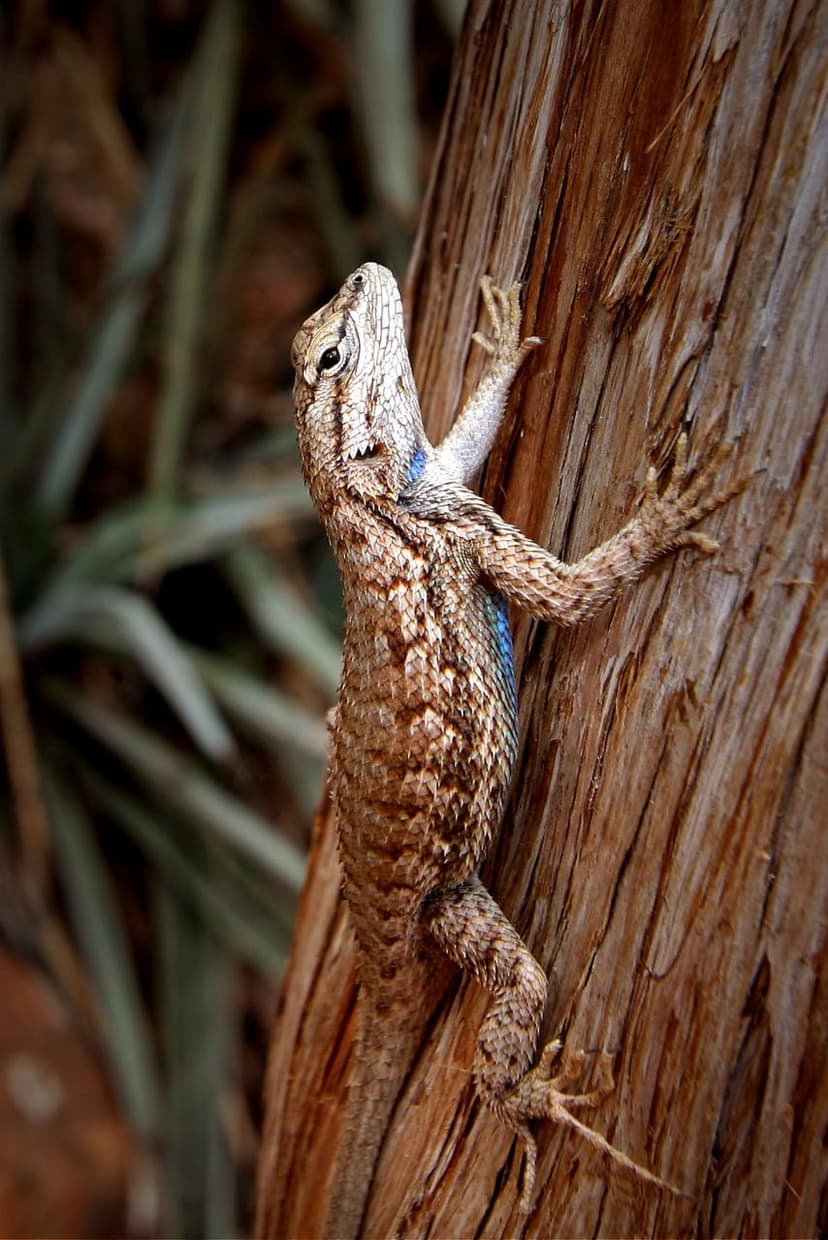
Plateau fence lizard
The plateau fence lizard (Sceloporus tristichus) is a spiny lizard found in the rocky and wooded areas of central Arizona, southwestern Utah, western Colorado, and parts of New Mexico and Wyoming. This grayish, brownish, or greenish reptile is characterized by keeled scales, dark cross-bands on its back, and distinctive metallic blue patches on its belly and throat. It is known to be inactive during extreme temperatures and primarily feeds on insects and other arthropods.