
Diporiphora lalliae
Diporiphora lalliae, also known as Lally's two-line dragon, is a species of lizard endemic to northern Australia. This agamid lizard is characterized by its long tail, a gular fold, and strongly keeled dorsal scales. It inhabits a variety of environments including forests, shrublands, grasslands, and rocky areas.
Key Facts
- ›Endemic to northern Australia, found in Queensland, Western Australia, and Northern Territory.
- ›May reach a snout-to-vent length of 6.2 cm, with a tail approximately three times this length.
- ›Possesses a gular fold and strongly keeled, homogeneous dorsal scales.
- ›Features four precloacal pores and enlarged canine teeth.
- ›Reproduction is oviparous, meaning it lays eggs.
- ›Inhabits diverse environments such as forests, shrublands, grasslands, and rocky areas.
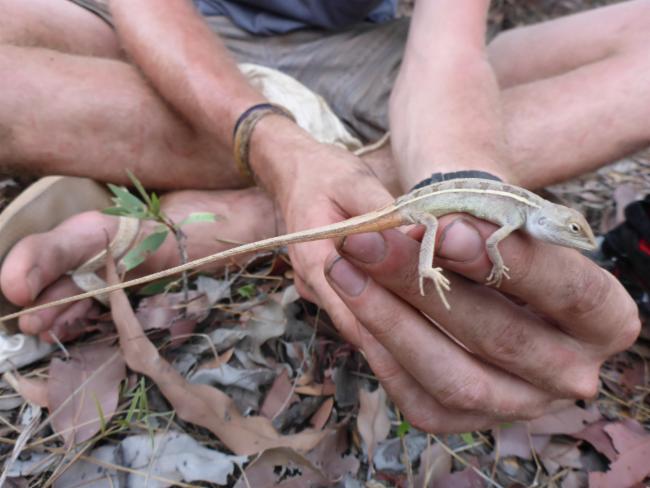
Lally's Two-Line Dragon, Northern Deserts Dragon
Australia
- May Attain A Snout-To-Vent Length of 6.2 cm .
- Tail Is Very Long, About Three Times Svl.
- Possesses A Gular Fold.
- Scales In the Axilla Are Small, But Not Granular.
- Four Precloacal Pores Are Present; No Femoral Pores.
- Postauricular Folds and Scapular Folds Are Strong.
- Dorsal Scales Are Strongly Keeled and Homogeneous.
- One Enlarged Canine Tooth On Each Side.
About Diporiphora lalliae
Diporiphora lalliae, commonly known as Lally's two-line dragon or the northern deserts dragon, is a species of lizard belonging to the Agamidae family. This species is native to Australia, with its natural range encompassing the northern parts of the continent, specifically in Queensland, Western Australia, and the Northern Territory.
Description and Habitat
This agamid lizard is characterized by its physical features, including a potential snout-to-vent length of up to 6.2 centimeters. Its tail is notably long, measuring approximately three times its snout-to-vent length. Anatomical details include a distinct gular fold, small scales in the axilla, and strongly keeled, homogeneous dorsal scales. Diporiphora lalliae also possesses four precloacal pores and a single enlarged canine tooth on each side of its jaw. The species is adaptable, inhabiting a variety of environments such as forests, shrublands, grasslands, and rocky areas, indicating a broad ecological niche within its native regions.
Reproduction
In terms of reproduction, Diporiphora lalliae is oviparous, meaning it reproduces by laying eggs. While specific details regarding clutch size or incubation periods are not extensively documented in available records, this reproductive strategy is common among many lizard species.
Etymology
The specific name, lalliae, honors Mrs. G.E. "Lally" Handley, who was associated with the Western Australian Museum. This naming convention highlights the contributions of individuals involved in the study and collection of Australian herpetofauna.
Source: Wikipedia ↗
Frequently Asked Questions
What is Diporiphora lalliae commonly known as?
Diporiphora lalliae is commonly known as Lally's two-line dragon and the northern deserts dragon. These names reflect its characteristics and geographic distribution.
Where is Diporiphora lalliae found?
This lizard species is native to northern Australia. Its range includes the Australian states of Queensland and Western Australia, as well as the Northern Territory.
What are the physical characteristics of Diporiphora lalliae?
Diporiphora lalliae can grow to a snout-to-vent length of up to 6.2 cm, with a tail that is about three times its body length. It has a gular fold, small scales in the axilla, and strongly keeled dorsal scales. It also possesses four precloacal pores and one enlarged canine tooth on each side.
What types of habitats does Diporiphora lalliae occupy?
Diporiphora lalliae is adaptable and found in a range of habitats. These include forests, shrublands, grasslands, and rocky areas, indicating it can thrive in varied terrestrial environments.
How does Diporiphora lalliae reproduce?
Diporiphora lalliae is oviparous, which means that reproduction occurs through the laying of eggs. This is a common reproductive strategy among many lizard species.
Related Lizards

Delma fraseri
Fraser's delma (Delma fraseri), also known as Fraser's scalyfoot, is a species of legless lizard found in Western Australia. It inhabits diverse environments including forests, shrublands, grasslands, and rocky areas. This oviparous species is named in honor of botanist Charles Fraser.

Lygodactylus pauliani
Lygodactylus pauliani is a species of gecko endemic to Madagascar, found in its southeastern forests, grasslands, rocky areas, and shrublands. Named in honor of entomologist Renaud Paulian, this lizard belongs to the Gekkonidae family. It is oviparous, meaning it reproduces by laying eggs.

Oplurus grandidieri
Grandidier's Madagascar swift, scientifically known as *Oplurus grandidieri*, is a rock-dwelling lizard endemic to the island of Madagascar. This species is characterized by a distinct light mid-dorsal stripe and inhabits rocky areas within forests, shrublands, and grasslands in the southern central highlands.