
Eremias persica
The Aralo-Caspian racerunner (Eremias persica) is a lizard species found across Iran, southern Turkmenistan, Afghanistan, and western Pakistan. It is characterized by continuous dorsolateral black stripes, which contrast strongly with its base pattern, and juveniles display four dark stripes on their backs. This species inhabits open plains and slopes with low vegetation and gravel surfaces.
Key Facts
- ›Native to Iran, southern Turkmenistan, Afghanistan, and western Pakistan.
- ›Distinctive feature: continuous dorsolateral black stripes contrasting with the base pattern.
- ›Juveniles have 4 dark stripes on the back and a non-red ventral tail surface, differing from Eremias velox.
- ›Inhabits open plains, slopes, and areas with low vegetation and gravel surfaces.
- ›Considered a species of least concern by the IUCN Red List.
- ›Closely related to Eremias velox, previously considered a subspecies.
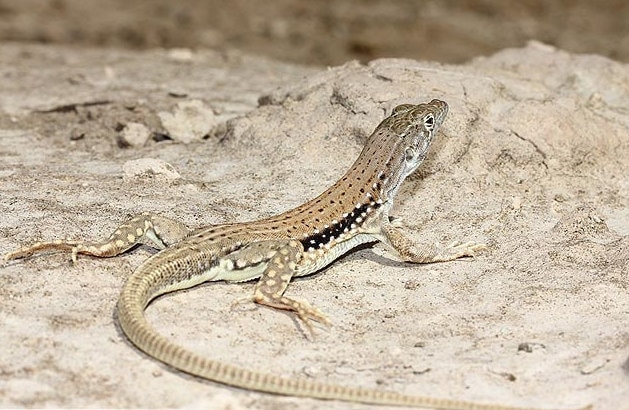
Aralo-Caspian Racerunner, Persian Racerunner
Iran, Southern Azerbaijan, Southern Turkmenistan, Afghanistan, Western Pakistan
Open Plains, Slopes, Low Vegetation Areas, Gravel Surfaces, Mixed Sand and Silt Areas
- Possesses Continuous Dorsolateral Black Stripes That Strongly Contrast With the Base Pattern.
- Juveniles Have 4 Dark Stripes On the Back Between Dorsolateral White-Spotted Stripes.
- Juveniles Have A Ventral Surface of the Tail That Is Not Red.
About Eremias persica
Eremias persica: The Persian Racerunner
The Eremias persica, commonly known as the Persian racerunner or Aralo-Caspian racerunner, is a species of lacertid lizard native to a broad geographical area encompassing Iranian Azerbaijan, much of Iran, southern Turkmenistan, Afghanistan, and western Pakistan. Described by William Thomas Blanford in 1875, its specific epithet, "persica," directly references its distribution within Persia, the historical name for Iran.
Morphology and Distinctions
This species is closely related to Eremias velox, with which it was previously classified as a subspecies. Both share widespread distribution across the Iranian Plateau and similar scale characteristics. However, Eremias persica can be morphologically distinguished from E. velox by several key features. It exhibits continuous dorsolateral black stripes that stand in strong contrast to its base pattern, unlike the interrupted stripes of E. velox. Furthermore, juveniles of Eremias persica display four dark stripes on their backs situated between dorsolateral white-spotted stripes, and their ventral tail surface is not red, whereas E. velox juveniles have three dark stripes and a carmine red ventral tail surface. Distinguishing juveniles from other species is generally easier than distinguishing adults.
Distribution and Habitat
The Persian racerunner is found across Iran, southern Azerbaijan, southern Turkmenistan, Afghanistan, and western Pakistan. Within Iran, its distribution is extensive across the central plateau, south of the Alborz Mountains, and extends into the Zagros Mountains. It notably avoids the central desert regions of Dasht-e Lut and Dasht-e Kavir. The preferred habitat of Eremias persica consists of open plains and slopes, typically characterized by low vegetation and gravel surfaces. It also occupies areas with a mix of sand, silt, and gravel.
Conservation Status
In 2016, Eremias persica was assessed for the IUCN Red List and categorized as a species of Least Concern. This designation reflects its wide distribution, presumed large population size, and the absence of significant, immediate threats to its survival. A synonym, Eremias nigrolateralis, also shared this 'Least Concern' status due to similar factors, being considered unlikely to be declining at a rate that would warrant a more threatened classification.
Source: Wikipedia ↗
Frequently Asked Questions
What are the common names for Eremias persica?
Eremias persica is commonly known as the Aralo-Caspian racerunner or the Persian racerunner. Another related species, Eremias intermedia, also shares the common name Aralo-Caspian racerunner.
Where is the Persian racerunner found?
The Persian racerunner is native to Iranian Azerbaijan, most of Iran, southern Turkmenistan, Afghanistan, and western Pakistan. Within Iran, it has a broad distribution across the central plateau, south of the Alborz Mountains, and in the Zagros Mountains.
What kind of habitat does Eremias persica prefer?
This lizard species prefers open plains and slopes with sparse vegetation and gravel surfaces. It can also be found in areas with mixed sand, silt, and gravel.
How can Eremias persica be distinguished from similar species?
Eremias persica can be distinguished from its close relative Eremias velox by its continuous dorsolateral black stripes that strongly contrast with the base pattern. Juveniles also differ, having four dark stripes on their backs and a non-red ventral tail surface.
What is the conservation status of the Persian racerunner?
The Persian racerunner was assessed for the IUCN Red List in 2016 and is considered a species of least concern. This designation is based on its extensive distribution and presumed lack of significant threats.
Related Lizards

Phrynocephalus versicolor
Phrynocephalus versicolor, also known as the Tuvan toad-headed agama, is a lizard species native to the desert regions of China and Mongolia. It is characterized by its rounded head, blunt snout, and variable coloration, often featuring olive or leaden-grey with dark transverse bars. This species inhabits stony plains, canyons, and sand dunes, demonstrating adaptations to extreme temperature fluctuations and arid conditions.

Great Plains skink
The Great Plains skink is a large North American lizard, recognized by its light gray or beige coloration with black-edged dorsal scales and a yellow belly. It inhabits open plains and foothills, often near water sources. This species is notable for its relatively large size within its genus and the distinctive blue tail of its juveniles.

Underwoodisaurus milii
The Underwoodisaurus milii, commonly known as the thick-tailed or barking gecko, is a reptile native to southern Australia. This species is distinguished by its plump tail and a unique barking defensive call. It inhabits rocky outcrops and shelters in burrows or under rocks during the day, emerging at night to prey on arthropods and smaller geckos.