
Gekko guishanicus
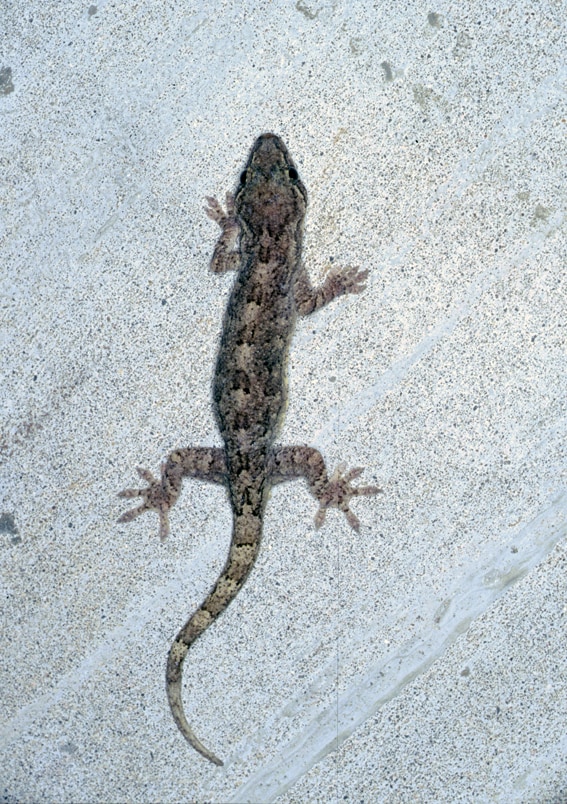
Gekko guishanicus is a small gecko species endemic to Guishan Island, Taiwan, previously misidentified as Gekko hokouensis. It is characterized by its brown body with distinctive dark brown transverse spots and a flat, narrow build. This nocturnal reptile inhabits artificial structures on the island and reproduces by laying two connected eggs.
Key Facts
- ›Endemic to Guishan Island, Taiwan.
- ›Small-sized gecko with a flat, narrow body.
- ›Brown background color with dark brown transverse spots on the body and tail.
- ›Nocturnal, active after sunset.
- ›Oviparous, laying two connected eggs per clutch.
- ›Previously mistaken for Gekko hokouensis.
Guishan Island, Taiwan
Artificial Buildings, Walls, Brickwork Joints
- Small-Sized Gecko
- Flat and Narrow Body
- Total Length Approximately 12.5 cm
- Snout-Vent Length Approximately 6 cm
- Background Color of Body and Back Is Brown
- Dark Brown Transverse Spots On the Body and Back
- 6 Dark Color Narrow Transverse Spots On the Center of the Back From Neck To Anus
- More Than 6 Dark Color Transverse Spots On the Tail
- Pair of Elongated Posterior Chin Scales
- 3-4 Submental Scales On Each Side
- 2-3 Larynx Scales Behind Elongated Posterior Chin Scales
- 8-10 Petals Without Claws On the Inner Finger
- Wart Scales On the Back of the Body and Limbs, Without Extra Large Ones
Nocturnal Activity, Active After Sunset
About Gekko guishanicus
Gekko guishanicus is a species of gecko belonging to the Genus Gekko and Family Gekkonidae. This species is endemic to Guishan Island, located in Yilan County, northeast Taiwan. It was previously mistaken for another species, Gekko hokouensis, but was identified as new based on morphological and molecular evidence, particularly from mtDNA CTB sequence analysis.
Species Characteristics
Gekko guishanicus is a small gecko with a distinctive flat and narrow body. Adults typically reach a total length of approximately 12.5 cm, with a snout-vent length (SVL) of about 6 cm. Its coloration consists of a brown background on the body and back, adorned with dark brown transverse spots. Specifically, there are six narrow, dark transverse spots along the center of the back from the neck to the anus, and more than six similar spots extend along the entire length of the tail. Anatomical details include a pair of elongated posterior chin scales, 3-4 submental scales on each side, and 2-3 larynx scales behind the chin scales. The inner finger possesses 8-10 petals lacking claws, and the body and limbs are covered in wart scales of uniform size, without any exceptionally large ones.
Distribution and Habits
Currently, Gekko guishanicus has only been documented on Guishan Island. Its preferred habitat consists of the walls of artificial structures situated on flat ground. These environments include brick houses, warehouses, and cement water storage towers, where it is often found on walls or within brickwork joints. As a nocturnal animal, Gekko guishanicus becomes active only after sunset. Regarding reproduction, it is an oviparous species, meaning it lays eggs. Each clutch typically consists of two connected eggs. Males of the species exhibit 6-8 precloacal pores arranged in a linear pattern.
Source: Wikipedia ↗
Frequently Asked Questions
Where is Gekko guishanicus found?
Gekko guishanicus is found exclusively on Guishan Island, located off the northeast coast of Taiwan. Its distribution is limited to this specific island.
What does Gekko guishanicus look like?
This species is a small gecko, reaching a total length of about 12.5 cm with a snout-vent length of around 6 cm. It has a flat, narrow body with a brown background color marked by dark brown transverse spots on its back and tail.
What is the habitat of Gekko guishanicus?
Gekko guishanicus typically inhabits the walls of artificial structures found on flat ground. This includes buildings such as brick houses, warehouses, and cement water storage towers.
When is Gekko guishanicus active?
Gekko guishanicus is a nocturnal animal. It becomes active and moves about only after sunset, foraging and engaging in other activities during the night.
How does Gekko guishanicus reproduce?
As an oviparous species, Gekko guishanicus reproduces by laying eggs. Each reproductive event typically results in the laying of two connected eggs.
Was Gekko guishanicus always recognized as a distinct species?
No, Gekko guishanicus was previously mistaken for another species, Gekko hokouensis. Its identification as a new species was based on morphological and molecular evidence.
Related Lizards

Common wall gecko
The common wall gecko, scientifically known as Tarentola mauritanica, is a robust gecko species native to the western Mediterranean region of North Africa and Europe. Characterized by enlarged, tubercules that give it a spiny, armored appearance, this nocturnal insectivore is frequently observed on walls in urban and coastal areas. It has a long history of cohabitation with humans, particularly in Spain, where it acts as an insect hunter.

Euleptes europaea
The European leaf-toed gecko (Euleptes europaea) is a small lizard distinguished by adhesive pads on its toes and tail, enabling it to climb exceptionally well. Its coloration varies from yellowish-brown to greyish-brown, often with blotchy patterns. Primarily found in rocky coastal regions and Mediterranean islands, this gecko is mostly nocturnal and feeds on insects and other small invertebrates.
European leaf-toed gecko
The European leaf-toed gecko is a small lizard found in the rocky coastal regions of France, Italy, and Tunisia, as well as on Mediterranean islands. It is characterized by its diamond-shaped head, vertical pupils, and adhesive toe pads that allow it to climb expertly. This species is primarily nocturnal and feeds on insects and other small invertebrates.