
Holguin anole
The Holguin anole, scientifically known as Anolis noblei, is a species of lizard native to eastern Cuba. It inhabits forests from near sea level up to 600 meters and is oviparous, meaning it reproduces by laying eggs. The species is recognized by two distinct subspecies.
Key Facts
- ›Native to eastern Cuba.
- ›Inhabits forest environments.
- ›Found at elevations from near sea level to 600 meters.
- ›Reproduces by laying eggs (oviparous).
- ›Has two recognized subspecies: Anolis noblei galeifer and Anolis noblei noblei.
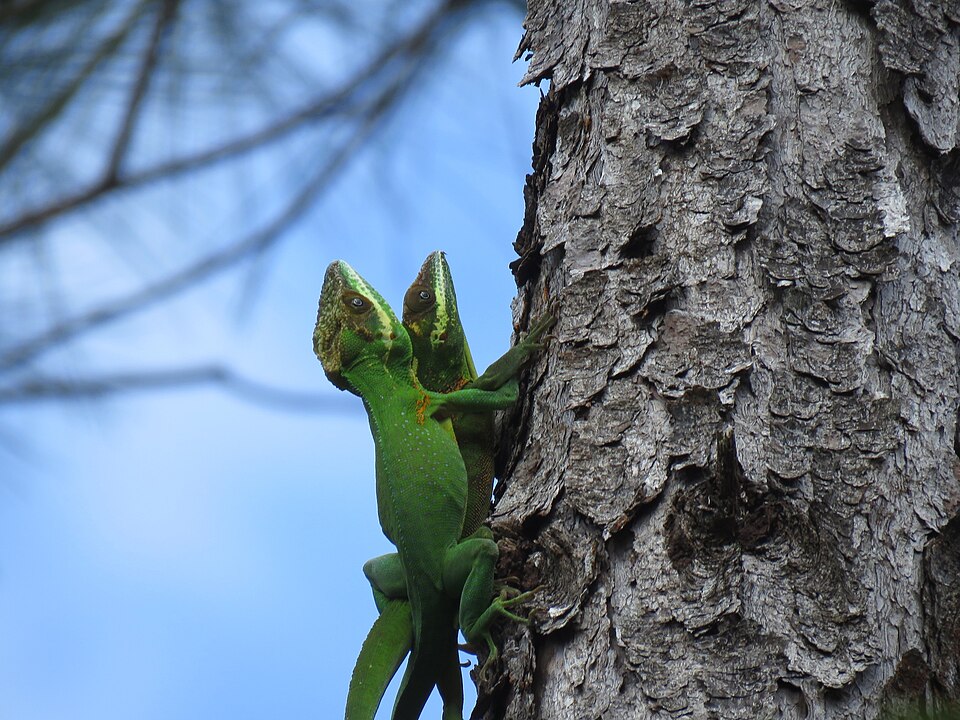
Holguin Anole, Noble's Anole, Oriente Giant Anole
Cuba
About Holguin anole
The Holguin anole, scientifically identified as Anolis noblei, is a species of lizard belonging to the family Dactyloidae. This species is exclusively found in Cuba, with its natural distribution concentrated in the eastern part of the island. It is also known by other common names, including Noble's anole and the Oriente giant anole.
Habitat and Distribution
The preferred natural habitat for the Holguin anole is forest environments. These lizards are typically found at elevations ranging from near sea level up to approximately 600 meters (about 2,000 feet). The species is endemic to Cuba, meaning it is found nowhere else in the world.
Reproduction and Subspecies
The Holguin anole reproduces by laying eggs, classifying it as an oviparous species. There are two recognized subspecies within Anolis noblei: Anolis noblei galeifer, described by Schwartz in 1964, and the nominotypical subspecies, Anolis noblei noblei, described by Barbour and Shreve in 1935.
Etymology
The specific epithet, noblei, was chosen in honor of the American herpetologist Gladwyn Kingsley Noble, recognizing his contributions to the field of herpetology.
Source: Wikipedia ↗
Frequently Asked Questions
What is the scientific name of the Holguin anole?
The scientific name of the Holguin anole is Anolis noblei. This binomial nomenclature is used to distinguish it within the scientific community.
Where is the Holguin anole found?
The Holguin anole is endemic to eastern Cuba. Its natural geographic distribution is confined to this region of the island.
What kind of habitat does the Holguin anole prefer?
The preferred natural habitat of the Holguin anole is forest. It can be found in these environments at elevations ranging from near sea level up to 600 meters (2,000 ft).
How does the Holguin anole reproduce?
The Holguin anole is oviparous, which means it reproduces by laying eggs. This is a common reproductive strategy among many lizard species.
Are there different types of Holguin anoles?
Yes, there are two recognized subspecies of Anolis noblei. These include Anolis noblei galeifer and the nominotypical subspecies, Anolis noblei noblei.
Related Lizards

Aaron Bauer's house gecko
Aaron Bauer's house gecko is a species of lizard found in the Western Ghats of Maharashtra, India. It is notable for its relatively large size within its genus, reaching up to 13 cm in snout-to-vent length. This species prefers rocky outcrops within forested areas as its natural habitat.

Adolfus jacksoni
Adolfus jacksoni, also known as Jackson's forest lizard, is a species of lizard belonging to the Lacertidae family, native to East Africa. It prefers forest habitats at significant altitudes and exhibits diurnal and semi-arboreal behaviors. This oviparous species lays clutches of three to five eggs, and communal nesting sites have been observed.

Agama
Agama are a genus of small to moderate-sized, long-tailed lizards native to Africa, particularly sub-Saharan regions. Known for their insectivorous diet and ability to adapt to various habitats, including human settlements, they display striking color changes based on mood and gender. These diurnal reptiles are characterized by powerful hind legs for swift movement and are recognized by their common names, some referencing their head-bobbing displays.