
Horsfield's spiny lizard (Salea horsfieldii)
Horsfield's spiny lizard (Salea horsfieldii) is a species of agamid lizard found in the high-altitude grassy hills of the Nilgiri Hills in India. This olive brown to green lizard is characterized by its white banded appearance, rough scales, and a distinctive crest on the male's neck. It inhabits forests at elevations between 1,600 and 2,500 meters.
Key Facts
- ›Endemic to the Nilgiri Hills of India.
- ›Prefers high-altitude grassy hills and forests.
- ›Males possess a spiny crest on the neck and tail.
- ›Coloration is typically olive brown to green with white bands and dark cross bands.
- ›Reproduces by laying eggs (oviparous).
- ›Snout-to-vent length is approximately 9.5 cm, with a tail of about 24.8 cm.
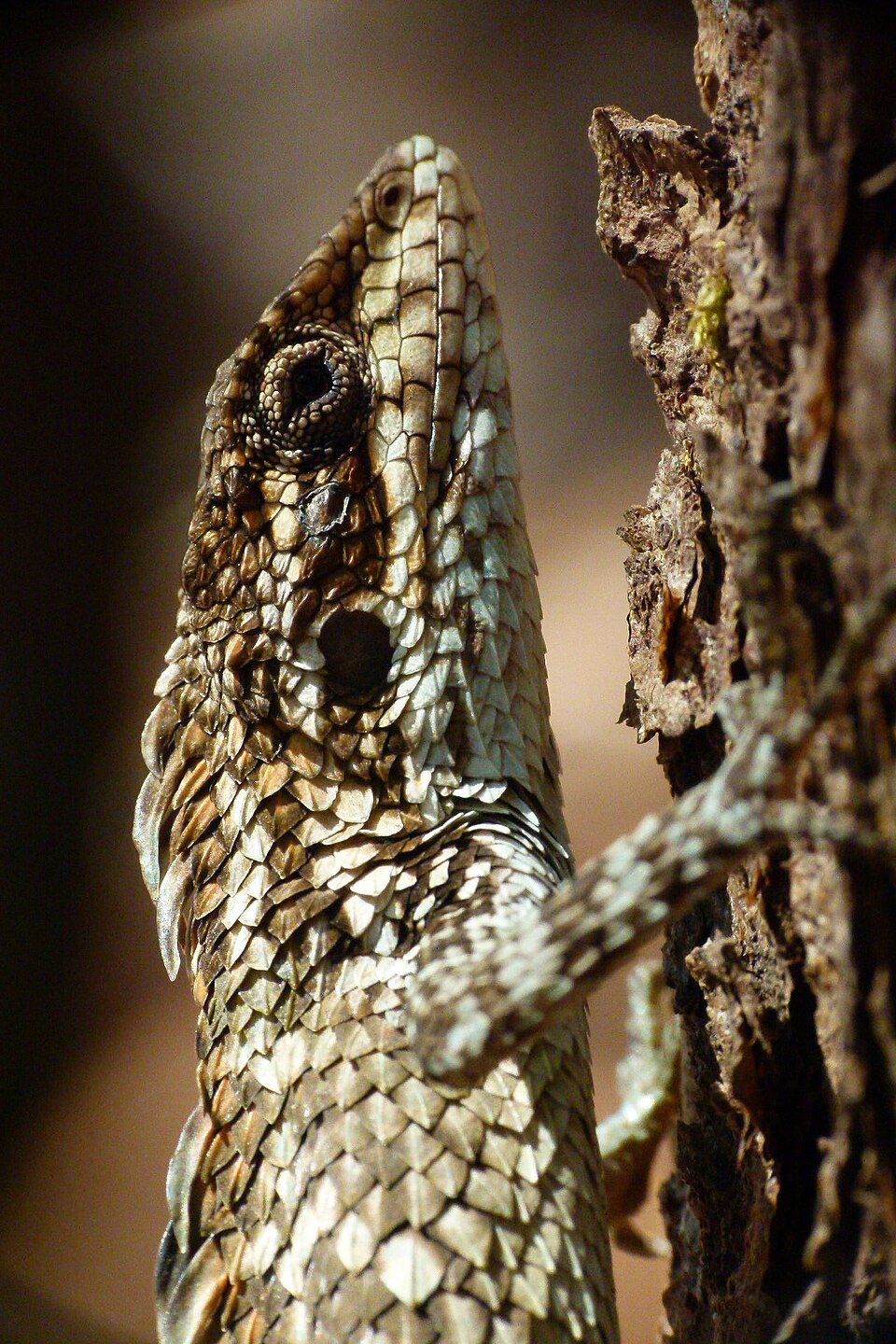
Horsfield's Spiny Lizard, Nilgiri Salea
India
Forest, Grassy Hills
- Olive Brown To Green Coloration With White Bands.
- Irregular Dark-Brown Cross Bands, Sometimes Broken By A Light-Brown Lateral Band.
- Snout Approximately 1.5 Times the Eye Diameter.
- Eye Diameter About Twice the Ear Opening Diameter.
- Large, Rough Scales On the Head.
- Some Brow Scales Are Curved Above the Eye.
- Row of Three Or Four Large Scales Between Eye and Ear Opening.
- Lanceolate, Keeled, Sharp-Tipped Scales On the Throat.
- Male Has A Nuchal Crest of Backward-Facing Lanceolate Spines, Followed By A Dorsal Crest.
- Large, Rhomboidal, Strongly Keeled Dorsal Scales, Often of Unequal Size.
- Ventral Scales Are Strongly Imbricate, Heavily Keeled, and Spine-Tipped, Nearly As Large As Dorsals.
- Limbs Are Somewhat Long; Hind Toes Reach Between Shoulder and Ear When Limb Is Held Along the Body.
- Tail Is Compressed.
- Male Has A Small Crest On the Tail; Female's Tail Is Crestless.
- Caudal Scales Are Sub-Equal and Strongly Keeled.
- Snout-To-Vent Length Is Approximately 9.5 cm .
- Tail Length Is Approximately 24.8 cm .
- Males Have A Crest On the Neck and Tail, Suggesting Potential Display Or Territorial Behaviors.
- Found In High-Altitude Grassy Hills and Forests.
About Horsfield's spiny lizard (Salea horsfieldii)
Horsfield's spiny lizard, scientifically known as Salea horsfieldii, is a reptile species belonging to the Agamidae family. This lizard is exclusively found in the Nilgiri Hills of India, thriving in high-altitude grassy hills and forest environments. It is recognized for its distinctive olive brown to green coloration, often adorned with white bands and irregular dark cross bands, and its rough, keeled scales.
Physical Characteristics
The species exhibits notable physical features. The snout is proportionally long compared to the eye diameter, which is significantly larger than the ear opening. Males possess a prominent spiny crest on the back of their neck, which extends as a dorsal crest after a break, and also a crest on their compressed tail, a feature absent in females. The scales covering the body are robust, rhomboidal, and strongly keeled, with ventral scales being particularly imbricate and spiny. Adult specimens typically measure around 9.5 cm from snout to vent, with a tail that extends to approximately 24.8 cm.
Habitat and Reproduction
Salea horsfieldii prefers forest habitats at elevations ranging from 1,600 to 2,500 meters (5,200 to 8,200 feet). The species is oviparous, meaning it reproduces by laying eggs. While specific details regarding their diet, lifespan, or breeding behaviors are not extensively documented in the provided historical accounts, their natural habitat suggests adaptations to montane ecosystems. The specific name, horsfieldii, honors the American naturalist Thomas Horsfield.
Source: Wikipedia ↗
Frequently Asked Questions
What is the scientific name for Horsfield's spiny lizard?
The scientific name for Horsfield's spiny lizard is Salea horsfieldii. This binomial nomenclature is used to classify the species within the scientific community.
Where can Horsfield's spiny lizard be found?
Horsfield's spiny lizard is endemic to the Nilgiri Hills in India. Its preferred natural habitat includes high-altitude grassy hills and forests.
What does Horsfield's spiny lizard look like?
This lizard is typically olive brown to green with a white banded appearance. It has rough scales, a snout about 1.5 times the eye diameter, and males sport a spiny crest on their neck and tail.
How does Salea horsfieldii reproduce?
Salea horsfieldii is oviparous, meaning it reproduces by laying eggs. Details regarding clutch size or incubation periods are not extensively documented in available records.
What is the habitat preference of Horsfield's spiny lizard?
The preferred natural habitat for Salea horsfieldii is forest areas, typically found at altitudes ranging from 1,600 to 2,500 meters (5,200 to 8,200 feet).
What are the distinguishing features of male Horsfield's spiny lizards?
Male Horsfield's spiny lizards are distinguished by a crest on the back of their neck, composed of several backward-facing spines. They also have a small crest on their tail, which is absent in females.
Related Lizards

Chinese water dragon
The Chinese water dragon is a large, diurnal lizard native to subtropical forests in southern China and Southeast Asia. These semi-arboreal reptiles are known for their green coloration, prominent crests in males, and their reliance on unpolluted streams for escape and habitat. Their diet primarily consists of arthropods, but they are omnivorous and will consume vertebrates and plants.

Ctenosaura pectinata
The western spiny-tailed iguana, scientifically known as Ctenosaura pectinata, is a moderately large lizard native to western Mexico. This species is characterized by its distinctive keeled scales on its tail, a crest of spines down its back, and variable coloration ranging from brown to grey-brown, with a yellowish underside. While primarily herbivorous as adults, juveniles consume insects, and they are known for their social behavior and adaptation to rocky habitats with nearby trees.

Gray's spiny-tailed iguana
Gray's spiny-tailed iguana, also known as the black iguana, is a sizable iguanid lizard native to Mexico and Central America. It is characterized by its distinctive black, keeled scales on its tail and a crest of spines running down its back. Primarily herbivorous, these diurnal lizards inhabit rocky areas with nearby trees and are known for their remarkable speed.