
Phyllodactylidae
Phyllodactylidae·Phyllodactylidae
Phyllodactylidae is a family of geckos found across the New World, North Africa, Europe, and the Middle East. Established through molecular phylogenetic analysis in 2008, this family is distinguished by a unique deletion in the phosducin (PDC) gene found in all its members. The family's name, derived from "leaf shaped fingers," reflects a key characteristic of these geckos.
Key Facts
- ›Comprises 163 species across 10 genera.
- ›Found in the New World, North Africa, Europe, and the Middle East.
- ›Delineated in 2008 based on molecular phylogenetic analysis.
- ›All members share a unique single codon deletion in the phosducin (PDC) gene.
- ›The family name refers to their distinctive leaf-shaped fingers.
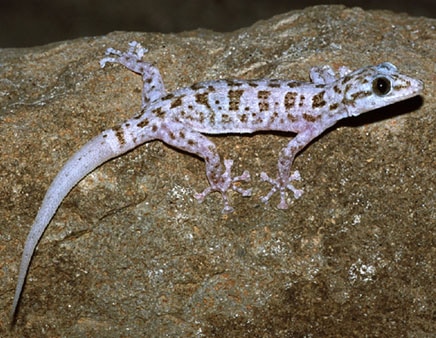
New World, North Africa, Europe, Middle East
Possess Leaf-Shaped Fingers
About Phyllodactylidae
The Phyllodactylidae represent a distinct family within the diverse group of geckos, scientifically classified under the infraorder Gekkota. This family encompasses a significant number of species, with 163 known species distributed across 10 distinct genera. Their natural range extends widely, covering the New World, North Africa, Europe, and the Middle East, indicating a broad adaptation to various environments.
Taxonomy and Genetics
The establishment of the Phyllodactylidae family is a relatively recent development in herpetological research, dated to 2008. Its delineation was primarily based on comprehensive molecular phylogenetic analyses. A key diagnostic feature uniting all members of this family is a unique genetic marker: a single codon deletion found in the phosducin (PDC) gene. This genetic trait serves as a significant identifier for species belonging to Phyllodactylidae.
Etymology and Key Features
The name "Phyllodactylidae" itself offers insight into a distinctive physical characteristic of these geckos. Derived from Greek roots, it translates to "leaf-shaped fingers." This anatomical feature is a notable aspect of their morphology, likely playing a role in their locomotion or arboreal habits, though specific ecological functions require further study.
Genera and Species
The family currently comprises ten genera, with one notable taxonomic revision including the recent synonymization of the genus Bogertia with Phyllopezus. The specific genera and their constituent species contribute to the overall diversity and evolutionary history of this gecko family. Further research continues to refine our understanding of their relationships and distributions.
Source: Wikipedia ↗
Frequently Asked Questions
What is the Phyllodactylidae family?
Phyllodactylidae is a family of geckos belonging to the infraorder Gekkota. They are characterized by a unique genetic marker and are distributed across several continents.
Where are Phyllodactylidae geckos found?
These geckos are naturally found throughout the New World, as well as in North Africa, Europe, and the Middle East. Their distribution spans a wide geographical range.
What is a notable characteristic of Phyllodactylidae geckos?
The family's name, Phyllodactylidae, is derived from their distinctive leaf-shaped fingers. This anatomical feature is a key identifier for members of this group.
How was the Phyllodactylidae family identified?
The family was established in 2008 following a molecular phylogenetic analysis. This scientific study revealed distinct genetic relationships among certain gecko species.
What genetic trait do all Phyllodactylidae members share?
All geckos within the Phyllodactylidae family possess a unique single codon deletion in their phosducin (PDC) gene. This genetic anomaly serves as a defining characteristic for the family.