
Podarcis bocagei
Bocage's wall lizard (Podarcis bocagei) is a species endemic to the Iberian Peninsula, characterized by its grey or yellowish-brown dorsal surface with dark markings, and white, yellow, pink, or orange underparts. It inhabits diverse environments including temperate forests, shrubland, coastal areas, and urban gardens. The species is oviparous and considered of 'least concern' by the IUCN due to its stable population and lack of specific threats.
Key Facts
- ›Endemic to the Iberian Peninsula, found in northern Portugal and northwestern Spain.
- ›Snout-to-vent length averages around 7 cm, with a tail twice that length.
- ›Males are typically larger than females.
- ›Dorsal coloration is usually grey or yellowish-brown, sometimes green in males, with dark speckling.
- ›Underparts are white, yellow, pink, or orange, lacking the small blue spots seen in similar species.
- ›Classified as 'least concern' by the IUCN due to a stable population and no major threats.

Bocage's Wall Lizard
Northern Portugal, Northwestern Spain
Temperate Forests, Temperate Shrubland, Mediterranean-Type Shrubby Vegetation, Sandy Shores, Rural Gardens, Urban Areas, Open Deciduous Woodland, Scrubland, Coastal Sand Dunes, Cultivated Areas, Villages
- Grows To A Snout-To-Vent Length of About 7 cm .
- Tail Is Twice the Svl.
- Males Are Larger Than Females.
- Sturdy and Somewhat Flattened Body.
- Dorsal Surface Is Usually Grey Or Yellowish-Brown, Sometimes Green In Males.
- Dorsal Surface Is Copiously Speckled With Rows of Dark Markings.
- Flanks May Be Brownish Or Yellowish.
- Underparts Are White, Yellow, Pink, Or Orange.
- Lacks the Small Blue Spots Along the Edge of the Belly Often Seen In Carbonell's Wall Lizard.
About Podarcis bocagei
Bocage's Wall Lizard (Podarcis bocagei)
Bocage's wall lizard, scientifically identified as Podarcis bocagei, is a species native to the Iberian Peninsula. This lizard is a member of the Lacertidae family and is recognized by its distinctive physical characteristics, including a sturdy, somewhat flattened body, a snout-to-vent length of approximately 7 cm, and a tail twice that length. Males tend to be larger than females. The typical coloration involves a dorsal surface that is usually grey or yellowish-brown, often speckled with dark markings, and can be green in males. Its underparts are generally white, yellow, pink, or orange, distinguishing it from similar species by the absence of small blue spots along the belly edge.
Habitat and Distribution
The natural habitats of Podarcis bocagei are diverse, encompassing temperate forests, shrubland, Mediterranean-type vegetation, sandy shores, rural gardens, and urban areas. Specifically, it is found in open deciduous woodlands, scrubland, coastal sand dunes, and cultivated regions, including villages. Its geographic range is confined to the Iberian Peninsula, specifically northern Portugal and northwestern Spain, extending south to the River Douro. The species can be found at altitudes from sea level up to 1,900 meters (6,200 ft).
Reproduction and Conservation
Bocage's wall lizard reproduces by laying eggs (oviparous). Mature females are capable of producing multiple clutches annually, with each clutch typically containing between 2 to 9 eggs. The species is considered common within its suitable habitats, and its population is described as steady. Due to these factors and the lack of identified specific threats, the International Union for Conservation of Nature (IUCN) has classified Podarcis bocagei as being of 'least concern', indicating a healthy and stable conservation status.
Source: Wikipedia ↗
Frequently Asked Questions
What is Bocage's wall lizard?
Bocage's wall lizard, scientifically known as Podarcis bocagei, is a species of lizard belonging to the Lacertidae family. It is native to the Iberian Peninsula and inhabits a variety of environments from coastal dunes to urban gardens.
Where is Podarcis bocagei found?
This lizard species is endemic to the Iberian Peninsula, with its natural range covering northern Portugal and northwestern Spain, extending as far south as the River Douro.
What does Bocage's wall lizard look like?
Podarcis bocagei typically has a grey or yellowish-brown back, often speckled with dark markings, and sometimes green in males. Its underparts are white, yellow, pink, or orange. It is a sturdy, somewhat flattened lizard, reaching a snout-to-vent length of about 7 cm.
What is the habitat of Bocage's wall lizard?
Bocage's wall lizard thrives in open deciduous woodlands, scrubland, coastal sand dunes, and cultivated areas. It can be found at altitudes ranging from sea level up to 1,900 meters.
How does Podarcis bocagei reproduce?
This species is oviparous, meaning it lays eggs. Sexually mature females can lay multiple clutches per year, with each clutch containing between 2 to 9 eggs.
Is Bocage's wall lizard endangered?
No, Bocage's wall lizard is not considered threatened. The International Union for Conservation of Nature (IUCN) has assessed its conservation status as 'least concern' due to its common presence, steady population, and lack of specific threats.
Related Lizards

Agama
Agama are a genus of small to moderate-sized, long-tailed lizards native to Africa, particularly sub-Saharan regions. Known for their insectivorous diet and ability to adapt to various habitats, including human settlements, they display striking color changes based on mood and gender. These diurnal reptiles are characterized by powerful hind legs for swift movement and are recognized by their common names, some referencing their head-bobbing displays.

Lygodactylus blancae
Lygodactylus blancae is a species of gecko endemic to Madagascar, belonging to the family Gekkonidae. While its natural habitat remains unknown, it has been observed in villages at significant altitudes. This species reproduces by laying eggs.
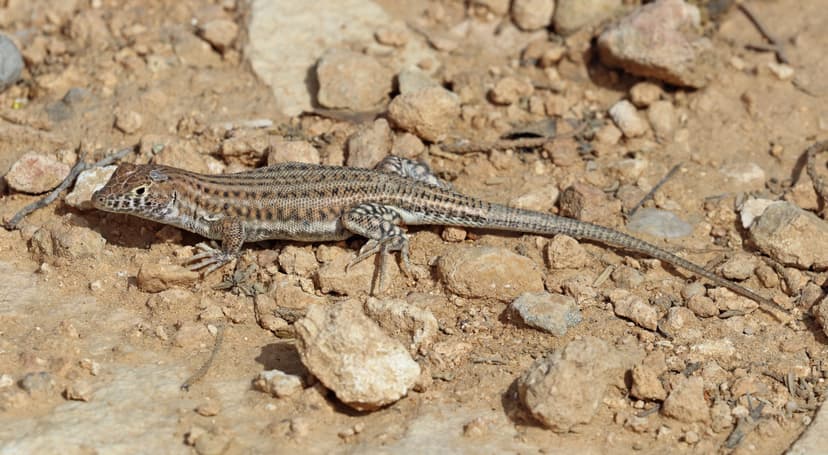
Acanthodactylus boskianus
Bosc's fringe-toed lizard (Acanthodactylus boskianus) is a medium-sized lizard found across North Africa and Western Asia. It is characterized by its olive-grey dorsal surface with dark stripes and distinctive long, fringed digits on its feet. This fast-moving lizard inhabits diverse environments, from coastal plains to oases, and is a common diurnal species within its extensive range.