
Stenodactylus
Stenodactylus·Gekkonidae
Stenodactylus is a genus of geckos native to the Middle East and North Africa, commonly referred to as short-fingered geckos. These reptiles are characterized by their specific adaptations to arid environments. The genus encompasses several species, each with varying distributions and specific ecological niches within the desert and semi-desert regions they inhabit.
Key Facts
- ›Stenodactylus geckos are found in the Middle East and North Africa.
- ›They are commonly known as short-fingered geckos.
- ›This genus includes multiple distinct species.
- ›They are adapted to arid and semi-arid environments.
- ›The species inhabit desert and semi-desert regions.

Short-Fingered Geckos
Middle East, North Africa
Characterized By Short Fingers.
About Stenodactylus
Stenodactylus is a genus of geckos found across the Middle East and North Africa. These reptiles are commonly known as short-fingered geckos, a name that likely alludes to a distinctive physical feature of the species within this group. The genus is characterized by its adaptation to arid and semi-arid environmental conditions, thriving in desert and semi-desert landscapes.
Species Diversity
The Stenodactylus genus comprises several recognized species, each with its own scientific classification and geographical distribution within the broader Middle Eastern and North African regions. Among these are the Iranian short-fingered gecko (Stenodactylus affinis), the Middle Eastern short-fingered gecko (Stenodactylus doriae), and Lichtenstein's short-fingered gecko (Stenodactylus sthenodactylus), among others. Each species occupies a specific niche within the desert ecosystems they inhabit, contributing to the biodiversity of these regions.
Source: Wikipedia ↗
Frequently Asked Questions
What are Stenodactylus geckos commonly called?
Stenodactylus geckos are commonly known as short-fingered geckos. This name likely refers to a physical characteristic of the species within the genus.
Where are Stenodactylus geckos found?
The Stenodactylus genus is distributed across the Middle East and North Africa. This broad geographic range covers a variety of desert and semi-desert landscapes.
What types of habitats do Stenodactylus geckos prefer?
Stenodactylus geckos are adapted to arid and semi-arid environments. They are typically found inhabiting desert and semi-desert regions within their native range.
How many species are in the Stenodactylus genus?
The Stenodactylus genus includes several described species. The provided information lists ten distinct species, each with its own scientific name and common name.
Related Lizards

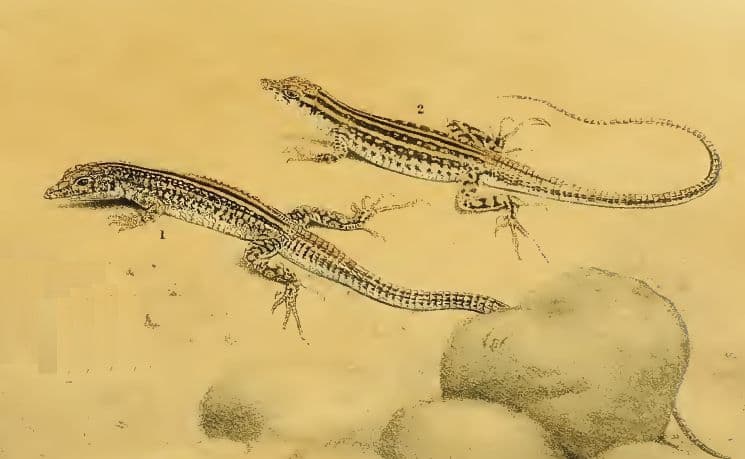
Eremias scripta
Eremias scripta, commonly known as the sand racerunner, is a species of lizard found across Central Asia. This species inhabits arid and semi-arid regions, including deserts and steppes, where it is well-adapted to sandy environments. Its specific characteristics and behaviors are typical of ground-dwelling lizards in these harsh climates.
Pseuderemias mucronata
Pseuderemias mucronata, commonly known as the Sinai racerunner or Blanford's sand racer, is a lizard species native to the Horn of Africa and parts of Northeast Africa. This species is characterized by its adaptation to arid environments, where it is found across desert and semi-desert regions.

Qinghai toadhead agama
The Qinghai toadhead agama (Phrynocephalus vlangalii) is a viviparous lizard endemic to the Tibetan Plateau in China. It inhabits high-altitude burrows, typically between 2,000 and 4,600 meters, adapting to arid and semi-arid environments. This species is known for its territorial defense displays, including tail curling and belly patch exposure, and exhibits sexual dimorphism in head and tail lengths, as well as tail-tip coloration.