
Eastern long-beaked echidna
Mammalia, Monotremata·Vulnerable·long snout·Eastern long-beaked echidna
The eastern long-beaked echidna (Zaglossus bartoni) is a species of monotreme native to New Guinea, primarily found in its eastern regions at high elevations. It is distinguished by having five claws on its forefeet and four on its hind feet, dense black fur, and a body length of 60 to 100 cm, weighing between 5 and 10 kg. This echidna lays eggs, a trait shared with reptiles and birds, and possesses mammary glands to feed its young, embodying a significant evolutionary link. It is an insectivore, feeding mainly on larvae, ticks, and earthworms, and inhabits tropical hill forests to sub-alpine forests and upland grasslands. The species rolls into a spiny ball for defense and digs burrows for protection. While historically listed as critically endangered, its status has improved to vulnerable.
Key Facts
- ›Found mainly in eastern New Guinea at elevations between 2,000 and 3,000 meters.
- ›Distinguished by five claws on forefeet and four on hind feet.
- ›Weight ranges from 5 to 10 kg, with a body length of 60 to 100 cm.
- ›Possesses dense black fur and rolls into a spiny ball for defense.
- ›Has a lifespan of approximately 30 years.
- ›Males retain spurs on hind legs, while females typically lose them.
- ›Diet consists mainly of insect larvae, ticks, and earthworms.
- ›Inhabits tropical hill forests, sub-alpine forests, upland grasslands, and scrub.
- ›Listed as vulnerable on the IUCN Red List.
- ›Deforestation and hunting by humans are primary threats.
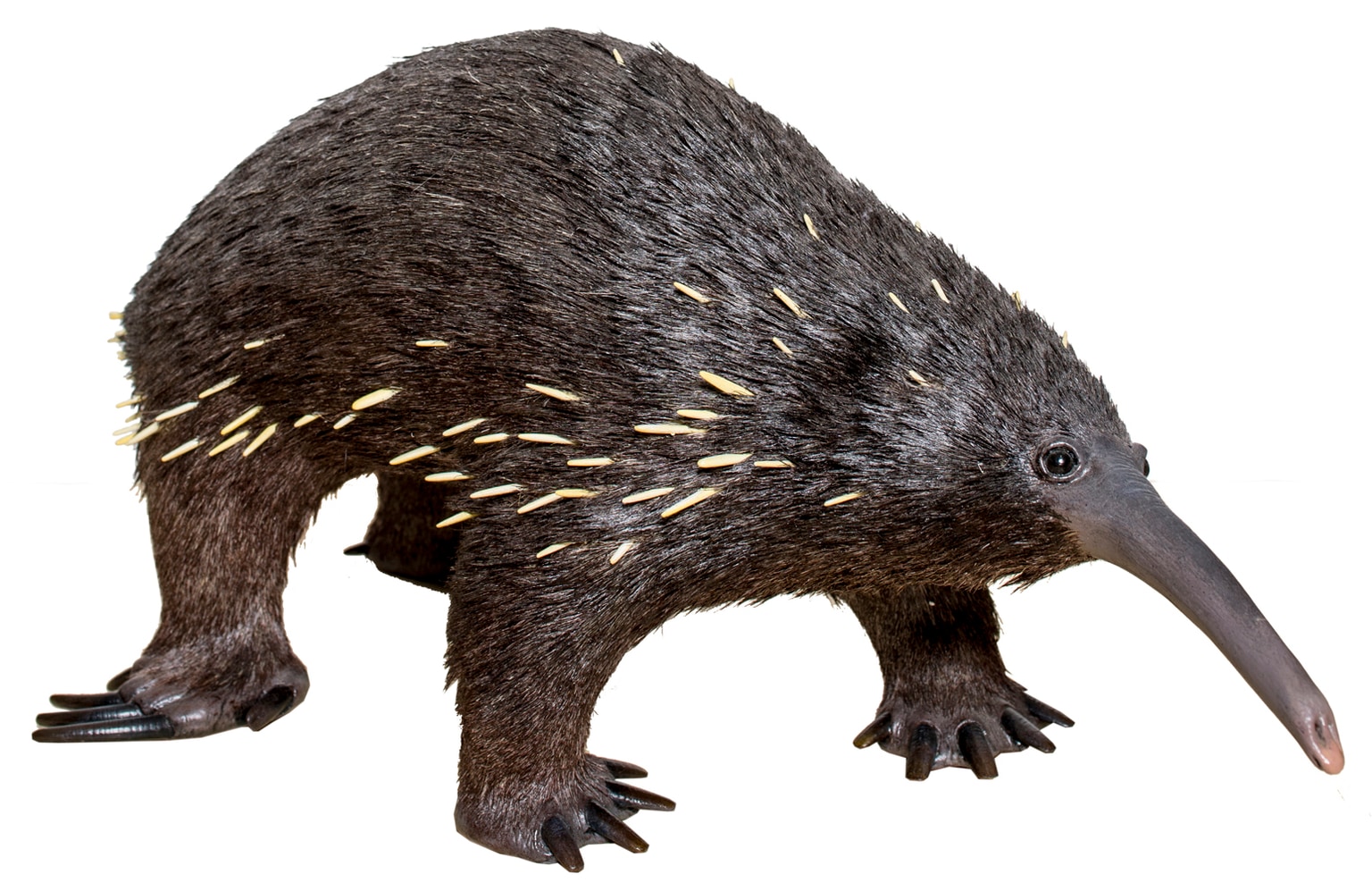
Tropical Hill Forests, Sub-Alpine Forests, Upland Grasslands, Scrub
- Five Claws On Forefeet, Four Claws On Hind Feet
- Dense Black Fur
- No Tail
- Spurs On Hind Legs
- Long Snout
Rolls Into A Spiny Ball For Defense, Digs Burrows For Protection, Mainly Nocturnal
Burrowing
Humans, Feral Dogs
About Eastern long-beaked echidna
The eastern long-beaked echidna, scientifically known as Zaglossus bartoni and sometimes referred to as Barton's long-beaked echidna, is a unique mammal found primarily in the eastern regions of New Guinea. This species is notable for its characteristic long snout and its classification within the order Monotremata, which includes only the echidnas and the platypus.
Description and Physical Traits
Distinguishing features of the eastern long-beaked echidna include having five claws on its forefeet and four on its hind feet. It possesses dense black fur and lacks a tail. Adults typically range in weight from 5 to 10 kilograms and have a body length of 60 to 100 centimeters. Like other echidnas, it has spurs on its hind legs; these are generally retained by males throughout life, while females often lose them as they mature. The echidna's spiny body serves as a defense mechanism, and it can roll into a ball when threatened. Its long snout is a crucial adaptation for foraging.
Ecology and Habitat
The eastern long-beaked echidna is an insectivore, with its diet consisting mainly of insect larvae, ticks, and earthworms. Its specialized snout and tongue are adapted for extracting these food sources from the soil and other substrates. The species inhabits a variety of environments, from tropical hill forests to sub-alpine forests, and also occupies upland grasslands and scrub. They are found at high elevations, with records indicating their presence up to around 4,150 meters.
Behavior and Reproduction
Eastern long-beaked echidnas are primarily nocturnal animals, meaning they are most active during the night. They dig burrows, which provide them with protection from predators and environmental conditions. Although they are mammals, they share the reproductive characteristic of laying eggs with reptiles and birds, a hallmark of monotremes. They also possess mammary glands to nourish their young, though specific details about their breeding behaviors are not extensively documented due to the challenges in studying these elusive animals.
Conservation Status
Once listed as critically endangered, the conservation status of the eastern long-beaked echidna has improved to vulnerable. Major threats to its population include deforestation, which reduces its natural habitat, and hunting by local human populations. Efforts are underway to understand and mitigate these pressures to ensure the survival of the species.
Source: Wikipedia ↗
Frequently Asked Questions
What are the unique physical characteristics of the eastern long-beaked echidna?
The eastern long-beaked echidna can be identified by its five claws on its forefeet and four on its hind feet. It has dense black fur, a body length of 60 to 100 centimeters, and weighs between 5 to 10 kilograms. It lacks a tail and can roll into a spiny ball for defense.
What is the diet of the eastern long-beaked echidna?
Eastern long-beaked echidnas are primarily insectivores. Their long snout is crucial for scavenging for insects such as larvae and ticks in hard-to-reach places. Earthworms are also a significant part of their diet, which they snatch up with their specialized tongues.
What is the habitat of the eastern long-beaked echidna?
The eastern long-beaked echidna inhabits a range of environments from tropical hill forests to sub-alpine forests, as well as upland grasslands and scrub. They have been found at elevations up to approximately 4,150 meters, utilizing the highest available areas in New Guinea.
What is the conservation status of the eastern long-beaked echidna?
The eastern long-beaked echidna is currently listed as 'vulnerable' on the IUCN Red List. This status improved from 'critically endangered' in 2016. The main factors contributing to its population decline include deforestation and hunting by humans.
How do eastern long-beaked echidnas reproduce?
As monotremes, eastern long-beaked echidnas lay eggs instead of giving birth to live young. They share a single opening called a cloaca for urine, feces, sperm transmission, and egg-laying, similar to reptiles and birds. Little is known about their specific breeding behaviors due to the difficulty in tracking.