
Aganisia
Aganisia is a small genus of orchids native to South America, characterized by their dwarf, epiphytic climbing habit. These orchids are found in mountainous or savanna forests and along rivers, producing small flowers that typically range from rose-tinted violet to blue-tinted violet. The genus name is derived from the Greek word for gratitude, possibly referencing the sweet scent of its blooms.
Key Facts
- ›Aganisia is a genus of epiphytic climbing orchids found in South America.
- ›The flowers of Aganisia orchids generally reach up to 4 cm in width.
- ›Flower colors vary, typically ranging from rose-tinted violet to blue-tinted violet.
- ›These orchids are characterized by pseudobulbs and small flowers produced from a creeping rhizome.
- ›They are found in diverse habitats including mountainous forests, savanna forests, and alongside rivers.
- ›The genus name is inspired by the Greek word for gratitude.

Epiphytic, Climbing
Rose-Tinted Violet, Blue-Tinted Violet
About Aganisia
Aganisia is a small genus of orchids belonging to the Orchidaceae family, specifically within the subfamily Epidendroideae. These orchids are native to South America and are characterized by their epiphytic climbing habit, often found in mountainous or savanna forests and along riverbanks.
Characteristics
The plants in the Aganisia genus are described as dwarf and produce pseudobulbs. They grow from a creeping rhizome, from which small flowers emerge. These flowers typically reach a width of up to 4 centimeters and exhibit a color range from rose-tinted violet to blue-tinted violet. The genus name, Aganisia, is derived from the Greek word ‘agnos,’ meaning gratitude, a name that may have been chosen due to the sweet scent of its flowers.
Distribution and Habitat
Aganisia orchids are distributed across a wide area in South America, including countries such as Brazil, Colombia, Venezuela, Guyana, French Guiana, Suriname, and Peru, as well as the island of Trinidad. They thrive in humid environments, often found in forests and near water sources.
Cultivation
Information suggests that Aganisia orchids are rarely cultivated, indicating that they may not be commonly grown by orchid enthusiasts or may present specific cultivation challenges.
Recognized Species
As of May 2014, four species were recognized within the Aganisia genus:
- Aganisia cyanea (Lindl.) Rchb.f. - Known as the Blue orchid, found in Venezuela, Colombia, Peru, and Brazil.
- Aganisia fimbriata Rchb.f. - Native to Brazil, Venezuela, Colombia, Peru, Guyana, and Suriname.
- Aganisia pulchella Lindl. - Found in Trinidad, French Guiana, Suriname, Guyana, Venezuela, and Brazil.
- Aganisia rosariana (V.P.Castro & J.B.F.Silva) F.Barros & L.R.S.Guim. - This species is reported from Brazil, specifically Rondônia.
Intergeneric Hybrids
Aganisia is also involved in several intergeneric hybrids, often with genera like Batemannia, Otostylis, Zygopetalum, Pabstia, and Promenaea, leading to hybrid names such as xOtonisia and xZygonisia.
Source: Wikipedia ↗
Frequently Asked Questions
What are the natural habitats of Aganisia orchids?
Aganisia orchids are found in mountainous or savanna forests, as well as along rivers. Their natural distribution spans across several South American countries and Trinidad.
What is the typical size and color of Aganisia flowers?
The flowers of Aganisia orchids generally reach about 4 cm in width. Their color can vary, commonly appearing as rose-tinted violet or blue-tinted violet.
What does the name Aganisia mean?
The genus name Aganisia is derived from the Greek word 'agnos,' which means gratitude. This naming may have been inspired by the sweet scent of the orchid flowers.
Are Aganisia orchids commonly cultivated?
According to available information, Aganisia orchids are rarely cultivated. This suggests they may present challenges for growers or are not as widely appreciated for horticultural purposes.
Which regions are home to Aganisia orchids?
Aganisia orchids are native to a broad region in South America, including Brazil, Colombia, Venezuela, Guyana, French Guiana, Suriname, and Peru, as well as Trinidad.
Related Orchid species
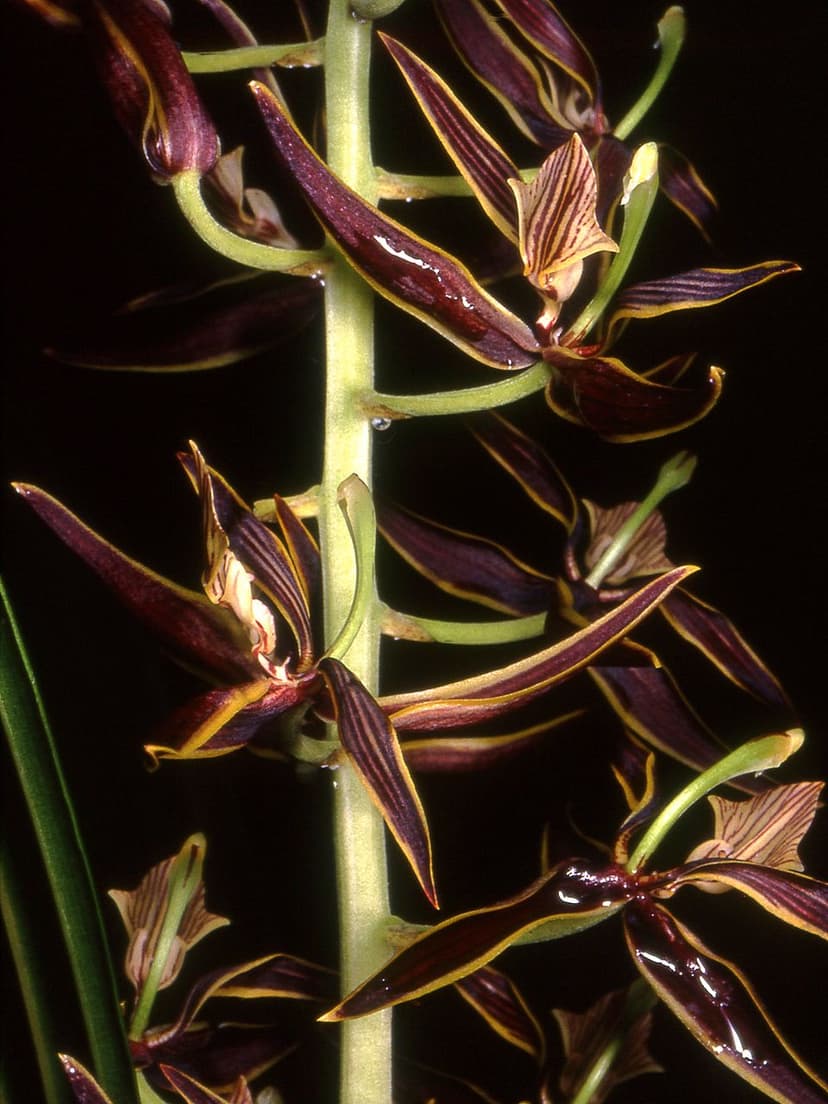
Braemia
Braemia vittata is the sole species within the genus Braemia, belonging to the orchid family. This species is indigenous to a wide range of South American countries, including Colombia, Ecuador, and Brazil. Its distinctiveness lies in being the only representative of its genus, highlighting its unique evolutionary path within the Orchidaceae family.

Cheiradenia
Cheiradenia is a monotypic genus of flowering plants belonging to the orchid family, Orchidaceae. Its sole known species, Cheiradenia cuspidata, is native to the northern regions of South America, including Venezuela, Guyana, Suriname, French Guiana, and northern Brazil. The genus is distinguished by its singular species, which is geographically confined to this specific area of the continent.

Gongora
Gongora is a genus of orchids belonging to the family Orchidaceae, comprising around 65 species primarily found in Central America and tropical South America, with a significant concentration in Colombia. These epiphytic plants are distinguished by their pendulous inflorescences bearing numerous flowers that hang upside down, often with distinctive fragrances and waxy blooms. The genus is named in honor of Antonio Caballero y Gongora, a Spanish viceroy and governor.