
Goodyera
Goodyera
Goodyera, commonly known as rattlesnake plantain or jade orchids, is a widespread genus of orchids found across Europe, North and Central America, Australia, and various islands. These terrestrial orchids are distinguished by their rosette of leaves at the base, often marked with white or pale green, and typically bear numerous small, white, resupinate flowers. They are differentiated from similar genera like Spiranthes by their creeping rhizome, leaf shape and coloration, and the presence of a small pouch on the labellum.
Key Facts
- ›The genus Goodyera comprises approximately 100 described species.
- ›They are primarily terrestrial orchids with a fleshy, creeping rhizome.
- ›Leaves are characteristically asymmetrical, elliptic, and green, often with white or pale green markings.
- ›Flowers are typically small, white, and resupinate.
- ›Goodyera species are found across Europe, Asia, North and Central America, Australia, and islands in the Indian and Pacific Oceans.
- ›They are distinguished from Spiranthes by their rhizomes, leaf patterns, and a pouched labellum.
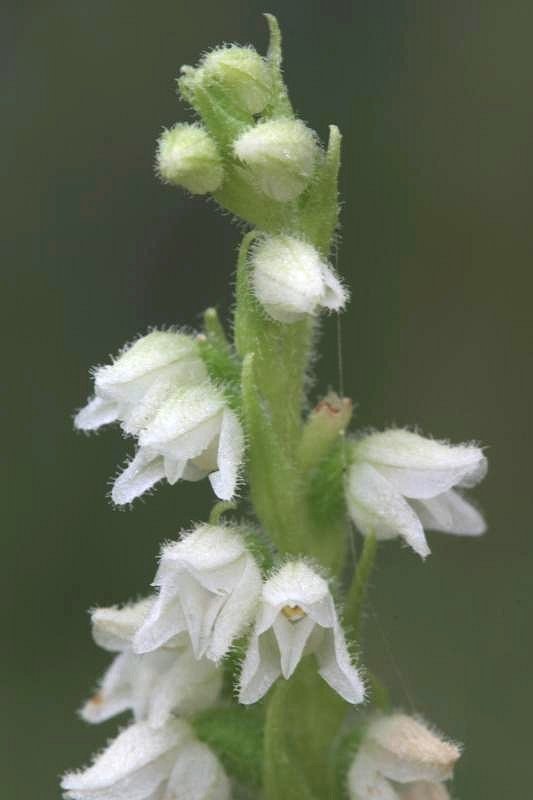
Rattlesnake Plantain, Jade Orchids, Ladies' Tresses
Europe, Madeira, North America, Central America, Australia, West Indian Ocean Islands, Pacific Ocean Islands, East Asia
Terrestrial
About Goodyera
Goodyera, a genus commonly known by names such as rattlesnake plantain, jade orchids, and ladies' tresses, represents a diverse group of orchids within the tribe Cranichideae. Approximately 100 species have been formally described, with a significant concentration of diversity found in East Asia. The genus's reach extends across continents, encompassing regions such as Europe, Madeira, North and Central America, Australia, and a wide array of islands from the west Indian Ocean to the Pacific Ocean.
Description and Characteristics
Plants belonging to the genus Goodyera are predominantly terrestrial. They are characterized by a fleshy, creeping rhizome from which a loose rosette of leaves emerges at the base of the flowering stem. These leaves are typically elliptic in shape, notably asymmetrical, and possess a green coloration often adorned with white or pale green markings. A distinctive feature of the entire plant, excluding the flowers, is the presence of slightly sticky hairs. The inflorescence usually bears numerous small, resupinate flowers. The structure of the flower involves the dorsal sepal and petals overlapping to form a hood over the column, while the lateral sepals spread widely. The labellum is unlobed and features a small pouch.
Taxonomy and Distinguishing Features
The genus Goodyera was first formally described by Robert Brown in 1813. However, its precise generic delimitation remains a subject of discussion among botanists, with some advocating for a more restricted circumscription of the genus. In horticultural contexts, the genus is abbreviated as 'G.'.
Goodyera orchids share similarities with orchids of the genus Spiranthes. Key differences that distinguish them include the presence of rhizomes in Goodyera, which are absent in Spiranthes. Furthermore, Goodyera species typically have leaves with characteristic shape and color patterns, often asymmetrical and marked, whereas Spiranthes species display plain green leaves and lack pouched labella. The labellum of Goodyera also possesses a small pouch, a feature not found in Spiranthes.
Source: Wikipedia ↗
Frequently Asked Questions
What are the common names for orchids in the Goodyera genus?
Orchids in the genus Goodyera are commonly referred to as rattlesnake plantain, jade orchids, or ladies' tresses. These names help distinguish them from other orchid genera.
Where are Goodyera orchids naturally found?
Goodyera orchids have a wide distribution, with a center of diversity in East Asia. They can also be found across Europe, Madeira, North and Central America, Australia, and on islands ranging from the west Indian Ocean to the Pacific Ocean.
What distinguishes Goodyera orchids from Spiranthes orchids?
Goodyera orchids can be distinguished from those in the genus Spiranthes by several key features. Goodyera possess a fleshy, creeping rhizome, while Spiranthes lack them. Additionally, Goodyera leaves are often asymmetrically marked with white or pale green, unlike the plain green leaves of Spiranthes, and the labellum in Goodyera has a small pouch, which is absent in Spiranthes.
What is the typical appearance of a Goodyera orchid plant?
Plants in the genus Goodyera are typically terrestrial, featuring a fleshy, creeping rhizome. They usually have a loose rosette of leaves at the base of a flowering stem. The leaves are elliptic, characteristically asymmetrical, and green with white or pale green markings. The entire plant, except for the flowers, is covered with slightly sticky hairs.
Related Orchid species

Galearis
Galearis is a genus of orchids belonging to the Orchidaceae family, with approximately ten recognized species. These orchids are native to both North America and eastern Asia. The genus is distinguished by its placement within the orchid family, whose name originates from the Greek word for 'testicle' due to the shape of its roots.
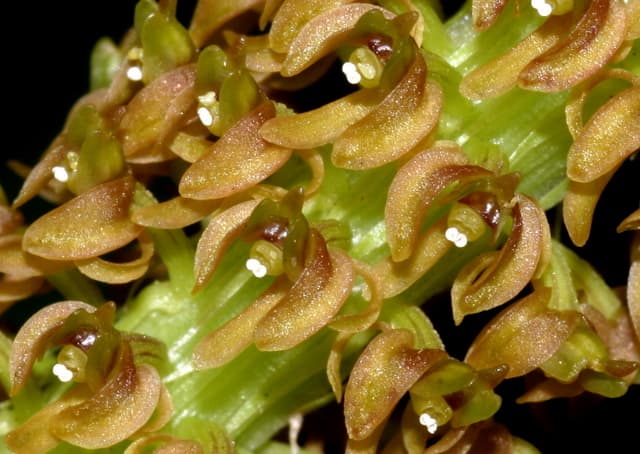
Dienia
Dienia, commonly known as snout orchids, is a genus of six species of evergreen orchids found across Southeast Asia, Australia, Micronesia, and Melanesia. These plants are characterized by their fleshy, above-ground stems, large pleated leaves, and small, non-resupinate flowers with a distinctive short, tongue-like labellum. While primarily terrestrial, some species can grow as epiphytes.

Brachycorythis
Brachycorythis is a genus of flowering plants belonging to the orchid family, Orchidaceae. It comprises approximately 40 to 50 species, predominantly found in Africa and Madagascar, with a smaller presence in South and East Asia. These orchids are characterized by their diverse geographical distribution and their inclusion within the large and varied orchid family.