
Pharaoh eagle-owl
The Pharaoh eagle-owl (Bubo ascalaphus) is a species of owl native to arid regions of North Africa and the Middle East. It is characterized by its mottled plumage, large orange-yellow eyes, and small ear tufts, making it one of the smaller eagle-owl species.
Key Facts
- ›Native to arid Northern Africa and the Middle East.
- ›Distinctive features include mottled tawny plumage and large orange-yellow eyes.
- ›Primarily hunts small mammals like gerbils, but also consumes birds, reptiles, and invertebrates.
- ›Nocturnal hunter, often perching to detect prey before swooping.
- ›Forms lifelong monogamous pair bonds.
- ›Listed as 'Least Concern' by the IUCN due to its large range and abundance.
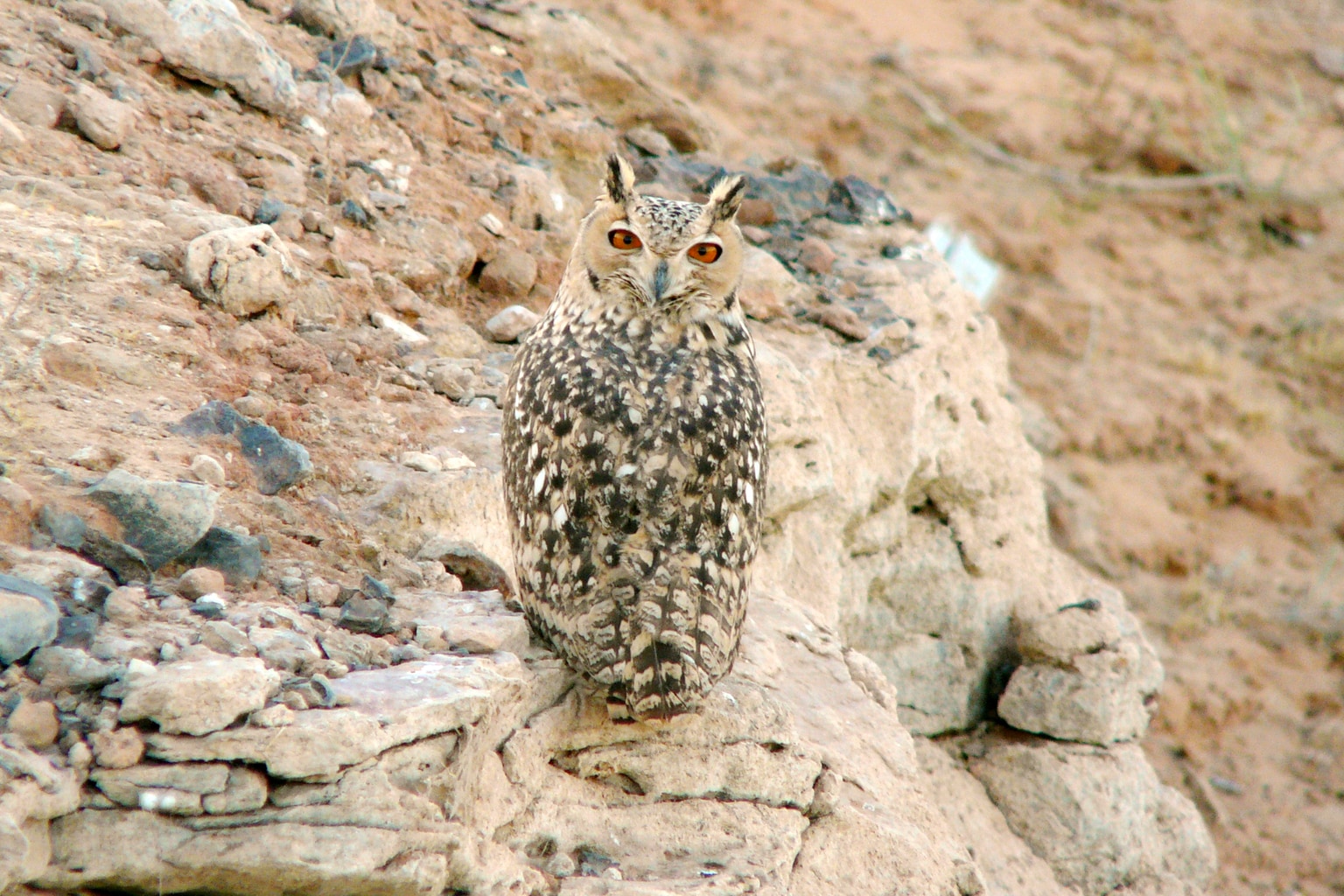
Pharaoh Eagle-Owl
Open, barren plains, Desert with scattered palms or endemic plants, Rocky outcrops, Wadis, Cliffs
North Africa, Middle East, Arabian Peninsula
Rodents, Other Small Mammals, Small Birds, Snakes, Lizards, Beetles, Scorpions, Other Birds of Prey
About Pharaoh eagle-owl
The Pharaoh eagle-owl (Bubo ascalaphus) is a species of owl native to the arid landscapes of North Africa and the Middle East. It is a medium-sized owl, distinguished by its mottled tawny plumage, large, striking orange-yellow eyes, and prominent ear tufts.
Distribution and Habitat
This owl thrives in harsh, open environments. Its natural range encompasses much of arid Northern Africa, from the desolate parts of the Saharan Desert eastward into the Arabian Peninsula and the Middle East. Preferred habitats include barren plains, deserts with sparse vegetation like palms, and rocky areas such as outcrops, wadis, and cliffs, where it finds suitable nesting sites.
Behavior and Ecology
The Pharaoh eagle-owl is a strictly nocturnal hunter, emerging at dusk to survey an area of approximately 5 square kilometers for prey. It employs a strategy of perching on elevated spots to listen and watch for moving quarry before descending swiftly to capture its meal. Its diet is varied, consisting mainly of small mammals like gerbils, but also including bats, desert foxes, hares, small birds, snakes, lizards, beetles, and scorpions. Notably, they are known to occasionally prey on smaller owls and kestrels.
Reproduction
These owls are monogamous and are known to form lifelong pair bonds. The breeding season typically occurs in late winter. Nests are simple scrapes located in rock crevices or among boulders. The female lays two eggs, which she incubates for around 31 days. Both parents actively participate in feeding the chicks, which fledge at approximately 20 to 35 days old but remain dependent on their parents for several more months.
Conservation Status
The Pharaoh eagle-owl is currently listed as 'Least Concern' on the IUCN Red List. This status reflects its very large geographic range and its reported abundance across significant portions of its habitat. The species does not appear to face any immediate, widespread threats that would jeopardize its population.
Source: Wikipedia ↗
Frequently Asked Questions
What is the scientific name of the Pharaoh eagle-owl?
The scientific name of the Pharaoh eagle-owl is Bubo ascalaphus. This binomial nomenclature is used to classify the species within the scientific community.
Where can the Pharaoh eagle-owl be found?
The Pharaoh eagle-owl is native to arid Northern Africa, including countries like Algeria, Egypt, and Morocco, and extends into the Middle East and Arabian Peninsula, found in places like Iran and Saudi Arabia.
What does the Pharaoh eagle-owl eat?
Its diet primarily consists of rodents, especially gerbils, but it will also prey on other small mammals, small birds, snakes, lizards, beetles, and scorpions. They have even been known to hunt other birds of prey.
What are the nesting habits of the Pharaoh eagle-owl?
The Pharaoh eagle-owl nests in scrapes among rocks or in crevices. Breeding typically occurs in late winter, with the female incubating the two eggs for about 31 days.
What is the conservation status of the Pharaoh eagle-owl?
The Pharaoh eagle-owl is listed as 'Least Concern' on the IUCN Red List. This is due to its very large geographic range and its reported abundance in significant parts of that range, with no particular immediate threats identified.
Related Owl species

Andaman scops owl
The Andaman scops owl is a small owl species native to the Andaman Islands of India, characterized by its predominantly brown plumage with white speckles and striking yellow eyes. First described in 1873, this nocturnal hunter inhabits semi-open areas and is known for its distinctive pulsating hoot. Despite some population decline due to deforestation, it is currently listed as 'Least Concern' by the IUCN.

Bare-shanked screech owl
The bare-shanked screech owl is a large owl found in the mountain forests of Costa Rica, Panama, and northwestern Colombia. It is distinguished by its bare lower legs and yellowish-pink toes. This species primarily hunts at night for large insects, shrews, and small rodents.

Buffy fish owl
The buffy fish owl (Ketupa ketupu), also known as the Malay fish owl, is a species of fish owl native to Southeast Asia. It is distinguished by its prominent ear tufts, powerful talons adapted for fishing, and a distinctive morose facial expression due to its bill placement. Primarily inhabiting tropical forests and wetlands, it is a nocturnal predator with a varied diet.