
Tasmanian boobook
The Tasmanian boobook (Ninox leucopsis) is a species of owl native to Tasmania and surrounding islands. Previously considered the same species as the morepork, it has been recognized as distinct since 2022 due to genetic and morphological evidence. This carnivorous owl primarily inhabits eucalypt forests and is known for being a nest predator.
Key Facts
- ›Native to Tasmania, King Island, and other Bass Strait islands.
- ›Distinct species from the morepork, confirmed by phylogenetic studies in 2022.
- ›Predominantly found in eucalypt forests.
- ›Carnivorous diet, including a known tendency to prey on nests.
- ›Sexually dimorphic, with males being smaller than females.

Tasmanian Spotted Owl
Eucalypt Forests
Tasmania, King Island, Bass Strait Islands, Southern Victoria, New South Wales, Lord Howe Island
Carnivorous, Nest Predator
About Tasmanian boobook
The Tasmanian boobook, scientifically known as Ninox leucopsis, is an owl species native to the island of Tasmania and its surrounding islands, including King Island and other islands within the Bass Strait. This species was formerly considered to be conspecific with the morepork (Ninox novaeseelandiae), but phylogenetic studies analyzing genetic and morphological characteristics have affirmed its status as a distinct species, a reclassification officially recognized in 2022.
Habitat and Distribution
The Tasmanian boobook is widespread across Tasmania and its associated islands. While its primary range is these islands, it has also been recorded in southern Victoria, with isolated sightings in New South Wales and on Lord Howe Island. The species predominantly inhabits eucalypt forests, which form its natural environment.
Diet and Behavior
This owl is carnivorous and has been identified as a nest predator. The Tasmanian boobook exhibits sexual dimorphism, meaning males and females differ in size, with males typically being smaller than females. Further details regarding its specific hunting techniques, vocalizations, or daily activity patterns are not extensively documented in the available information.
Source: Wikipedia ↗
Frequently Asked Questions
What is the scientific name of the Tasmanian boobook?
The scientific name of the Tasmanian boobook is Ninox leucopsis.
Where is the Tasmanian boobook native to?
The Tasmanian boobook is native to Tasmania, King Island, and other islands in the Bass Strait. It has also been recorded in parts of southern Victoria and historically in New South Wales and Lord Howe Island.
How is the Tasmanian boobook different from the morepork?
Phylogenetic studies analyzing genetic and morphological characteristics have confirmed that the Tasmanian boobook is a distinct species from the morepork (Ninox novaeseelandiae), a status officially recognized in 2022.
What is the habitat of the Tasmanian boobook?
The Tasmanian boobook predominantly occurs in eucalypt forests. It is widespread across its native islands.
What does the Tasmanian boobook eat?
The Tasmanian boobook is carnivorous. It is also noted as a nest predator.
Are male and female Tasmanian boobooks different in size?
Yes, the Tasmanian boobook is sexually dimorphic. Males are typically smaller than females.
Related Owl species
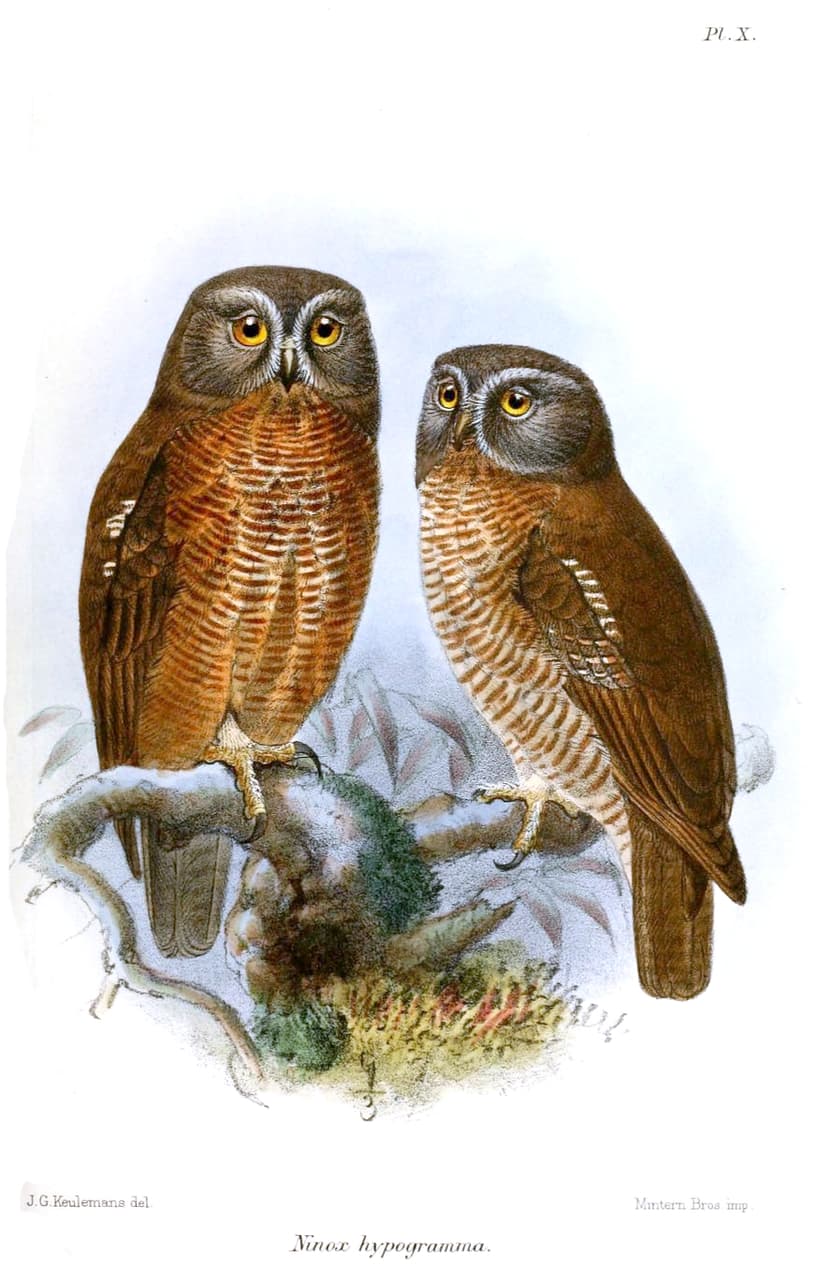
Halmahera boobook
The Halmahera boobook is a species of owl native to the Indonesian islands of Halmahera, Ternate, and Bacan. Its primary habitat is subtropical or tropical moist lowland forests. This owl was formerly recognized as a subspecies of the Moluccan boobook but is now considered a distinct species.
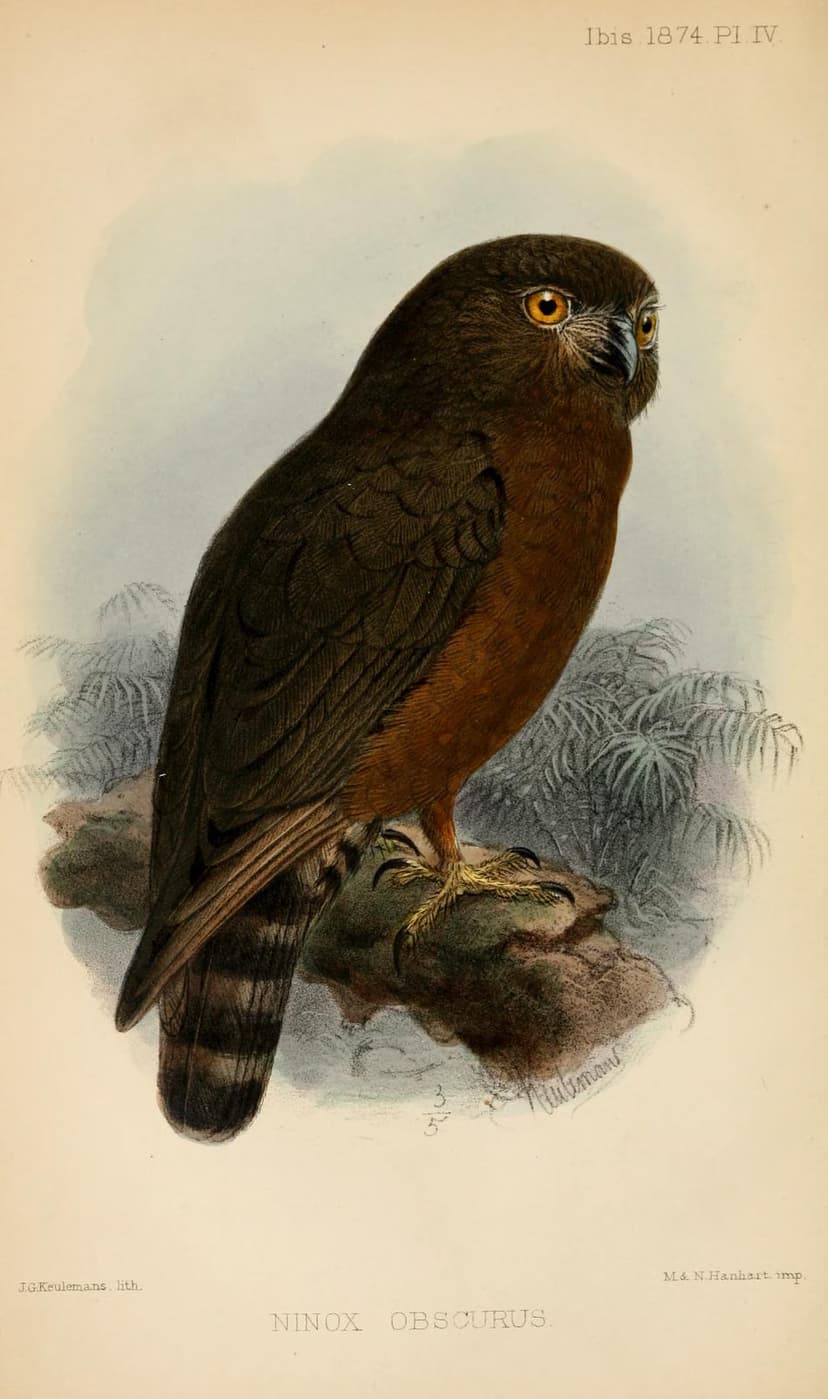
Hume's boobook
Hume's boobook (Ninox obscura) is a species of owl native to the Andaman Islands. This owl inhabits subtropical or tropical moist lowland forests and mangrove forests. It is currently considered a rare species due to ongoing habitat loss.
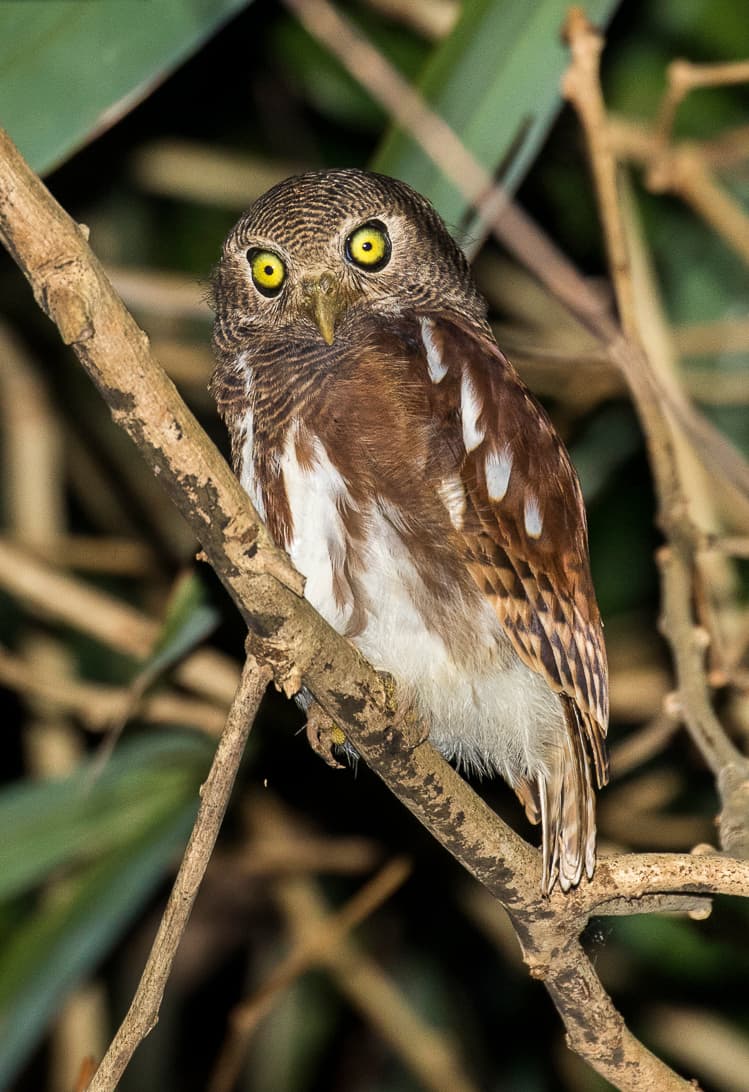
Javan owlet
The Javan owlet is a species of owl native to the Indonesian islands of Java and Bali. It inhabits subtropical or tropical moist lowland forests. This small owl belongs to the family Strigidae.