
Green parakeet
The green parakeet is a New World parrot native to Mexico and southern Texas, distinguished by its predominantly green plumage with yellow underparts and red speckles on its cheeks and throat. This species, also known as the green conure or Mexican green conure, inhabits semi-open landscapes and is recognized for its varied vocalizations, ranging from sharp squeaks to loud, harsh calls.
Key Facts
- ›Native to Mexico and southern Texas (Rio Grande Valley).
- ›Length ranges from 28 to 30.5 cm (11 to 12 in) with a weight of approximately 230 g (8.1 oz).
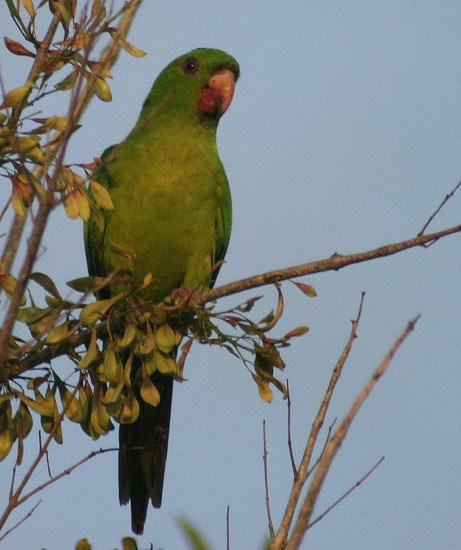
- ›Adults are generally green, paler and yellower on their underparts, with variable red speckles on cheeks and throat.
- ›Inhabits semi-open landscapes such as deciduous woodland, gallery forest, and scrublands.
- ›Diet includes seeds and fruits, and it can be a crop pest.
- ›Vocalizations include sharp squeaky notes, loud harsh calls, and shrill noisy chattering.
Green Conure, Mexican Green Conure
Mexico, North America
Deciduous Woodland, Gallery Forest, Scrublands, Cities and Towns
- Red speckles on cheeks and throat
- Orange-red iris surrounded by bare pale beige skin
Seeds, Fruits
Sharp Squeaky Notes, Loud Harsh Calls, Shrill Noisy Chattering, Rolling, Harsh, and High-Pitched Screek
Tree Cavities, Caves, Cliff Faces
About Green parakeet
The green parakeet, scientifically known as Psittacara holochlorus, is a vibrant New World parrot native to the diverse landscapes of Mexico and extending into the Rio Grande Valley of southern Texas. This species, also referred to as the green conure or Mexican green conure, is characterized by its predominantly green plumage, which often becomes paler and yellower on its underparts. Distinctive markings include variable amounts of red speckles on its cheeks and throat, and an orange-red iris surrounded by pale beige skin.
Distribution and Habitat
The green parakeet primarily inhabits semi-open environments. Its preferred habitats include deciduous woodlands, gallery forests along rivers, and scrublands. While generally found at elevations between 500 and 2,000 meters in its native Mexico, the established population in Texas has also been observed in urban settings like cities and towns. The species is non-migratory but will undertake local movements in search of food resources.
Diet and Behavior
The diet of the green parakeet consists mainly of seeds and fruits. Due to their feeding habits, they can sometimes be considered agricultural pests. Their vocalizations are varied and can include sharp squeaky notes, loud harsh calls, and shrill noisy chattering, with their flight call being a distinctive rolling, harsh, and high-pitched screek.
Reproduction
While the precise breeding season is not fully defined, it appears to encompass at least the months of January through April. Green parakeets typically nest in tree cavities, caves, or on cliff faces. A clutch usually consists of four eggs, with an estimated incubation period of about 23 days. Details regarding parental care and the time to fledging are not extensively documented.
Conservation
According to the International Union for Conservation of Nature (IUCN), the green parakeet is listed as Least Concern, with an estimated population of around 200,000 mature individuals, though this population is noted to be decreasing. No immediate threats have been identified for the Mexican population. However, in Texas, the species is considered Vulnerable due to pressures from hunting.
Source: Wikipedia ↗
Frequently Asked Questions
What is the scientific name of the green parakeet?
The scientific name of the green parakeet is Psittacara holochlorus. It was formerly placed in the genus Aratinga but was moved to the genus Psittacara.
Where does the green parakeet live?
The green parakeet is native to Mexico and has a population established in the lower Rio Grande Valley of Texas. Its natural range includes eastern Mexico from Nuevo León and Tamaulipas south to Veracruz, and northwestern Mexico in Sonora, Sinaloa, and Chihuahua.
What does the green parakeet look like?
Adult green parakeets are primarily green, with their undersides being paler and yellower. They often have variable amounts of red speckles on their cheeks and throat, and their underwing coverts are yellowish green. Their irises are orange-red, and their bills are horn-colored.
What is the habitat of the green parakeet?
In its native range, the green parakeet prefers semi-open landscapes, including deciduous woodland, gallery forest, and scrublands. It is typically found at elevations between 500 and 2,000 meters and shuns humid lowland forests.
What is the diet of the green parakeet?
The diet of the green parakeet is known to include seeds and fruits. They can sometimes be considered a crop pest due to their feeding habits.
What are the vocalizations of the green parakeet?
Green parakeets have a varied range of vocalizations, which include sharp squeaky notes, loud harsh calls, and shrill noisy chattering. Their flight call is described as a rolling, harsh, and high-pitched screek.
What is the conservation status of the green parakeet?
The IUCN considers the green parakeet to be of Least Concern, with an estimated population of about 200,000 mature individuals that is decreasing. However, NatureServe lists the species as Vulnerable in Texas due to hunting pressure.
Related Parrot species

Alexandrine parakeet
The Alexandrine parakeet is a large, predominantly green parrot native to South and Southeast Asia, distinguished by its prominent red shoulder patch and massive red beak with yellow tips. Named in honor of Alexander the Great, who introduced these birds to Europe, they are known for their intelligence, vocal abilities, and long lifespan, making them popular in aviculture. Despite their established presence in some areas, they face conservation challenges due to habitat loss and illegal trade.

Australian king parrot
The Australian king parrot is a striking parrot species native to the humid, forested eastern regions of Australia. It is distinguished by the vibrant red plumage of the adult male, contrasting with the predominantly green female. These parrots are known for their relatively quiet nature and devotion to their human companions when kept as pets.

Bismarck hanging parrot
The Bismarck hanging parrot (Loriculus tener) is a small parrot species endemic to the forests of the Bismarck Archipelago in Papua New Guinea. It is distinguished by its predominantly green plumage, a bright red throat patch, and a black beak. This species faces threats from habitat loss and is sometimes considered a subspecies of the orange-fronted hanging parrot.