
Monk parakeet
Myiopsitta monachus·Psittacidae·29·100
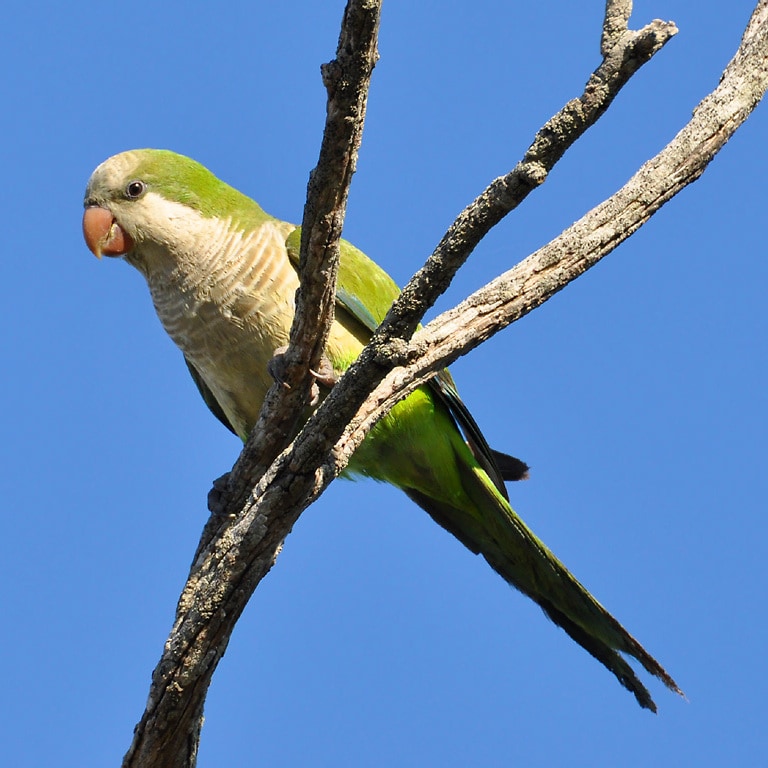
The monk parakeet, also known as the Quaker parrot, is a small to medium-sized, bright-green parrot native to South America. It is distinguished by its greyish breast, greenish-yellow abdomen, and its unique ability among parrots (shared only with the closely related cliff parakeet) to build large external nests rather than relying on tree cavities. These highly social and intelligent birds are also known for their vocalizations and their adaptability, leading to widespread feral populations globally.
Key Facts
- ›Native to temperate to subtropical regions of South America, including Argentina, Brazil, and Uruguay.
- ›Distinctive for building large, communal external nests in trees or man-made structures.
- ›Known for its intelligence and social behavior, often developing large vocabularies as pets.
- ›Possesses a lifespan of approximately 15 years in the wild and can live 10-20 years in captivity.
- ›Feral populations are found worldwide, capable of surviving in colder climates due to their nesting habits.
- ›Considered an agricultural pest in its native range and in many introduced areas.
Monk Parrot, Quaker Parrot
South America
Temperate To Subtropical Areas, Urban Areas, Farms, Palm Groves, Areas With Eucalyptus Forestry
Bright Green, Greyish Breast, Greenish-Yellow Abdomen, Dark Blue Remiges, Orange Bill
Build Large, External Communal Nests, Greyish Breast, Greenish-Yellow Abdomen
Crops
Highly Intelligent, Social, Gregarious
- Loud and Throaty Chape
- Quak Quaki Quak-Wi Quarr
- Screeches Skveet
- Develop Individual Voice Prints
- Develop Vocal Dialects That Differ Between Groups
- Build large, external nests in trees or manmade structures
- Build single large nests with separate entrances for each pair in colonies
- Nests can reach the size of a small automobile
About Monk parakeet
The monk parakeet, scientifically known as Myiopsitta monachus and also called the monk parrot or Quaker parrot, is a small to medium-sized parrot species native to South America. It is easily recognizable by its bright green upperparts, greyish breast with darker scalloping, and a greenish-yellow abdomen. A particularly distinctive characteristic of the monk parakeet, shared only with the closely related cliff parakeet, is its unique nesting behavior: they construct large, external nests in trees or on man-made structures, rather than utilizing tree cavities.
Native Range and Habitat
Monk parakeets originate from the temperate to subtropical regions of South America, commonly found in countries such as Argentina, Brazil, and Uruguay. They inhabit a variety of environments, with feral populations also establishing themselves in urban areas, farms, and palm groves. Their adaptability, particularly their ability to survive in colder climates, has led to the establishment of self-sustaining feral populations in numerous locations worldwide, including North America and Europe.
Behavior and Ecology
These birds are highly gregarious and social, often breeding colonially. They build substantial communal nests that can house multiple pairs, each with its own entrance, and these structures can grow to be quite large. Monk parakeets are also known for their intelligence and vocal abilities; they can develop extensive vocabularies when kept as pets and exhibit distinct vocal dialects within different feral groups. They are considered agricultural pests in their native range and in many introduced regions due to their impact on crops.
Captivity and Conservation
As pets, monk parakeets are prized for their intelligence and social nature, often forming strong bonds with their owners. However, due to their status as an agricultural pest and invasive species in some areas, their ownership and sale are restricted or outlawed in certain regions. Their average lifespan in the wild is around 6 years, but in captivity, they can live for 10 to 20 years.
Source: Wikipedia ↗
Frequently Asked Questions
What is a monk parakeet?
The monk parakeet is a species of true parrot native to South America, characterized by its bright green plumage, greyish breast, and yellow abdomen. They are known for their intelligence, social nature, and unique nest-building behavior.
Where do monk parakeets come from?
Monk parakeets originate from the temperate to subtropical areas of South America, commonly found in countries like Argentina, Brazil, and Uruguay. They are considered a common species within their native range.
What makes monk parakeets unique?
Unlike most parrot species that nest in tree cavities, monk parakeets build large, external nests, often in trees or on man-made structures. They are also highly social and intelligent, capable of forming large colonies and developing complex vocalizations.
What is the lifespan of a monk parakeet?
In their natural environment, monk parakeets have an average lifespan of about 6 years. However, when kept in captivity, they can live significantly longer, typically ranging from 10 to 20 years.
Are monk parakeets social?
Yes, monk parakeets are highly gregarious species. They often breed colonially, constructing large, communal nests with individual entrances for each pair, and can be found living in large social groups.
Why are monk parakeets considered pests?
In both their native South America and in many areas where they have become established, monk parakeets are considered destructive agricultural pests. They can cause significant damage to crops, and their nests on electrical equipment can pose fire risks.
Can monk parakeets survive in cold climates?
Yes, monk parakeets are one of the few parrot species capable of surviving in temperate zones and cold climates. This adaptability is partly due to their nest-building habits, which can provide insulation and shelter, sometimes even utilizing warm electrical equipment.
Related Parrot species

Red-crowned parakeet
The red-crowned parakeet (Cyanoramphus novaezelandiae), also known as the red-fronted parakeet, is a small parrot native to New Zealand. It is distinguished by its bright green plumage and a distinctive red marking on its head, along with red patches on its rump. This adaptable species can be found in various habitats and has a diverse diet, though its population has been significantly impacted by invasive predators.

Alexandrine parakeet
The Alexandrine parakeet is a large, predominantly green parrot native to South and Southeast Asia, distinguished by its prominent red shoulder patch and massive red beak with yellow tips. Named in honor of Alexander the Great, who introduced these birds to Europe, they are known for their intelligence, vocal abilities, and long lifespan, making them popular in aviculture. Despite their established presence in some areas, they face conservation challenges due to habitat loss and illegal trade.

Australian king parrot
The Australian king parrot is a striking parrot species native to the humid, forested eastern regions of Australia. It is distinguished by the vibrant red plumage of the adult male, contrasting with the predominantly green female. These parrots are known for their relatively quiet nature and devotion to their human companions when kept as pets.