
Arthrolycosidae
The hunting strategy of Arthrolycosidae is not documented. If they were spiders, strategies could range from web-building to active hunting or ambush predation, depending on their specific morphology.·Extinct
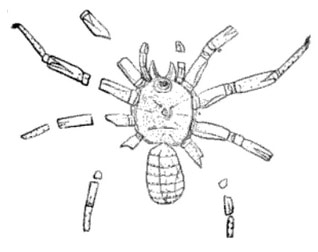
Arthrolycosidae is an extinct family of arachnids, with fossils dating from the Carboniferous to the Permian periods. While some specimens are considered spiders, others possess features that make their classification as such uncertain, particularly the presence of segmented abdomens but a lack of definite spinnerets.
Key Facts
- ›Extinct family of arachnids, possibly spiders.
- ›Fossils date from the Carboniferous to the Permian periods.
- ›Alexander Petrunkevitch considered them "mesotheles", placing them in the spider suborder Mesothelae.
- ›Paul a. Selden noted they have a general spider appearance but lack definite spinnerets.
- ›Includes the genera Arthrolycosa and Eocteniza.
- ›Fossils have been found in the United States, Ukraine, Russia, and England.
United States, Ukraine, Russia, England
Segmented Abdomens, Lack of Definite Spinnerets
About Arthrolycosidae
Arthrolycosidae is an extinct family of arachnids, with its fossil record spanning the Carboniferous to Permian periods. The classification of these ancient creatures as definite spiders remains a subject of scientific discussion. While some paleontologists, like Alexander Petrunkevitch, considered them to belong to the spider suborder Mesothelae, others, such as Paul A. Selden, have noted that while they exhibit a general spider-like appearance with segmented abdomens, they lack clearly defined spinnerets, which are a key characteristic of modern spiders.
Genera and Distribution
The family Arthrolycosidae currently includes two recognized genera: Arthrolycosa and Eocteniza. Fossils of Arthrolycosa have been discovered in the United States (specifically the Mazon Creek fossil beds), Ukraine, and Russia. The genus Eocteniza has been found in England, specifically at Coseley. The presence of these fossils across different continents indicates a wide geographic distribution for this ancient arachnid family during its existence.
Classification Debate
The primary point of contention regarding Arthrolycosidae lies in their definitive placement within the arachnid tree of life. The presence of segmented abdomens suggests a primitive form, but the absence of distinct spinnerets in many specimens complicates their identification as true spiders. This has led to the view that while they may have had the "general appearance of spiders," their internal morphology might have differed significantly, placing them in a transitional or related group rather than directly within modern spider families.
Source: Wikipedia ↗
Frequently Asked Questions
What period did Arthrolycosidae live in?
Arthrolycosidae fossils are found from the Carboniferous to the Permian periods. This spans a significant portion of the late Paleozoic Era, a time of great diversification for terrestrial life.
Are Arthrolycosidae definitively classified as spiders?
The classification of Arthrolycosidae as spiders is debated. While Alexander Petrunkevitch placed them in the spider suborder Mesothelae, Paul A. Selden has pointed out that they possess segmented abdomens but lack definite spinnerets, making their spider identity uncertain for some specimens.
What genera are included in Arthrolycosidae?
As of 2015, the genera placed within the Arthrolycosidae family are Arthrolycosa and Eocteniza. Arthrolycosa is considered by some to be a spider, while Eocteniza is noted as being problematic in its spider classification.
Where have fossils of Arthrolycosidae been found?
Fossils attributed to Arthrolycosidae have been discovered in several locations. These include the United States (specifically Mazon Creek), Ukraine, Russia, and England (Coseley).