
Achill
Ireland
Achill Island is the largest of Ireland's islands, situated off the west coast of County Mayo. It is a historically rich area with evidence of settlement dating back to the Neolithic period, and it played a significant role in various historical events, including the O'Malley clan's maritime influence and the controversial Achill Mission.
Key Facts
- ›Largest of the Irish isles with an area of approximately 148 km2 (57 sq MI).
- ›Connected to the mainland by Michael Davitt Bridge since 1887.
- ›Has a population of 2,345 as of the 2022 census.
- ›Evidence of settlement dates back to the Neolithic period (3rd or 4th millennium BC).
- ›Home to the Deserted Village, a settlement abandoned in the 1850s.
- ›Partially located within the Gaeltacht (traditional Irish-speaking region).
About Achill
Achill Island
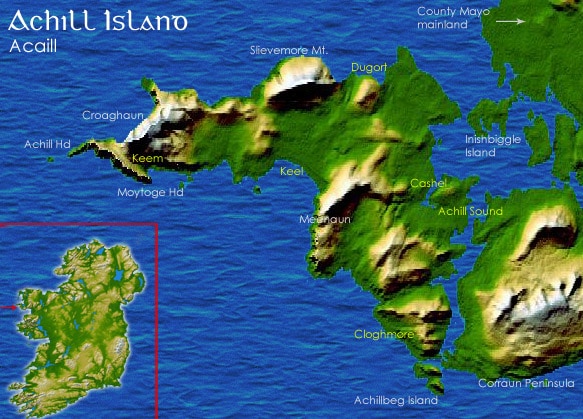
Achill Island, known in Irish as Acaill or Oileán Acla, is the largest of Ireland's offshore islands, located on the west coast in County Mayo. It spans an area of approximately 148 square kilometers (57 square miles) and is connected to the mainland by the Michael Davitt Bridge. The island has a rich history, with evidence of human occupation dating back to at least the Neolithic period.
Prehistory and Early Settlement
Archaeological findings suggest that Achill was inhabited from the Neolithic era, around the 3rd or 4th millennium BC. During this period, the island's climate was warmer and drier, supporting dense woodlands. The remains of megalithic tombs and monuments, such as court cairns and portal tombs, point to early settlement and agricultural practices. Prehistoric field systems and stone foundations beneath the island's peat bogs offer further insights into its ancient landscape. The Iron Age saw an increase in settlement, with the presence of small promontory forts indicating a potentially warlike society.
Early Medieval Period and Medieval Overlordship
The early medieval period, from the 5th century AD, witnessed agricultural expansion, partly due to the introduction of iron implements. Evidence of early medieval artifacts has been found across the island. The arrival of Christianity is marked by sites such as Kildamhnait, named after Saint Damhnait, and an ecclesiastical site at Slievemore possibly founded by Saint Colman. Historically, Achill Island was part of the territory of ancient Umhall, ruled by chieftains such as the O'Malleys, a clan whose presence dates back to at least the 12th century. Carrickkildavnet Castle is associated with this clan, and Grace O'Malley, a renowned sea captain and pirate, was a prominent figure from this lineage.
17th to 19th Centuries: Missionaries, Famine, and Emigration
The 17th century saw the arrival of Ulster families seeking refuge on Achill, contributing to the island's distinct dialects of Irish. By the 18th century, widespread poverty and reliance on the potato were prevalent. The 19th century was marked by the establishment of the Achill Mission (1831–1880s) at Dugort by Rev. Edward Nangle. This Protestant mission included schools, cottages, and agricultural initiatives, and became particularly active during the Great Famine (1845-1849), providing significant relief but also facing controversy over accusations of "souperism." The famine severely impacted the island, although its demographic decline was less severe than the national average. The mission eventually purchased a large portion of the island, becoming its de facto landlord. The latter half of the 19th century also saw the construction of the Michael Davitt Bridge and the extension of the railway to Achill Sound. The Deserted Village, a settlement of approximately 80-100 ruined stone houses, was abandoned in the 1850s, with many inhabitants relocating to coastal villages or emigrating.
20th Century and Modern Achill
Throughout the 19th and 20th centuries, seasonal migration for agricultural work, particularly to Scotland for potato harvesting, was common. The 20th century also saw tragedies such as the Kirkintilloch fire of 1937, where ten young migrant workers from Achill died. The island continues to be a significant cultural and historical site, with its landscape and past settlements drawing interest from historians and visitors alike.
Source: Wikipedia ↗
Frequently Asked Questions
When was Achill Island first settled?
Archaeological evidence indicates that Achill Island was occupied from at least the Neolithic period, with settlement believed to have begun around the 3rd or 4th millennium BC. During this time, the island's climate was warmer and drier, supporting dense woodland.
What is the significance of the Deserted Village on Achill Island?
The Deserted Village, located near Dugort at the base of Slievemore, comprises ruined stone houses from a settlement established no earlier than around 1750. It was abandoned during the 1850s, a process accelerated by the Great Famine, poor harvests, and rising rents.
What was the Achill Mission?
The Achill Mission, also known as "the Colony," was founded in 1831 by Anglican minister Rev. Edward Nangle at Dugort. It included schools, cottages, an orphanage, and an infirmary, aiming to establish a Protestant presence and provide education and aid, particularly during the Great Famine.
Who was Grace O'Malley and what is her connection to Achill Island?
Grace O'Malley, known as Granuaile, was a famous chieftain of the O'Malley clan who controlled the waters of the western seaboard. Carrickkildavnet Castle on Achill Island is associated with the O'Malley clan, who were once a ruling family there.
What historical events have impacted Achill Island?
Achill Island has experienced significant historical events, including the Great Famine, the controversial Achill Mission, the Clew Bay Drowning of 1894, and the Kirkintilloch fire of 1937, which tragically claimed the lives of ten migrant potato pickers from the island.