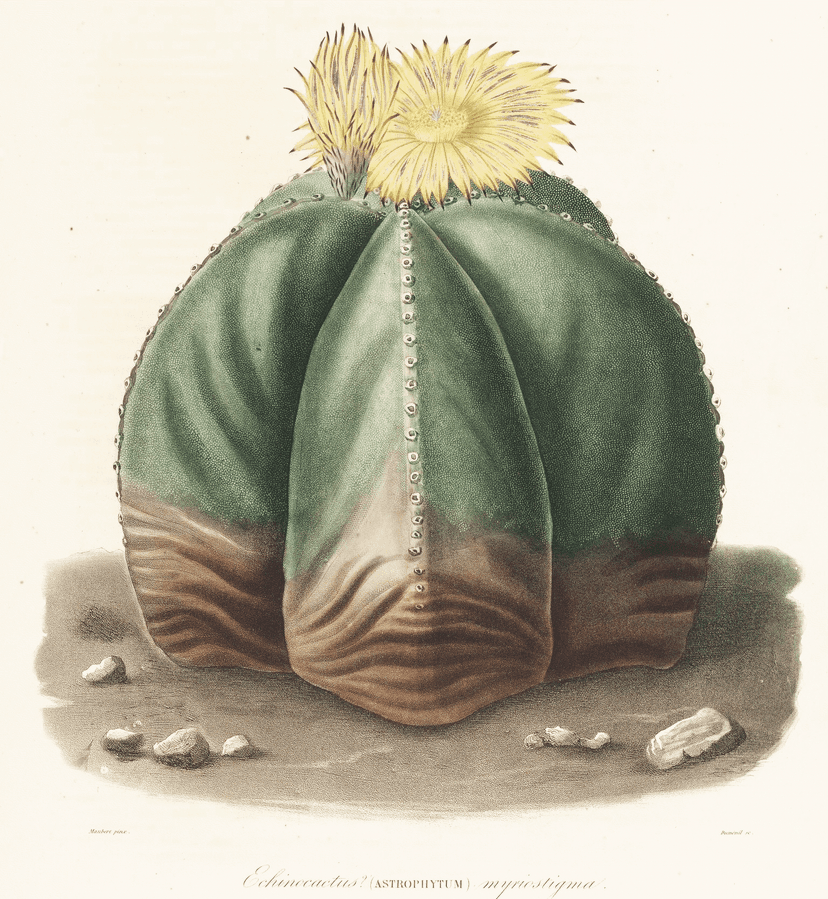
Astrophytum asterias
Astrophytum·Globular·April to June
Astrophytum asterias, commonly known as the sand dollar cactus or star cactus, is a small, spineless cactus native to limited regions of Texas in the United States and Mexico. It is distinctive for its flattened, disc-like body divided into ribs and covered in white scales, and its bright yellow flowers with red bases.
Key Facts
- ›Native to Texas (USA) and Mexico (Nuevo León, Tamaulipas).
- ›Small, round, spineless, and squat, reaching up to 15 CM in diameter.
- ›Features a greenish-brown body with white scales (trichomes) and 7-10 ribs.
- ›Produces yellow flowers with red bases from March to June.
- ›Fruit is green to pink, oval, and woolly-husked.
- ›Listed as endangered by the us Fish and Wildlife Service and vulnerable by the IUCN.
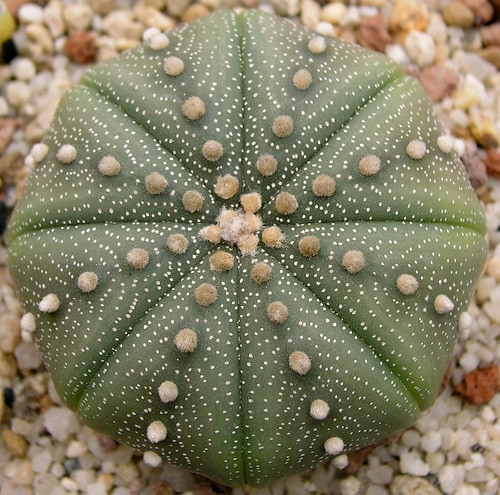
Sand Dollar Cactus, Sea Urchin Cactus, Star Cactus, Star Peyote
- Small, Round, Spineless, and Squat Body
- Reaches A Height of 2.5–6 Cm and A Diameter of 5–15 Cm
- Disc-Shaped Body Divided Into 7–10 Ribs
- Woolly Areoles In the Middle of Each Rib
- Greenish-Brown Body Color, May Appear Speckled
- Covered In White Scales
- Oval Fruits That Are Green To Pink
- Fruit Coat Covered With Woolly Hairs
Yellow, Red
About Astrophytum asterias
What is Astrophytum asterias?
Astrophytum asterias, commonly known as the sand dollar cactus, sea urchin cactus, star cactus, or star peyote, is a small, spineless cactus species native to very limited areas of Texas in the United States and the Mexican states of Nuevo León and Tamaulipas. It is characterized by its squat, disc-shaped body, which typically reaches a diameter of 5 to 15 cm and is divided into 7 to 10 ribs. The body is a greenish-brown color and is covered in a distinctive speckling of white scales, known as trichomes, which are particularly woolly around the areoles located on the middle of each rib.
Description and Biology
The cactus flowers are a striking yellow with red bases and are very woolly on their outer parts. These flowers appear from March to June. Following flowering, the plant produces green to pink oval fruits, also covered in woolly hairs. Astrophytum asterias reproduces through sexual outcrossing, relying on cross-pollination, with medium to large bees, such as Diadasia rinconis, being its primary pollinators. The species reaches sexual maturity after a few years, typically when it attains a diameter of 2 to 3 cm.
Distribution and Habitat
Historically, Astrophytum asterias was more abundant, but its current distribution is restricted to a small portion of Starr County, Texas, and a few specific sites in Tamaulipas. It is typically found growing in thorn scrub environments, nestled amongst rocky ground. It is believed that this species may have previously inhabited richer, flat grasslands that have since been converted for other uses. Its presence has likely been extirpated from Nuevo León.
Cultivation and Conservation
Despite its rarity in the wild, the sand dollar cactus has been cultivated as a houseplant since the 1840s. It is easily propagated from seed, meaning most plants found in nurseries are grown rather than wild-collected. The popularity among collectors has led to the development of various cultivars, such as the 'Super Kabuto'.
Astrophytum asterias faces significant conservation challenges. It is listed as endangered by the United States Fish and Wildlife Service, vulnerable by the IUCN, and critically imperiled by The Nature Conservancy. Its trade is regulated under Appendix I of CITES, prohibiting commercial international trade in wild-collected specimens. The decline of the species in the wild is largely attributed to habitat destruction from urban development, agricultural conversion, road construction, and invasive grasses, as well as ongoing illegal collection and poaching. A recovery plan has been drafted by the U.S. Fish and Wildlife Service to address these issues and secure the future of the species.
Source: Wikipedia ↗
Frequently Asked Questions
What are the common names for Astrophytum asterias?
Astrophytum asterias is known by several common names, including sand dollar cactus, sea urchin cactus, star cactus, and star peyote. These names reflect its appearance and sometimes its relation to other cacti.
Where does the sand dollar cactus grow in the wild?
The sand dollar cactus is native to the lower Rio Grande Valley of Texas in the United States and the Mexican states of Nuevo León and Tamaulipas. Its distribution is now restricted to small portions of these areas.
What is the typical habitat of Astrophytum asterias?
In its natural habitat, Astrophytum asterias is found amongst rocky ground within thorn scrub environments. It may have previously inhabited richer, flat grasslands that have since been altered by development.
When does Astrophytum asterias flower and produce fruit?
The flowers of the star cactus typically bloom from March to June, which corresponds to the summer season in its native range. Fruiting occurs shortly after, from April to June.
What are the main threats to Astrophytum asterias in the wild?
The primary threats to Astrophytum asterias are habitat destruction due to urban development, agricultural conversion, and road construction. Over-collection, poaching, and accidental harvesting due to confusion with peyote also contribute to its decline.
Is Astrophytum asterias endangered?
Yes, Astrophytum asterias is listed as endangered by the United States Fish and Wildlife Service and critically imperiled by The Nature Conservancy. It is also listed as vulnerable on the International Union for Conservation of Nature's Red List.