
Partnach Gorge
The Partnach Gorge is a deep gorge located near Garmisch-Partenkirchen in Bavaria, Germany. It was formed by the erosive power of the Partnach stream, which cut through layers of muschelkalk and softer marls over millions of years. Designated a natural monument in 1912, it has been developed for tourism and is accessible year-round.
Key Facts
- ›The gorge is approximately 702 meters long and over 80 meters deep.
- ›It was formed by the Partnach stream eroding through Alpine muschelkalk (shell-bearing limestone) and softer Partnach strata.
- ›The gorge was designated a natural monument in 1912.
- ›A significant rockfall occurred in 1991, necessitating the construction of a rock-blasted gallery.
- ›It served as a film location for the 1979 movie 'Nosferatu the Vampyre'.
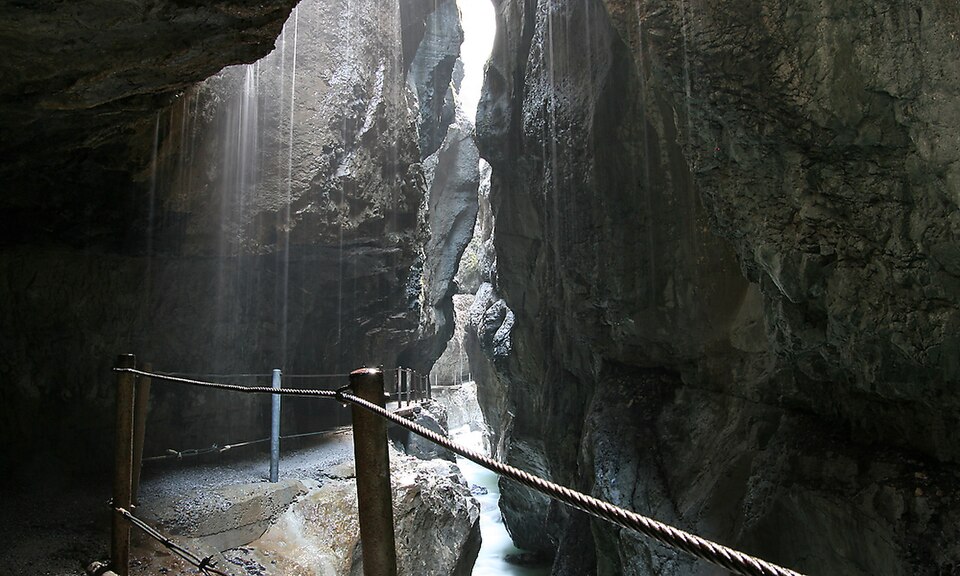
Partnachklamm
River Erosion
Alpine Muschelkalk Rock Layers, Partnach Strata, Rock-Blasted Gallery
About Partnach Gorge
The Partnach Gorge (Partnachklamm) is a striking natural landmark located in the Reintal valley near Garmisch-Partenkirchen in southern Germany. This deep gorge has been carved over millennia by the relentless erosive power of the Partnach stream, creating a dramatic landscape of towering rock walls.
Formation and Geology
The gorge's geological history stretches back to the Triassic period, approximately 240 million years ago. During this time, dark grey, hard layers of Alpine muschelkalk, also known as Wurstelkalk, were deposited on the seabed of a shallow sea. These strata still bear the fossilized traces of marine animals. Following this, about 5 million years later, softer marls were laid down in the same marine basin, which are now recognized as the Partnach strata. The subsequent Alpine mountain folding created the Warnberg Saddle from these rock layers. The Partnach stream, originating from the Schneeferner glacier on the Zugspitzplatt plateau, possessed sufficient erosive force to rapidly wear away the softer Partnach strata while keeping pace with the continuous uplift of the land. This process allowed the stream to cut deeply into the harder Alpine muschelkalk, shaping the narrow, gorge-like valley, while the areas composed of softer strata exhibit a wider valley cross-section.
Modern Significance and Accessibility
Since 1912, the Partnach Gorge has been managed as a tourist attraction and is open for visits throughout the year. An entrance fee is applicable during daylight hours in both the summer and winter seasons, with visitors entering at their own risk outside these times. A notable geological event occurred on June 1, 1991, when approximately 5,000 cubic meters of rock detached from a cliff face at the southern end of the gorge, obstructing the original path and the watercourse. This resulted in the formation of a small, natural dammed lake, with the Partnach rerouting its flow through the fallen boulders. To address this, a 108-meter-long gallery, blasted directly from the rock, was constructed and opened in 1992 to bypass the rock piles and the lake. This gallery is illuminated by windows, allowing continued access to the gorge's natural beauty.
Cultural Footprint
The dramatic scenery of the Partnach Gorge has also captured the attention of filmmakers. It notably served as a filming location for the 1979 rendition of the classic vampire film, 'Nosferatu the Vampyre', underscoring its atmospheric and visually compelling character.
Source: Wikipedia ↗
Frequently Asked Questions
How was the Partnach Gorge formed?
The gorge was formed by the erosive force of the Partnach stream. This stream, fed by glacier meltwater, cut through layers of Alpine muschelkalk and softer Partnach strata over millions of years, keeping pace with the uplifting of the terrain.
What are the dimensions of the Partnach Gorge?
The Partnach Gorge is approximately 702 meters (2,303 ft) in length and, in some places, exceeds 80 meters (260 ft) in depth.
Is the Partnach Gorge accessible to visitors?
Yes, the gorge has been developed for tourists and can be visited all year round. An entry fee is charged during specific hours in summer and winter.
What geological features are found in the Partnach Gorge?
The gorge walls primarily consist of Alpine muschelkalk, a hard shell-bearing limestone, with traces of marine animal activity visible. Softer marls, known as Partnach strata, are also present and contribute to the valley's shape.
Have there been any significant geological events in the Partnach Gorge?
Yes, on June 1, 1991, a substantial rockfall occurred, dislodging approximately 5,000 m³ of rock. This event blocked the old path and the watercourse, forming a small dammed lake, and led to the construction of a gallery to bypass the debris.
Related Canyons

Danube Gorge
The Danube Gorge, also known as the Weltenburg Narrows, is a significant geological feature in Bavaria, Germany, carved by the Danube River. This protected nature reserve showcases impressive limestone cliffs and unique rock formations, formed during the Upper Jurassic period.

Rhine Gorge
The Rhine Gorge, also known as the Upper Middle Rhine Valley, is a 65 km long section of the Middle Rhine River in Germany. It was designated a UNESCO World Heritage Site in 2002 due to its stunning cultural landscape, its historical significance as a European transport route, and the unique architectural adaptations to the steep valley slopes. The gorge was carved by the Rhine River during a recent geological uplift, revealing ancient Devonian sedimentary rocks, primarily slate, which are rich in fossils.

Spetzgarter Gorge
The Spetzgarter Tobel is an erosion ravine and nature reserve located in the northwest of Überlingen, Germany, within the Lake Constance Basin. It is characterized by the Killbach creek, which has carved a gorge up to 65 meters deep through molasse and sandstone. The reserve is significant for its protected orchid-beech forests, ash forests, and diverse alpine plant species, including wild garlic and lily of the valley.