
Taubenloch
Gorge·Switzerland·Suze
Taubenloch is a gorge located in the Canton of Bern, Switzerland, carved by the Suze river as it traverses the first Jura Mountain chain. This natural passage has historically served as a vital route connecting the Swiss Plateau to the Jura mountains, with evidence of Roman road construction through its vicinity.
Key Facts
- ›The gorge spans approximately 2 kilometers in length.
- ›It is situated between Frinvillier (517 M) and Bözingen (447 M).
- ›The Suze river flows through the gorge, originating in the Erguel valley.
- ›Taubenloch has been a significant natural crossing point of the Jura mountains since Roman times.
- ›A private corporation was established in 1889 to create a hiking path through the gorge.
- ›Part of the gorge is designated as a protected natural site in Switzerland since 1927.
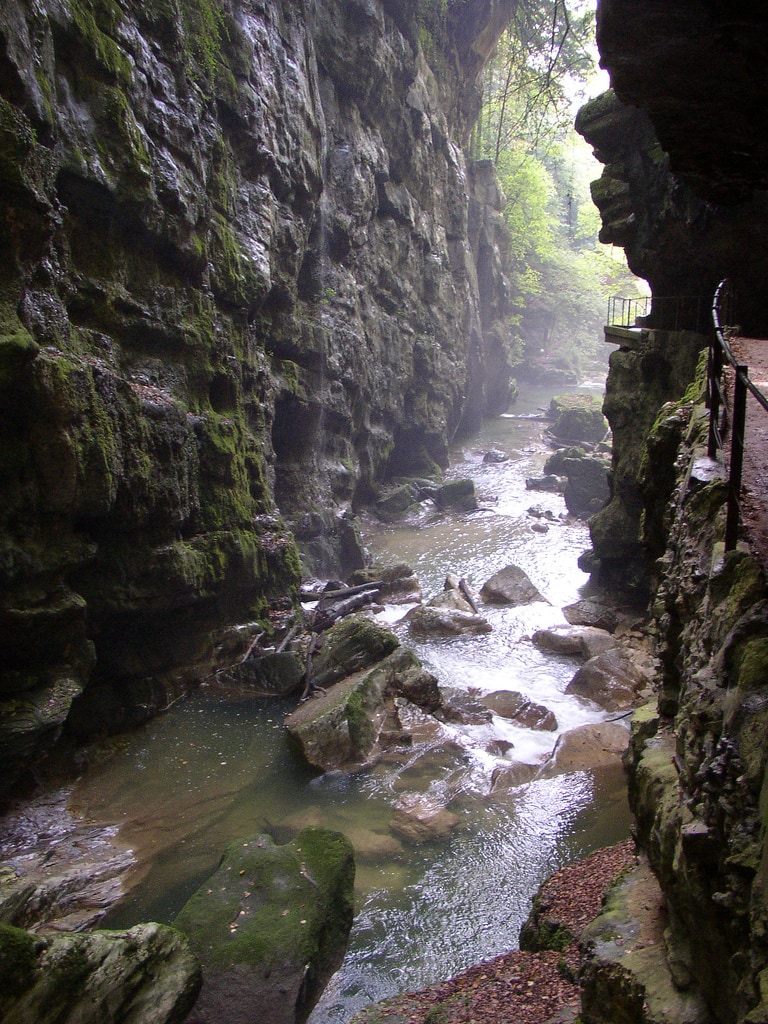
Gorges du Taubenloch
River Erosion
- Natural Crossing of the First Jura Mountain Chain
- Suze River Course
- Roman Road Spur Route
About Taubenloch
Taubenloch, also known by its French name Gorges du Taubenloch, is a significant gorge situated in the Canton of Bern, Switzerland, north of the city of Biel/Bienne. This natural formation cuts through the first Jura Mountain chain, as viewed from the Swiss Plateau, and is carved by the Suze river, which originates in the Erguel valley and flows into Lake Biel.
Geological and Historical Significance
The gorge extends for approximately two kilometers between the villages of Frinvillier, at an altitude of 517 meters, and Bözingen, a suburb of Biel/Bienne at 447 meters. Taubenloch represents one of the rare natural passages across the Jura mountains between the Swiss Plateau and the French border, making it a historically vital route. Evidence suggests the area was well-established during the Roman Empire, with a Roman road passing through it as a spur from Petinesca, crossing the Jura via the Col de Pierre Pertuis pass.
Naming and Preservation
The name Taubenloch first appeared in written records in 1532. While its exact origin is debated, one theory suggests it derives from German words signifying a precipice or trench and a hole. Another explanation, rooted in local legend, connects the name to a young woman nicknamed 'die Taube' (the dove) who tragically ended her life by leaping into the gorge. A less romantic interpretation points to pigeons nesting in the area. Recognizing its natural beauty and importance, a private non-profit corporation was founded in 1889 to establish a hiking path through the gorge. Since 1927, a portion of the Taubenloch gorge has been recognized and protected as a natural site within Switzerland.
Source: Wikipedia ↗
Frequently Asked Questions
What is the origin of the name Taubenloch?
The name Taubenloch first appeared in a 1532 document. Theories suggest it derives from German words for 'precipice' or 'trench' and 'hole', or it may reference pigeons nesting in the gorge. A local legend attributes the name to a young woman, 'die Taube' (the dove), who tragically died by throwing herself into the gorge.
What is the geological significance of Taubenloch?
Taubenloch is geologically significant as a natural crossing of the first Jura Mountain chain, providing a passage between the Swiss Plateau and the Jura mountains. Its formation is attributed to the erosive power of the Suze river.
What historical importance does Taubenloch hold?
Historically, Taubenloch was a crucial natural route. During the Roman Empire, a spur road passed through the gorge, crossed the Jura via the Col de Pierre Pertuis pass, and led towards Augusta Raurica and modern Germany.
What activities are available at Taubenloch?
Hiking is a primary activity at Taubenloch. A dedicated hiking path was established in the late 19th century, and part of the gorge is a protected natural site, making it a destination for nature exploration.
Is Taubenloch easily accessible?
The gorge is accessible for hiking, with a path established for visitors. For vehicular traffic, the Transjurane motorway project is expected to utilize the route of the gorge, linking to the E27.
Related Canyons

Aare Gorge
The Aare Gorge is a dramatic canyon carved through a limestone ridge near Meiringen, Switzerland, by the Aare River. Formed approximately 10,000 years ago by glacial meltwater erosion at the end of the Ice Age, this narrow passage features sheer cliffs and is a significant tourist attraction, partly due to its proximity to the famous Reichenbach Falls.

Küsnachter Tobel
The Küsnachter Tobel is a small river canyon located on the southwestern slope of the Pfannenstiel mountain in Switzerland, carved by the Küsnachter Dorfbach stream. This gorge, extending about 12 kilometers in length and up to 70 meters deep, is renowned for its wild, primeval landscape and serves as a popular hiking destination. It also holds ecological significance as a spawning ground for lake trout and features geological points of interest like glacial erratics and a cave formed in glacial conglomerate.

Rofla Gorge
The Rofla Gorge is a narrow, ancient section of the Hinterrhein river in Graubünden, Switzerland. It served as a significant natural obstacle on the routes to the Splügen and San Bernardino mountain passes. Today, a footpath allows visitors to experience the gorge and its waterfall.