
Acroteriobatus leucospilus
Acroteriobatus leucospilus·Medium·Ovoviviparous
Acroteriobatus leucospilus, commonly known as the grayspotted guitarfish, is a species of ray found along the coast of Madagascar, South Africa, Mozambique, and Tanzania. It is characterized by elongated bluish-gray spots on its snout and numerous small bluish spots on its fins, with a white ventral surface. This species faces significant population decline due to overfishing and harvesting.
Key Facts
- ›Ovoviviparous reproduction system.
- ›Maximum recorded length of 96 CM for females.
- ›Inhabits inshore areas down to 100 meters depth.
- ›Characterized by bluish-gray spots on snout and fins.
- ›Population has declined by at least 50% in the last 15 years.
- ›Caught in trawl and gillnet fisheries.
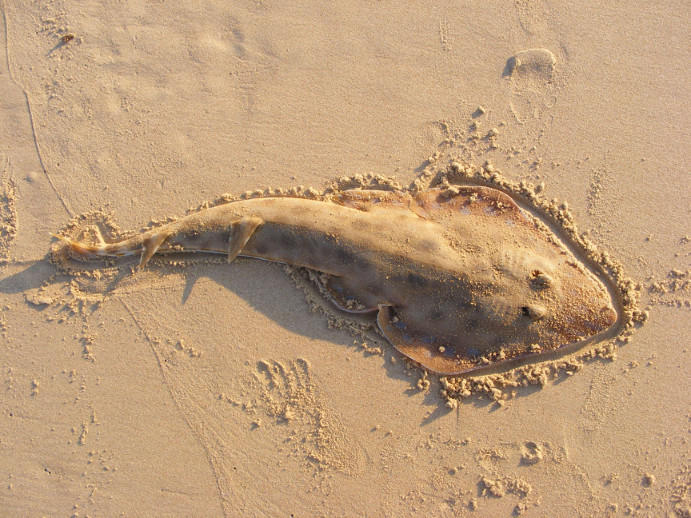
Grayspotted Guitarfish
Madagascar, South Africa, Mozambique, Tanzania
- Elongated Bluish-Gray Spots On Snout
- Numerous Small Bluish Spots On Fins
- White Ventral Surface
- White Or Striped Blue-Brownish Lateral Tail Folds
- 37 To 41 Nasal Lamellae
- Often Captured By Trawl and Gillnet Fisheries.
Elongated Bluish-Gray Spots On Snout, Numerous Small Bluish Spots On Fins
About Acroteriobatus leucospilus
Acroteriobatus leucospilus: The Grayspotted Guitarfish
Acroteriobatus leucospilus, more commonly recognized as the grayspotted guitarfish, is a species belonging to the Rhinobatidae family of rays. This cartilaginous fish is found along the coastal waters of several African nations, including Madagascar, South Africa, Mozambique, and Tanzania. Its presence in these regions is notable, though its populations have faced considerable pressure.
Description and Habitat
The grayspotted guitarfish is distinguished by a distinctive pattern of elongated bluish-gray spots adorning its snout. Further small bluish spots are scattered across its pectoral, pelvic, dorsal, and caudal fins. Its underside, or ventral surface, is white, and it possesses white or striped blue-brownish lateral tail folds. This species inhabits inshore areas, typically found at depths up to 100 meters (328 feet). The maximum recorded length for female specimens is 96 cm.
Reproduction and Conservation
Reproductively, Acroteriobatus leucospilus is ovoviviparous, meaning that its young develop from eggs that hatch within the mother's body before being born live. Unfortunately, the grayspotted guitarfish has experienced a significant population reduction, estimated at least 50% over the past 15 years. This decline is primarily attributed to the impacts of overfishing and harvesting, as the species is frequently captured by trawl and gillnet fisheries operating within its habitat. The meat of the grayspotted guitarfish is sold locally, and its fins are a commodity exported to Asian markets.
Source: Wikipedia ↗
Frequently Asked Questions
What are the distinguishing physical features of the grayspotted guitarfish?
The grayspotted guitarfish is identified by elongated bluish-gray spots on its snout and numerous small bluish spots scattered across its pectoral, pelvic, dorsal, and caudal fins. It also possesses a white ventral surface and white or striped blue-brownish lateral tail folds.
Where is the grayspotted guitarfish found?
This species is distributed along the coastal areas of Madagascar, South Africa, Mozambique, and Tanzania. It typically inhabits inshore waters.
What is the reproductive strategy of Acroteriobatus leucospilus?
Acroteriobatus leucospilus exhibits an ovoviviparous reproductive system. This means that the eggs hatch inside the mother's body, and the young are born live.
What is the conservation status of the grayspotted guitarfish?
The grayspotted guitarfish has experienced a significant population reduction of at least 50% over the past 15 years. This decline is attributed to overfishing and harvesting pressures within its habitat.
What is the maximum size a grayspotted guitarfish can reach?
The maximum recorded length for the grayspotted guitarfish is 96 cm, observed in female specimens. This indicates a moderate size for this species.
Related Cartilaginous fish species
Acroteriobatus blochii
The bluntnose guitarfish, or fiddlefish (Acroteriobatus blochii), is a species of ray belonging to the Rhinobatidae family. This ray inhabits shallow seas and estuarine waters along the coasts of Angola, Namibia, and South Africa. It is known for its guitarfish-like body shape and is often confused with closely related species.

Acroteriobatus omanensis
Acroteriobatus omanensis, commonly known as the Oman guitarfish, is a species of guitarfish native to the Gulf of Oman and the Arabian Sea. It is distinguished by its dense pattern of small, symmetrical ocelli and a very narrowly pointed nose. This small guitarfish inhabits the subtidal zone at depths of up to 100 meters, typically found in muddy and sandy seafloor areas.
Acroteriobatus zanzibarensis
The Zanzibar guitarfish (Acroteriobatus zanzibarensis) is a species of ray belonging to the Rhinobatidae family, found exclusively in the waters of Tanzania. It inhabits both open and shallow seas, characterized by its unique guitarfish-like body shape, a common feature among its relatives.