
Bowenia spectabilis
Subtropical or tropical moist lowland forests, near streams, sheltered slopes, lowland wet sclerophyll forest.·Subterranean rhizome with emergent foliage.·Not Specified
Bowenia spectabilis is a striking cycad species native to the rainforests of northeastern Queensland, Australia. Known for its unique, fern-like foliage, this species thrives in moist lowland forests and sheltered slopes. Its subterranean, yam-like rhizome has historically been utilized as a food source by Indigenous Australians.
Key Facts
- ›Endemic to northeastern Queensland, Australia.
- ›Inhabits subtropical or tropical moist lowland forests.
- ›Features unique, fern-like leaf structures.
- ›Its rhizome has been used as a food source by Indigenous Australians.
- ›Found from the Mcilwraith Range south to near Tully, and up to 700 meters on the Atherton Tableland.

Australia
Rhizome is yam-like and subterranean.
- Unique, Fern-Like Foliage.
- Leaves Are Described As Resembling Fern Fronds.
Food source for Indigenous Australians.
About Bowenia spectabilis
Bowenia spectabilis is a distinctive species of cycad belonging to the Zamiaceae family, notable for its unique, fern-like appearance. This species is strictly endemic to the northeastern region of Queensland, Australia.
Habitat and Distribution
The natural habitat of Bowenia spectabilis comprises subtropical and tropical moist lowland forests. It is commonly found in close proximity to water sources, such as streams, and flourishes on sheltered slopes within lowland wet sclerophyll forests. The species has also been recorded at elevations up to 700 meters in areas like the Atherton Tableland, indicating some adaptability to varied forest environments.
Its geographical distribution spans northeastern Queensland, extending from the McIlwraith Range on the Cape York Peninsula southward to the vicinity of Tully. This restricted range underscores its endemic status.
Botanical Features and Traditional Use
One of the most striking characteristics of Bowenia spectabilis is its foliage, which closely resembles that of ferns, setting it apart from many other cycads. Beneath the surface, the plant possesses a subterranean rhizome that is yam-like in form. Historical records, such as the 1889 book 'The Useful Native Plants of Australia,' document that this rhizome was a traditional food source for the Indigenous Australians of the region.
While the species is well-documented in terms of its range and habitat, specific details regarding its reproductive biology, such as pollination mechanisms or detailed cone morphology, are not widely elaborated upon in general descriptions. Similarly, information on its growth rate, specific toxicity, or formal conservation status requires further dedicated study.
Source: Wikipedia ↗
Frequently Asked Questions
Where is Bowenia spectabilis found naturally?
Bowenia spectabilis is endemic to northeastern Queensland, Australia. Its natural range extends from the McIlwraith Range on the Cape York Peninsula southwards to near Tully.
What kind of habitat does Bowenia spectabilis prefer?
This cycad species thrives in subtropical or tropical moist lowland forests. It is often found growing close to streams and on sheltered slopes within lowland wet sclerophyll forests.
Has Bowenia spectabilis been used by humans?
Yes, the yam-like rhizome of Bowenia spectabilis has historically been used for food by Indigenous Australians. This usage dates back to at least 1889.
Can Bowenia spectabilis grow at higher altitudes?
While primarily a lowland species, Bowenia spectabilis has been observed growing at altitudes of up to 700 meters in regions like the Atherton Tableland.
Related Cycad species

Cycas angulata
Cycas angulata is the largest Australian species of cycad, distinguished by its tall, often branched stems and numerous grey-green to glaucous leaves reaching up to 1.7 meters in length. Native to the Northern Territory and northwest Queensland, it is occasionally cultivated as an ornamental plant and its seeds were historically used as a food source by Aboriginal Australians after careful detoxification.
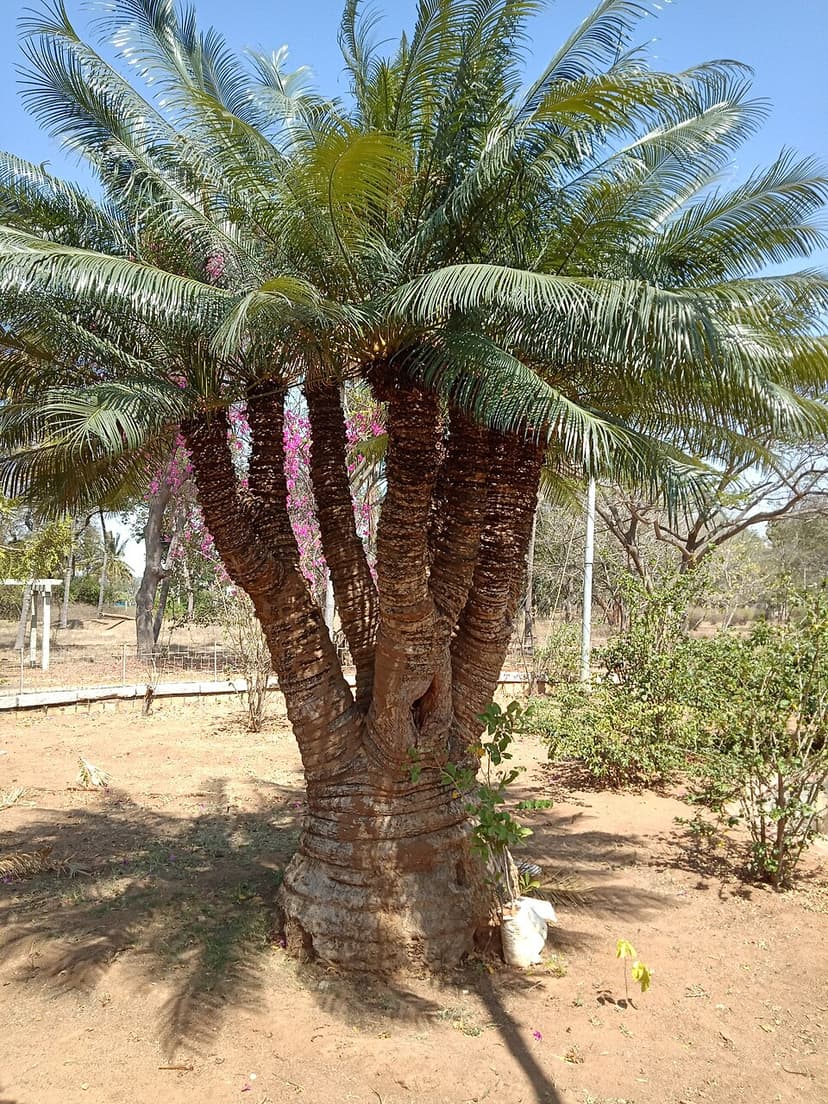
Cycas indica
Cycas indica is a species of cycad native to the dry plains of Karnataka, India. It is distinguished by its branching growth habit. A closely related species, Cycas swamyi, is considered a synonym of Cycas indica.

Cycas chevalieri
Cycas chevalieri is a species of cycad belonging to the Cycadaceae family. This plant is primarily found in central Vietnam, with its known distribution including Nghe An Province. It is also believed to potentially occur in neighboring Laos.