
Cycas angulata
Found in the lower reaches of rivers near Borroloola and on islands.·Arborescent, frequently branched·Not specified
Cycas angulata is the largest Australian species of cycad, distinguished by its tall, often branched stems and numerous grey-green to glaucous leaves reaching up to 1.7 meters in length. Native to the Northern Territory and northwest Queensland, it is occasionally cultivated as an ornamental plant and its seeds were historically used as a food source by Aboriginal Australians after careful detoxification.
Key Facts
- ›Largest Australian Cycas species, with stems reaching up to 5 meters tall.
- ›Leaves are pinnate, up to 1.7 meters long, with 180-320 leaflets.
- ›Native to northeastern Northern Territory and northwestern Queensland, Australia.
- ›Seeds are starchy but highly toxic to mammals in their natural state.
- ›Historically processed by Aboriginal Australians for food through leaching and baking or fermentation.
- ›Occasionally grown as an ornamental plant.

Australia
- Near vertical single or clustered stems
- Growing to 5 m tall
- 15–25 cm or more in diameter
- Older specimens lose leaf base scars and gain a checkerboard appearance
- Petioles armed with spines in younger individuals, lost in older ones
1.1–1.7 m long, Pinnate with 180-320 leaflets, Leaflets 14–23 cm long and 4.5–6.5 mm wide, Grey-green to glaucous color, Up to 40 leaves in the crown
- Female cones are open type sporophylls, 25–50 cm long, brown, with 6-12 ovules each.
- Lamina of female cones is triangular ending in a sharp narrow spine.
- Male cones are solitary, erect, 20–25 cm long and 12–15 cm diameter.
- High starch content
- Ripened during the dry season
- Highly toxic to mammals in natural state
- Require leaching and baking or fermentation to be edible
Ornamental Plant, Food Source
About Cycas angulata
Cycas angulata is a striking species of cycad native to Australia, notable for being the largest within the genus Cycas in that region. It is found in the northeastern Northern Territory, near Borroloola, and in northwest Queensland, including the Bountiful Islands. This species is characterized by its arborescent, often branched stems that can reach impressive heights of up to 5 meters, and in rare cases, up to 12 meters.
Description and Morphology
The stems of Cycas angulata are typically near vertical and can be single or clustered. As they age, the stems lose their leaf base scars, developing a distinctive checkerboard appearance. The leaves are large, measuring between 1.1 and 1.7 meters in length, and are pinnate, composed of 180 to 320 leaflets. These leaflets are typically grey-green to glaucous and measure 14–23 cm long. Younger plants feature spiny petioles, a characteristic that diminishes with age.
The reproductive structures of Cycas angulata include large female cones (sporophylls) that are 25–50 cm long and bear 6-12 ovules each, with a triangular lamina ending in a sharp spine. Male cones are solitary, erect, and measure 20–25 cm in length and 12–15 cm in diameter.
Historical Use as Food
Historically, the seed-like kernels of Cycas angulata were a vital food source for Aboriginal Australians, particularly during the dry season when other food resources were scarce. The seeds are rich in starch but highly toxic in their natural state. Recognizing this danger, indigenous peoples developed methods to detoxify the kernels, primarily through leaching with water for several days followed by baking, or by allowing the kernels to ferment before cooking. Despite these traditional preparations, the kernels are known to contain carcinogens and are not recommended for human consumption even today.
Cultivation
Cycas angulata is occasionally cultivated as an ornamental plant, appreciated for its substantial size and distinctive cycad form.
Source: Wikipedia ↗
Frequently Asked Questions
What is Cycas angulata?
Cycas angulata is a species of cycad native to Australia. It is recognized as the largest Australian species within the genus Cycas and is known for its tall, often branched stems and long, pinnate leaves.
Where is Cycas angulata found naturally?
This species is indigenous to the northeastern part of Australia's Northern Territory, specifically near Borroloola, and also to the northwest of Queensland, including the Bountiful Islands.
What are the characteristics of its leaves and stems?
Cycas angulata has arborescent stems that can grow up to 5 meters tall and are frequently branched. The leaves are pinnate, measuring 1.1–1.7 meters long, and are adorned with 180-320 grey-green to glaucous leaflets.
Were the seeds of Cycas angulata edible?
Yes, the seed-like kernels were historically eaten by Aboriginal Australians. They are high in starch and ripened during the dry season. However, the seeds are highly toxic in their natural state and require extensive processing, such as leaching and baking or fermentation, to be made safe for consumption.
Is Cycas angulata poisonous?
In its natural state, the seeds of Cycas angulata are highly toxic to mammals. Traditional methods involving leaching and baking or fermentation were used by Aboriginal Australians to remove these toxins before consumption.
What does the scientific name 'angulata' refer to?
The scientific name 'angulata' is derived from Latin and means 'angular'. This refers to the distinct arrangement of the leaflets along the leaf petiole.
Related Cycad species

Cycas chevalieri
Cycas chevalieri is a species of cycad belonging to the Cycadaceae family. This plant is primarily found in central Vietnam, with its known distribution including Nghe An Province. It is also believed to potentially occur in neighboring Laos.

Bowenia spectabilis
Bowenia spectabilis is a striking cycad species native to the rainforests of northeastern Queensland, Australia. Known for its unique, fern-like foliage, this species thrives in moist lowland forests and sheltered slopes. Its subterranean, yam-like rhizome has historically been utilized as a food source by Indigenous Australians.
Cycas indica
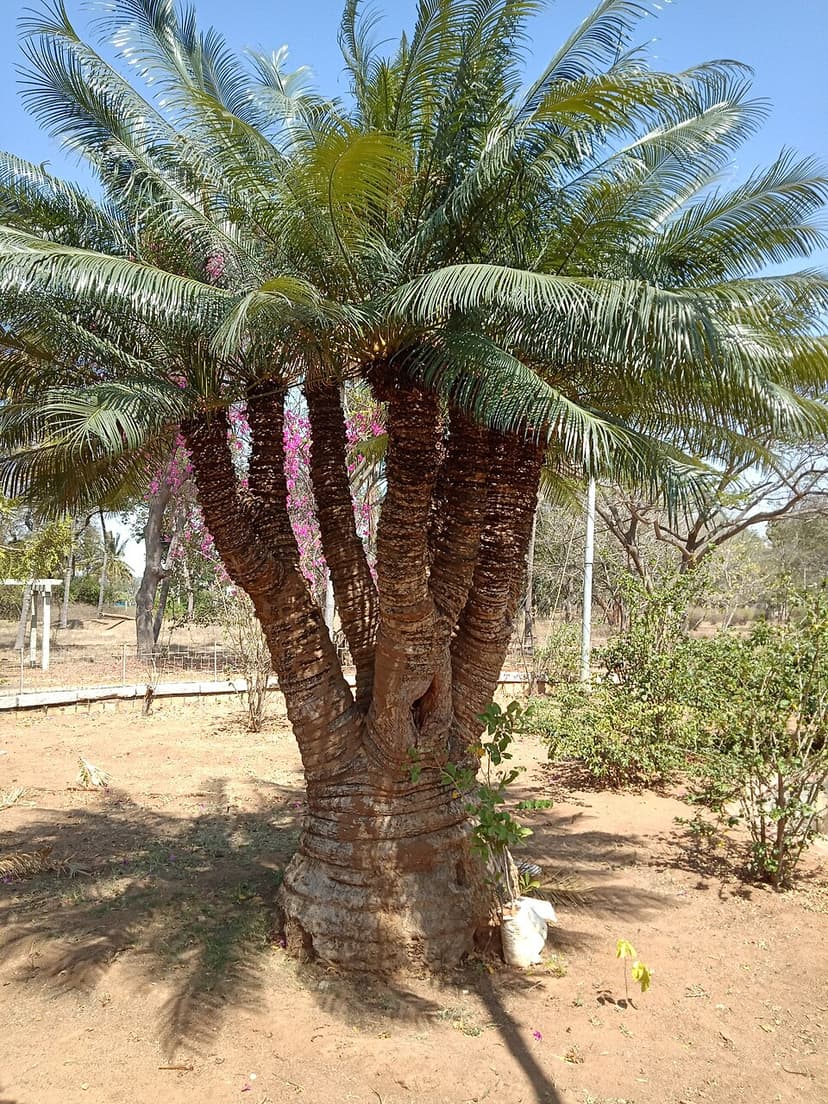
Cycas indica is a species of cycad native to the dry plains of Karnataka, India. It is distinguished by its branching growth habit. A closely related species, Cycas swamyi, is considered a synonym of Cycas indica.