
Cycas riuminiana
Terrestrial environments within Luzon, Philippines, with specific subpopulations noted near Mount Arayat, Morong and Bagac, Lobo, Mount Dipalayag, and Baler.·Cycad
Cycas riuminiana, also known as Arayat pitogo or pitogo, is a species of cycad native to the island of Luzon in the Philippines. This cycad is characterized by its edible young fronds and poisonous seeds, which can be detoxified and processed into flour. It is found in five distinct subpopulations across several provinces of Luzon.
Key Facts
- ›Endemic to Luzon, Philippines.
- ›Young fronds are edible when cooked.
- ›Ripe seeds are poisonous but can be detoxified for consumption.
- ›Found in five subpopulations in Pampanga, Bataan, Batangas, Isabela, and Aurora provinces.
- ›Also known by local names such as bayit and sawang.

Arayat Pitogo, Pitogo, Bayit, Sawang
Luzon, Philippines
Young Curled-Up Fronds Are Edible.
- Ripe Seeds Are Poisonous But Can Be Detoxified.
- Detoxified Seeds Can Be Processed Into A Flour-Like Substance.
- Young fronds are edible
- Seeds can be processed into flour for cakes or gruels after detoxification
About Cycas riuminiana
Cycas riuminiana, commonly recognized as Arayat pitogo or simply pitogo, is a species of cycad indigenous to the island of Luzon in the Philippines. It is also known locally by various names, including bayit in the Tagalog language and sawang in Ilocano.
Distribution and Subpopulations
The species is found in five distinct subpopulations across Luzon. These are located in Pampanga province near Mount Arayat, Bataan province near Morong and Bagac, Batangas province near Lobo, Isabela province near Mount Dipalayag, and Aurora province near Baler.
Botanical and Culinary Significance
Cycas riuminiana possesses a dual role in its native regions, serving both as a botanical specimen and a source of food. The young, tightly curled fronds (or young leaves) are edible and can be prepared as a vegetable. In contrast, the mature, ripe seeds of the plant are poisonous. However, a traditional method exists to detoxify these seeds: they are crushed and subjected to multiple soaking periods in water to leach out the toxins. Once rendered safe, the seeds can be dried, ground into a flour-like substance, and used to create small cakes or gruels, highlighting a significant aspect of local food preparation and resourcefulness.
Source: Wikipedia ↗
Frequently Asked Questions
What are the common names for Cycas riuminiana?
Cycas riuminiana is commonly known as Arayat pitogo or pitogo. It also has local names such as bayit in Tagalog and sawang in Ilocano.
Where is Cycas riuminiana found?
This cycad species is endemic to the island of Luzon in the Philippines. It is distributed across five distinct subpopulations in provinces including Pampanga, Bataan, Batangas, Isabela, and Aurora.
Are parts of Cycas riuminiana edible?
Yes, the young, curled-up fronds of Cycas riuminiana are edible and can be prepared as a vegetable dish. However, the ripe seeds are poisonous.
How are the seeds of Cycas riuminiana used?
While the ripe seeds are poisonous, they can be rendered edible through a process of crushing and repeated soaking in water to remove toxins. Once detoxified, they can be dried and ground into a flour for making small cakes or gruels.
Related Cycad species

Cycas petraea
Cycas petraea is a species of cycad exclusively found in Thailand. It is known to inhabit a specific range of limestone mountains adjacent to the Phu Kra Dueng massif in Phu Kradueng National Park, Loei Province. This species is distinguished by its unique geographic restriction.
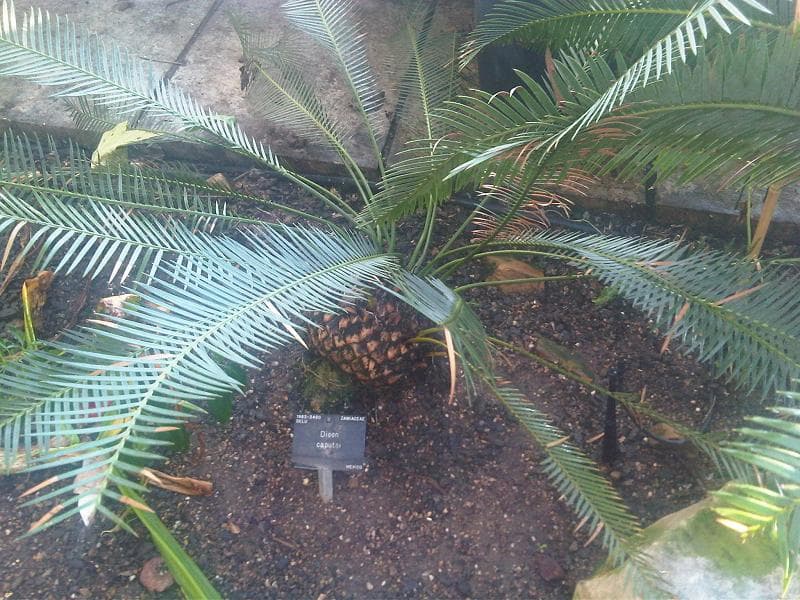
Dioon caputoi
Dioon caputoi is a species of cycad indigenous to Puebla, Mexico, specifically near Loma de la Grana. This cycad is characterized by its presence in dry scrubland habitats and its unique mutualistic relationship with the beetle Pharaxonotha bicolor, which acts as its primary pollinator. Critically endangered, its survival is dependent on protection within the Tehuacán-Cuicatlán Biosphere Reserve.

Ceratozamia latifolia
Ceratozamia latifolia is a species of cycad native to the cloud zone oak forests of the Sierra Madre Oriental in Mexico, specifically in the states of Querétaro, Hidalgo, and San Luis Potosí. This species is characterized by its broad leaves, a feature reflected in its specific epithet 'latifolia'. It belongs to the Zamiaceae family and plays a role in its unique ecological niche.