
Encephalartos manikensis
The specific habitat details are not provided in the text, but it is native to Mozambique and Zimbabwe.·Tree-like
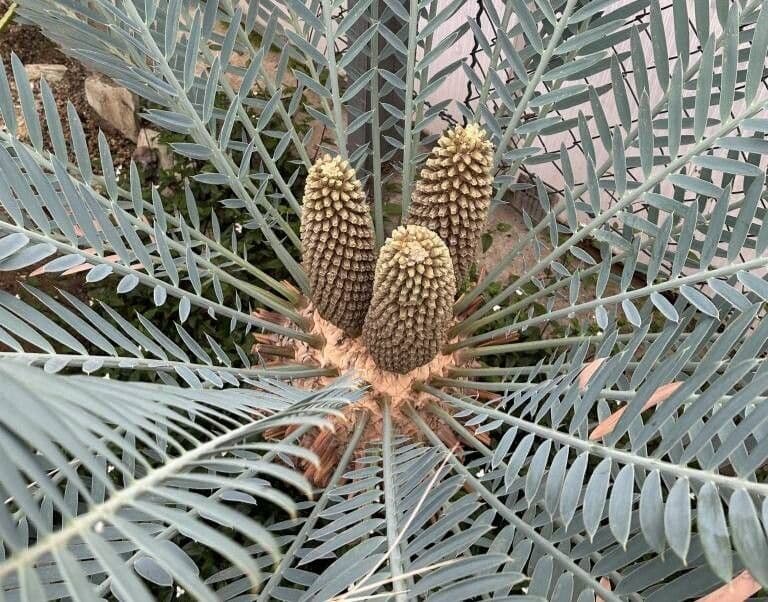
Encephalartos manikensis, commonly known as the Gorongo Cycad or Gorongowe Cycad, is a species of cycad native to Mozambique and Zimbabwe. It is characterized by a tree-like structure reaching up to 1.5 meters in height, topped with a crown of feather-like leaves. This dioecious species produces distinct male and female cones, with the female cones being larger and broader than the male ones.
Key Facts
- ›Native to Mozambique and Zimbabwe.
- ›Grows up to 1.5 meters tall, sometimes with multiple stems.
- ›Features feather-like leaves that are 1-2 meters long.
- ›Dioecious, with separate male and female plants.
- ›Male cones are cylindrical-ovoid, 25–65 cm long.
- ›Female cones are ovoid, 30–45 cm long.

Gorongo Cycad, Gorongowe Cycad
Mozambique, Zimbabwe
- Grows up to 1.5 m tall
- Sometimes with additional stems growing from its base
- Feather-like leaves forming a crown
- 1–2 m long
- Supported by a 5–6 cm long petiole
- Consist of around 60 pairs of lance-shaped leaflets
- Leaflets may have 1-2 spines on both upper and lower edges
- Leaflets attached to the stem at a 180° angle
- Leaflets taper to thorns near the petiole
- Male Plants Produce 1-4 Erect, Cylindrical-Ovoid Cones
- Male Cones Are 25–65 cm Long and 15–22 cm Wide
- Male Cones Are Light Green
- Female Plants Bear 1-2 Ovoid Cones
- Female Cones Are 30–45 cm Long and 20–25 cm Wide
Roughly Ovoid, 3–5 cm Long, Have A Bright Red Sarcotesta
About Encephalartos manikensis
Encephalartos manikensis: The Gorongo Cycad
Encephalartos manikensis, known by its common names the Gorongo Cycad and Gorongowe Cycad, is a species of cycad that is native to the regions of Mozambique and Zimbabwe. This plant is distinguished by its tree-like growth form, typically reaching heights of up to 1.5 meters, and sometimes developing multiple stems from its base.
Botanical Description
The species features a prominent crown of feather-like leaves, which can extend from 1 to 2 meters in length. Each leaf is supported by a petiole measuring approximately 5 to 6 centimeters and is composed of around 60 pairs of lance-shaped leaflets. These leaflets possess a notable characteristic: they may bear one to two spines along both their upper and lower edges and are attached to the stem at a 180° angle, tapering towards the petiole into thorns.
Reproduction
Encephalartos manikensis is a dioecious species, meaning that individual plants are either male or female. Male plants are characterized by the production of one to four erect, cylindrical-ovoid cones, which are light green in color and measure between 25 to 65 centimeters in length and 15 to 22 centimeters in width. Female plants, in contrast, bear one to two ovoid cones that are generally larger, ranging from 30 to 45 centimeters in length and 20 to 25 centimeters in width. The seeds produced by this cycad are roughly ovoid, measuring 3 to 5 centimeters long, and are enclosed in a distinctive bright red sarcotesta.
Source: Wikipedia ↗
Frequently Asked Questions
What are the common names for Encephalartos manikensis?
Encephalartos manikensis is commonly known as the Gorongo Cycad or the Gorongowe Cycad. These names reflect its geographic origins and general appearance.
Where is Encephalartos manikensis found naturally?
This cycad species is indigenous to Mozambique and Zimbabwe. It thrives in the natural environments of these two southern African countries.
What is the typical height of Encephalartos manikensis?
Encephalartos manikensis typically grows to a height of up to 1.5 meters. It can sometimes develop additional stems from its base, contributing to its overall structure.
How are the leaves of Encephalartos manikensis described?
The leaves are feather-like and form a crown at the top of the stem. They can reach lengths of 1 to 2 meters and are composed of approximately 60 pairs of lance-shaped leaflets.
Does Encephalartos manikensis have male and female plants?
Yes, Encephalartos manikensis is dioecious, meaning it has separate male and female individuals. This is a common characteristic among cycad species.
What do the cones of Encephalartos manikensis look like?
Male plants produce 1-4 erect, cylindrical-ovoid cones that are light green and measure 25–65 cm in length by 15–22 cm in width. Female plants bear 1-2 ovoid cones that are 30–45 cm long and 20–25 cm wide.
What are the seeds of Encephalartos manikensis like?
The seeds of Encephalartos manikensis are roughly ovoid in shape, measuring 3–5 cm long. They are distinguished by a bright red outer layer called a sarcotesta.
Related Cycad species

Encephalartos laevifolius
Encephalartos laevifolius is a critically endangered cycad species native to South Africa and Eswatini. It is a tree-like plant that can grow up to 3.5 meters tall, characterized by its pinnate leaves with smooth-edged, leathery leaflets. This dioecious species produces distinct male and female cones, and its seeds are covered in a sarcotesta.
Encephalartos heenanii
Encephalartos heenanii, commonly known as Heenan's cycad, is a tree-like cycad species native to Southern Transvaal Province, South Africa. It is characterized by its robust stem, reaching up to 3 meters in height, and striking light green leaves that can grow over a meter long. This dioecious species produces distinct male and female cones, with seeds enclosed in a red sarcotesta.

Encephalartos nubimontanus
Encephalartos nubimontanus is a striking cycad species native to Limpopo, South Africa. It exhibits a tree-like growth habit, with a substantial stem that can reach up to 2.5 meters in height. The species is distinguished by its large, pinnate leaves and is dioecious, with male and female plants producing distinct cones.