
Encephalartos heenanii
The typical natural environment for Encephalartos heenanii is within the Southern Transvaal Province of South Africa. Specific biome details are not provided.·Tree-like·Not specified
Encephalartos heenanii, commonly known as Heenan's cycad, is a tree-like cycad species native to Southern Transvaal Province, South Africa. It is characterized by its robust stem, reaching up to 3 meters in height, and striking light green leaves that can grow over a meter long. This dioecious species produces distinct male and female cones, with seeds enclosed in a red sarcotesta.
Key Facts
- ›Native to Southern Transvaal Province, South Africa.
- ›Can grow up to 3 meters tall with a stem diameter of 25-35 cm.
- ›Leaves are light green, 100-125 cm long, with lanceolate leaflets.
- ›Dioecious species, meaning it has separate male and female plants.
- ›Male cones are yellow and ovoid, while female cones are similar in shape.
- ›Seeds are oblong and covered by a red sarcotesta.
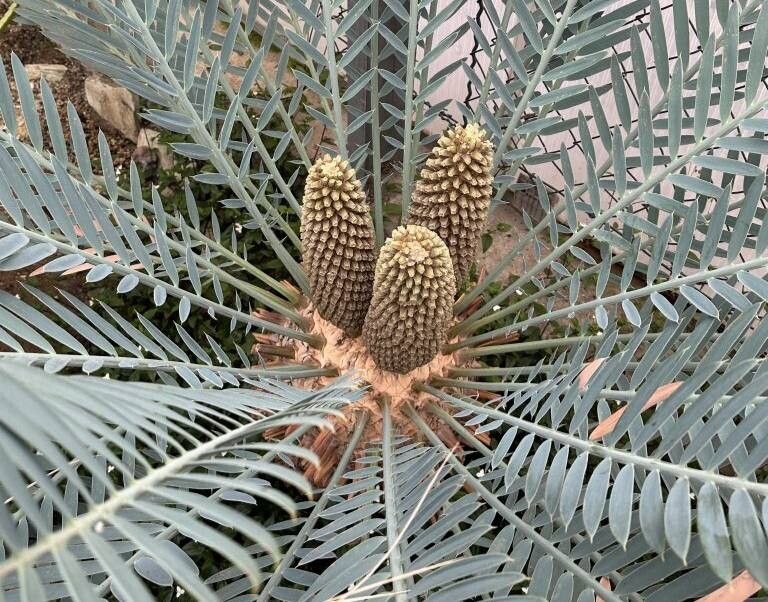
Heenan's Cycad
Southern Transvaal Province, South Africa
- Reaches heights of up to 3 meters
- Stem diameter of 25–35 cm
- Often produces shoots or branches from its base
- Light green color
- 100–125 cm long
- Twisted, spiral spine
- Curved upper part
- Lanceolate leaflets, 12–15 cm long
- Leaflets arranged oppositely on the rachis at a 45-80° angle
- Leaflets have smooth, entire margins
- Basal leaves are smaller but not reduced to spines
- Male cones are yellow, ovoid-shaped, 27–30 cm long, and 15–17 cm wide.
- Each plant can produce up to three male cones.
- Female cones are similar in shape, 23–30 cm long, and 17–18 cm in diameter.
- Typically, each plant produces only one female cone, but up to three can rarely occur.
Oblong, 23–25 mm Long, Covered By A Red Sarcotesta
About Encephalartos heenanii
Encephalartos heenanii, commonly referred to as Heenan's cycad, is a species of cycad indigenous to the Southern Transvaal Province of South Africa. This plant exhibits a tree-like growth form, capable of reaching heights of up to 3 meters with a substantial stem diameter of 25 to 35 cm. It is notable for its tendency to produce shoots or branches from its base.
Botanical Description
The leaves of Encephalartos heenanii are a distinctive light green hue, measuring between 100 to 125 cm in length. They are characterized by a twisted, spiral spine and a curved upper portion. The lanceolate leaflets, approximately 12 to 15 cm long, are arranged oppositely on the rachis at an angle of 45 to 80 degrees and possess smooth, entire margins. While basal leaves are present, they are smaller and do not develop into spines.
Reproduction
Encephalartos heenanii is a dioecious species, meaning that individual plants are either male or female. The male cones are yellow, ovoid in shape, and measure 27–30 cm in length and 15–17 cm in width, with a single plant capable of producing up to three such cones. Female cones share a similar shape, ranging from 23 to 30 cm in length and 17 to 18 cm in diameter. Typically, a female plant bears only one cone, though rarely up to three may develop. The seeds produced are oblong, measuring 23–25 mm long, and are enclosed in a characteristic red sarcotesta.
Source: Wikipedia ↗
Frequently Asked Questions
What are the common names for Encephalartos heenanii?
Encephalartos heenanii is commonly known as Heenan's cycad. No other common names are widely documented in the provided information.
Where is Encephalartos heenanii found naturally?
This cycad species is indigenous to the Southern Transvaal Province of South Africa. Its natural habitat is within this specific region.
What is the typical size of an Encephalartos heenanii plant?
Encephalartos heenanii is a tree-like cycad that can reach heights of up to 3 meters. Its stem typically has a diameter ranging from 25 to 35 cm.
Describe the leaves of Encephalartos heenanii.
The leaves of Encephalartos heenanii are light green and can grow quite long, measuring between 100 to 125 cm. They feature lanceolate leaflets that are arranged oppositely on the rachis at a 45-80° angle and have smooth, entire margins.
What are the reproductive cones of Encephalartos heenanii like?
This species is dioecious, meaning male and female cones are on separate plants. Male cones are yellow, ovoid, and measure 27–30 cm long by 15–17 cm wide, while female cones are similar in shape, ranging from 23–30 cm long and 17–18 cm in diameter.
What do the seeds of Encephalartos heenanii look like?
The seeds of Encephalartos heenanii are oblong, measuring about 23–25 mm in length. They are distinctive for being covered by a red sarcotesta.
Related Cycad species
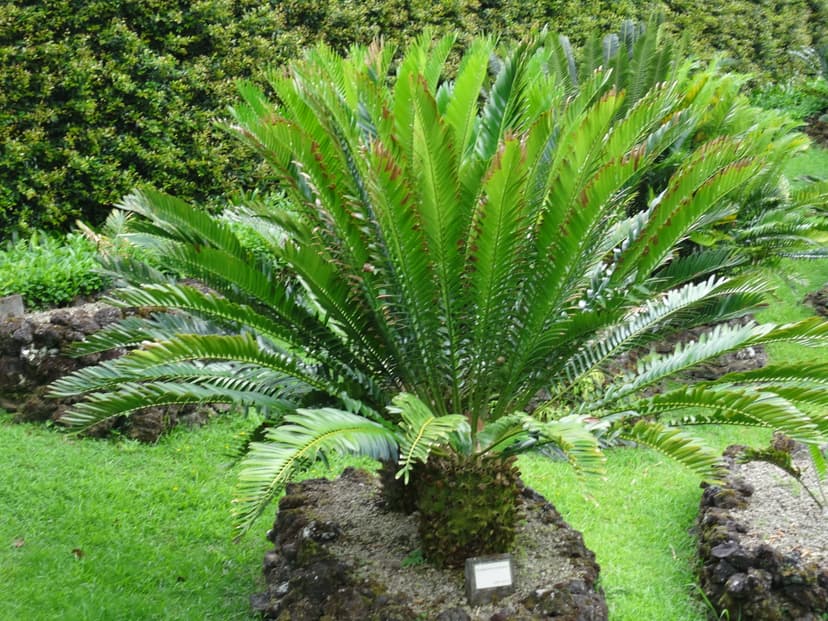
Encephalartos msinganus
Encephalartos msinganus is a tree-like cycad species native to Kwazulu-Natal, South Africa. It is characterized by its stiff, light green leaves that can reach up to 1.5 meters in length, and its robust, spiny apex. This dioecious species produces distinct male and female cones, with oblong seeds covered in a red sarcotesta.

Encephalartos laevifolius
Encephalartos laevifolius is a critically endangered cycad species native to South Africa and Eswatini. It is a tree-like plant that can grow up to 3.5 meters tall, characterized by its pinnate leaves with smooth-edged, leathery leaflets. This dioecious species produces distinct male and female cones, and its seeds are covered in a sarcotesta.

Encephalartos manikensis
Encephalartos manikensis, commonly known as the Gorongo Cycad or Gorongowe Cycad, is a species of cycad native to Mozambique and Zimbabwe. It is characterized by a tree-like structure reaching up to 1.5 meters in height, topped with a crown of feather-like leaves. This dioecious species produces distinct male and female cones, with the female cones being larger and broader than the male ones.