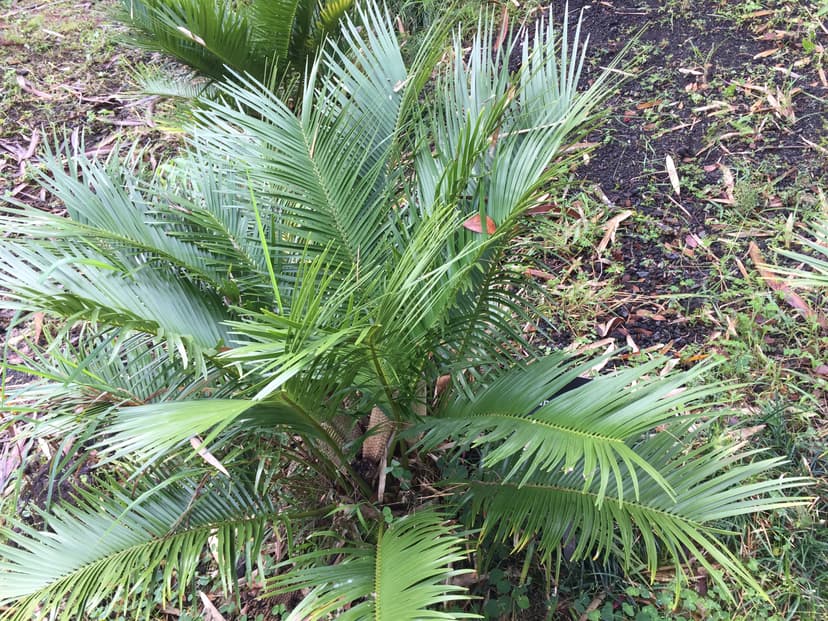
Zamia angustifolia
Coastal sand dunes (Bahamas); semi-deciduous dry forests (Cuba)·Shrub-like·Threatened (in Bahamas)
Zamia angustifolia is a species of cycad found in the Bahamas and Cuba. In the Bahamas, it is restricted to a few coastal dune sites and faces threats from habitat loss, while it is more abundant in Cuba's semi-deciduous dry forests. This species is characterized by its dark gray to black cones with pointed tips and is part of the broader Zamia pumila species complex.
Key Facts
- ›Found in the Bahamas and Cuba.
- ›Threatened by habitat loss in the Bahamas.
- ›Abundant in eastern Cuba.
- ›Possesses dark gray to black strobili (cones) with acuminate points.
- ›Belongs to the Zamia pumila species complex.
- ›Formerly referred to as "bay rush" in the Bahamas.

Bay Rush
Bahamas, Cuba
Dark Gray To Black Strobili, Acuminate Points On Cones
Starch Production
Habitat Loss
About Zamia angustifolia
Zamia angustifolia is a species of cycad native to the Bahamas and Cuba, belonging to the genus Zamia within the family Zamiaceae. While it is abundant in the semi-deciduous dry forests of eastern Cuba, its population in the Bahamas is significantly threatened by habitat loss, with only a few remaining individuals found on coastal sand dunes on Eleuthera. The species is part of the broader Zamia pumila species complex, indicating close evolutionary ties to other cycads in the region.
Botanical Features
Zamia angustifolia is characterized by its distinctive reproductive structures, known as strobili or cones. These cones are typically dark gray to black and feature acuminate, or pointed, tips. Historically, in the Bahamas, the plant was referred to as "bay rush" and was utilized for its starch content, which was harvested and sold in local markets. However, contemporary assignments of Zamia plants on islands like Andros and New Providence are now attributed to Zamia integrifolia, suggesting a complex taxonomic history and distribution.
Conservation and Taxonomy
The conservation status of Zamia angustifolia is of particular concern in the Bahamas due to its limited distribution and the ongoing development in areas adjacent to its natural habitat. Surveys have identified a small number of plants, highlighting the vulnerability of this population. The taxonomic relationship between the populations found in the Bahamas and Cuba is an area that warrants further scientific study to fully understand the species' genetic diversity and evolutionary pathways.
Source: Wikipedia ↗
Frequently Asked Questions
What are the native regions of Zamia angustifolia?
Zamia angustifolia is native to the Bahamas and Cuba. In the Bahamas, it is found at specific coastal sand dune locations, while in Cuba, it occurs in semi-deciduous dry forests in the eastern provinces.
What is the conservation status of Zamia angustifolia?
The species is considered threatened in the Bahamas due to habitat loss from nearby development. While abundant in Cuba, the taxonomic relationship between the Bahamian and Cuban populations requires further investigation.
What do the cones of Zamia angustifolia look like?
Zamia angustifolia produces dark gray to black cones, also known as strobili. These cones are distinguished by their acuminate (pointed) tips.
Is Zamia angustifolia related to other Zamia species?
Yes, Zamia angustifolia is recognized as part of the Zamia pumila species complex. This indicates a close evolutionary relationship with other species within the Zamia genus, particularly Zamia integrifolia.
What were some historical uses of Zamia angustifolia in the Bahamas?
Historically, plants of Zamia angustifolia were harvested on Andros and New Providence islands in the Bahamas to produce starch. This starch was then sold in Nassau markets, where the species was referred to as "bay rush".