
Brachylophosaurus
Herbivore·Late Cretaceous·Alberta, Canada·Bipedal/Quadrupedal (Facultative Biped)
Brachylophosaurus is a genus of hadrosaurid dinosaur that lived during the Late Cretaceous period in western North America. Known for its distinctive flat, paddle-like crest on its skull, this herbivore is recognized for its well-preserved fossil "mummies" that offer insights into its soft tissues and diet.
Key Facts
- ›Brachylophosaurus lived during the Late Cretaceous period.
- ›It is characterized by a unique, flat, paddle-like bony crest on its skull.
- ›Fossils have been found in Alberta, Canada, and Montana, USA.
- ›The dinosaur had a beak-like upper jaw and dental batteries for chewing plants.
- ›Well-preserved "mummy" specimens have provided extensive information on its soft tissues and diet.
- ›Its diet consisted of leaves, conifers, ferns, algae, liverworts, and flowering plants.

- Possessed a flat, paddle-like bony crest on the rear of the skull.
- Had a relatively small head.
- Featured unusually long lower arms.
- Had a wider beak on the upper jaw than contemporary hadrosaurs.
- Dental batteries with hundreds of teeth for efficient chewing.
- Adult length estimated at 9-11 meters.
- Weight estimated up to 7 metric tons.
Maiasaura, Gryposaurus, Kritosaurus, Saurolophus, Edmontosaurus, Gilmoreosaurus, Bactrosaurus
North America
About Brachylophosaurus
Brachylophosaurus was a genus of hadrosaurid dinosaur that roamed western North America during the Late Cretaceous period. This herbivorous dinosaur is primarily distinguished by its unique, flat, paddle-like bony crest that adorned the top of its skull in adult individuals. The genus name itself, derived from Greek, translates to "short-crested lizard," reflecting this prominent feature.
Discovery and Naming
The first specimens of Brachylophosaurus were discovered in the Oldman Formation of Alberta, Canada, by Charles Mortram Sternberg, who named the species Brachylophosaurus canadensis in 1953. While initially known from limited material, extensive fossil discoveries in the Judith River Formation of Montana, USA, have since uncovered numerous skulls, skeletons, and even fossilized skin impressions, including a significant bonebed containing hundreds of individuals. Some researchers have proposed additional species, such as Brachylophosaurus goodwini, but current consensus leans towards a single species within the genus.
Physical Characteristics and Paleobiology
Brachylophosaurus was a large dinosaur, typically reaching lengths of at least 9 meters (30 ft) and potentially up to 11 meters (36 ft), with an estimated weight of up to 7 metric tons. It possessed a relatively small head, unusually long lower arms, and a broad beak on its upper jaw. Like other hadrosaurs, it had dental batteries composed of hundreds of teeth, enabling efficient chewing of plant material. Studies of fossilized stomach contents reveal a diet of leaves, conifers, ferns, algae, liverworts, and flowering plants, indicating it was a generalist herbivore that both browsed and grazed.
Exceptional Fossil Preservation
Remarkably well-preserved "mummy" specimens of Brachylophosaurus, such as the famous individual nicknamed "Leonardo," have provided unparalleled insights into its soft tissues. These fossils, formed by natural casts in the surrounding stone, preserve detailed skin impressions, musculature outlines, and even evidence of parasites. These discoveries have significantly enhanced our understanding of hadrosaur anatomy and biology, showcasing folds in the skin, polygonal basement scales, and a distinctive midline row of feature scales along the back. The preservation quality has led to "Leonardo" being recognized as one of the best-preserved dinosaur specimens ever found, even featuring in documentaries.
Classification and Paleoecology
Brachylophosaurus belongs to the Hadrosaurinae subfamily within the Hadrosauridae family, often referred to as "duck-billed" dinosaurs. Its presence in formations like the Oldman and Judith River indicates it coexisted with other dinosaur species during the Late Cretaceous. Some paleontologists suggest that less common hadrosaurs like Brachylophosaurus might have inhabited more upland environments or represented individuals migrating through regions where they eventually died.
Source: Wikipedia ↗
Frequently Asked Questions
What is Brachylophosaurus?
Brachylophosaurus was a genus of hadrosaurid dinosaur that lived in western North America during the Late Cretaceous period. It is known for its distinctive bony crest on its skull.
What did Brachylophosaurus eat?
Studies of stomach contents from fossilized remains indicate that Brachylophosaurus was a herbivore. Its diet included leaves, conifers, ferns, algae, liverworts, and flowering plants, and it was both a browser and a grazer.
Where was Brachylophosaurus discovered?
Fossils of Brachylophosaurus have been discovered in western North America, primarily in the Oldman Formation of Alberta, Canada, and the Judith River Formation of Montana, USA.
What are the most notable features of Brachylophosaurus?
Its most striking feature is the bony crest on its skull, which is flat and paddle-like in adults. Other notable traits include a relatively small head, unusually long lower arms, and a broad beak.
What is significant about the "mummy" specimens of Brachylophosaurus?
Several exceptionally well-preserved specimens, often referred to as "mummies," have yielded detailed impressions of skin and soft tissues. These fossils have provided invaluable information about the dinosaur's appearance, musculature, and even its diet and internal parasites.
How large was Brachylophosaurus?
Brachylophosaurus reached an adult length of at least 9 meters (30 ft), with some estimates suggesting a maximum length of 11 meters (36 ft) and a weight of up to 7 metric tons.
Related Dinosaur species
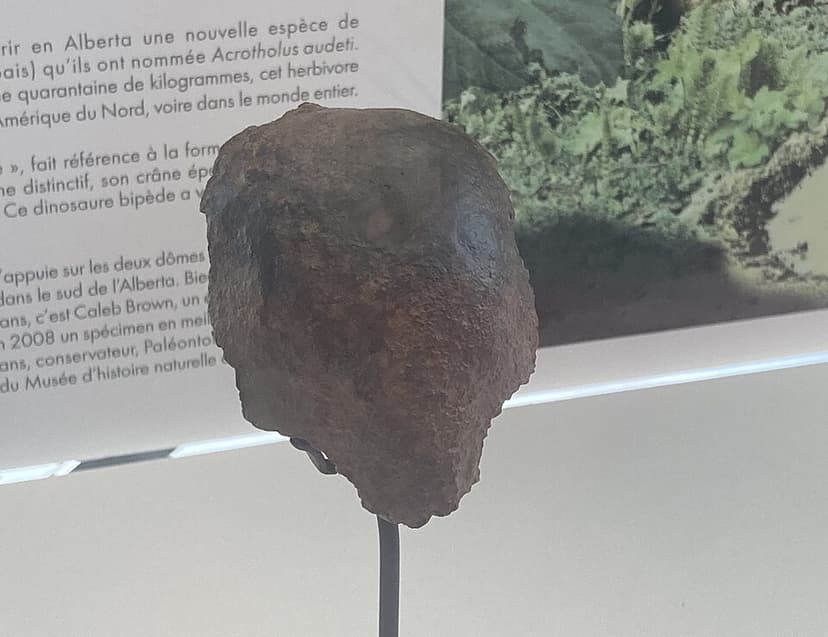
Acrotholus
Acrotholus is an extinct genus of pachycephalosaurian dinosaur that lived during the Santonian stage of the Late Cretaceous period in what is now Canada. It is notable for being one of the earliest known members of the pachycephalosaur family with a well-developed, dome-shaped skull. Acrotholus was a bipedal herbivore whose cranial dome has been theorized to have been used for intraspecies combat or display.

Albertaceratops
Albertaceratops was a centrosaurine horned dinosaur that lived during the middle Campanian age of the Late Cretaceous period in what is now Alberta, Canada. It is distinguished by its unique combination of long brow horns and a bony ridge over its nose, along with large, outwardly-projecting hooks on its frill. This dinosaur is estimated to have reached lengths of up to 5.8 meters and weighed around 3,500 kilograms.

Anchiceratops
Anchiceratops is an extinct genus of chasmosaurine ceratopsid dinosaur that roamed what is now Alberta, Canada, during the Late Cretaceous Period, approximately 73 to 68 million years ago. This heavily built, quadrupedal herbivore was characterized by a distinctive skull featuring two long brow horns, a short nasal horn, and an elongated, rectangular frill with ornate, triangular projections along its edges. The genus name "Anchiceratops" translates to "near horned face," reflecting its perceived evolutionary relationship to other ceratopsids.