
Acrotholus
Acrotholus is an extinct genus of pachycephalosaurian dinosaur that lived during the Santonian stage of the Late Cretaceous period in what is now Canada. It is notable for being one of the earliest known members of the pachycephalosaur family with a well-developed, dome-shaped skull. Acrotholus was a bipedal herbivore whose cranial dome has been theorized to have been used for intraspecies combat or display.
Key Facts
- ›Acrotholus lived during the Santonian of the Late Cretaceous period.
- ›Its fossils were discovered in the Milk River Formation of Alberta, Canada.
- ›It is considered one of the earliest indisputable members of the pachycephalosaur family.
- ›Acrotholus was a bipedal herbivore with a characteristic dome-shaped skull.
- ›The dome's function is debated, with theories including intraspecies combat or sexual display.
- ›Its discovery provided insights into the preservation of small-bodied dinosaurs.
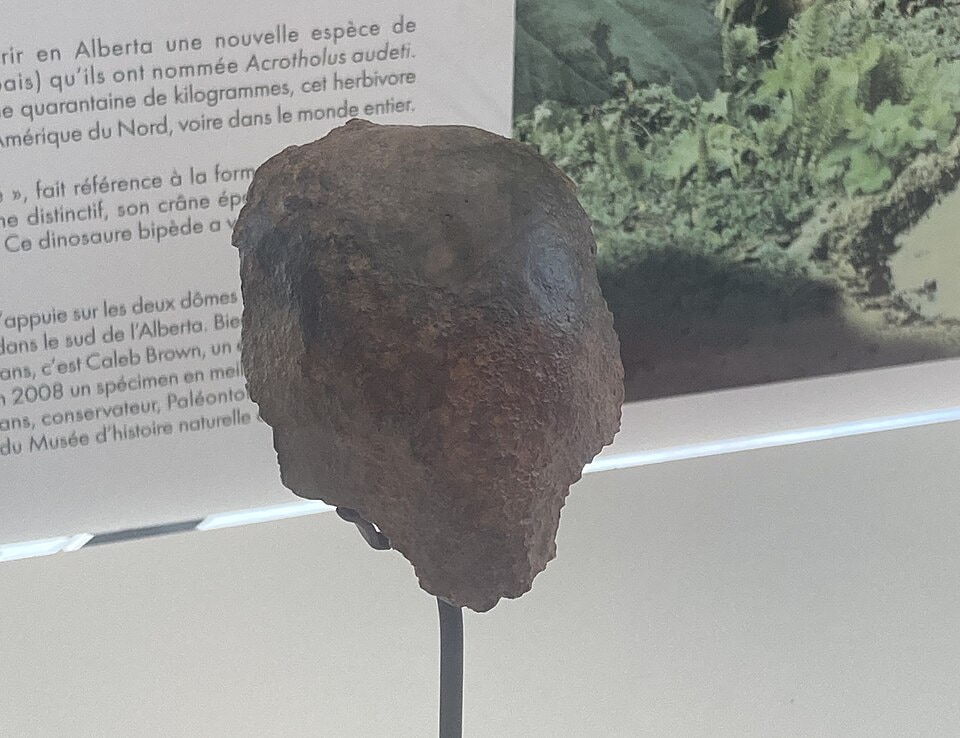
- Characterized by a dome-shaped skull, oval in shape.
- Dome had a maximum thickness of 55 mm above the cerebral fossa.
- Lack of tesserae or tubercles indicates an adult or near-adult specimen.
- Low vascularity and high density within the skull structure.
- Possessed a relatively small body size, estimated at 40 kg or less for pachycephalosaurs.
- The supraorbital region was incorporated into the dome, differing from other pachycephalosaurs.
Prenocephale Prenes, Stegoceras Validum, Homalocephale, Dracorex Hogwartsia, Stygimoloch Spinifer
North America
About Acrotholus
Acrotholus is an extinct genus of pachycephalosaurian dinosaur that lived during the Santonian stage of the Late Cretaceous period, approximately 83 to 72 million years ago. Its fossils have been discovered in the Milk River Formation of Alberta, Canada. The genus is particularly significant as it represents one of the earliest known indisputable members of the pachycephalosaur family, characterized by its distinctive dome-shaped skull.
Discovery and Significance
The holotype of Acrotholus, A. audeti, was found in 2008. The species was named in honor of Roy Audet, who permitted access to his ranch where the discovery was made. The finding of Acrotholus contributed to a greater understanding of the fossil record, particularly regarding the preservation of small-bodied organisms and the evolutionary trajectory of early pachycephalosaurs. The robust cranial dome, a hallmark of this group, is resistant to pre-depositional destruction, which may explain why approximately 66% of known pachycephalosaur specimens consist solely of cranial remains.
Description and Paleobiology
Acrotholus was a bipedal herbivore. Its most striking feature was its skull, which bore a thickened, dome-like structure. Unlike some other pachycephalosaurs, the dome of A. audeti was oval-shaped and showed no signs of juvenile features like tesserae or tubercles, suggesting the specimen was an adult. Computed tomography (CT) scans revealed low vascularity and high density within the dome, with fully fused sutures. The incorporation of supraorbital bones into the dome was also a notable characteristic. The precise function of this cranial dome remains a subject of debate. Leading hypotheses suggest it may have been used for intraspecies combat, a role supported by pathologies observed in related species, or for visual purposes such as sexual display or species recognition.
Paleoecology
Fossil evidence suggests that pachycephalosaurids, including Acrotholus, often inhabited coastal areas and regions near floodplains. Their hindlimb proportions are comparable to those of modern wading birds and moose, animals that frequent wetland environments. The Milk River Formation, where A. audeti was found, has yielded fossils of other Late Cretaceous species, including dinosaurs like Saurornitholestes and mammals such as Alphadon, painting a picture of a diverse ancient ecosystem.
Source: Wikipedia ↗
Frequently Asked Questions
When did Acrotholus live?
Acrotholus lived during the Santonian stage of the Late Cretaceous period. This places its existence approximately 83 to 72 million years ago.
Where were Acrotholus fossils found?
The holotype fossil of Acrotholus was discovered in the Deadhorse Coulee Member of the Milk River Formation in Southern Alberta, Canada. This formation is known for preserving fossils from the Late Santonian.
What does the name Acrotholus mean?
The scientific name Acrotholus is derived from Greek words. 'Akros' means 'highest' and 'tholos' means 'dome,' translating to 'highest dome'.
What did Acrotholus eat?
Acrotholus was a herbivore, meaning it primarily consumed plants. This diet is characteristic of many pachycephalosaurian dinosaurs.
What was the purpose of Acrotholus's dome?
The exact function of Acrotholus's cranial dome is debated among paleontologists. Popular hypotheses suggest it was used for intraspecies combat, similar to head-butting in modern animals, or possibly for visual signaling like sexual display or species recognition.
How large was Acrotholus?
Pachycephalosaurs, including Acrotholus, are generally characterized by their relatively small size compared to other dinosaurs of their time. They typically weighed 40 kg or less.
What is significant about Acrotholus's discovery?
The discovery of Acrotholus led to new revelations in the fossil record concerning the preservation of small-bodied organisms and the evolution of early pachycephalosaurs. Its well-developed cranial dome makes it one of the earliest indisputable members of its family.
Related Dinosaur species

Albertadromeus
Albertadromeus is an extinct genus of herbivorous dinosaur from the Late Cretaceous period, known from Alberta, Canada. It was a small, bipedal runner, likely specialized in eating ferns and low vegetation. The genus contains a single species, Albertadromeus syntarsus.

Brachylophosaurus
Brachylophosaurus is a genus of hadrosaurid dinosaur that lived during the Late Cretaceous period in western North America. Known for its distinctive flat, paddle-like crest on its skull, this herbivore is recognized for its well-preserved fossil "mummies" that offer insights into its soft tissues and diet.

Albertavenator
Albertavenator is a genus of small troodontid theropod dinosaur that lived in Alberta, Canada, during the early Maastrichtian stage of the Late Cretaceous period, approximately 71 million years ago. Known from partial skull material, its distinct cranial features, particularly its short and broad frontal bones, differentiate it from other troodontids. The recognition of Albertavenator has helped to clarify the diversity of small theropods in North America during this period.