
Diabloceratops
Herbivore·Cretaceous Period·Utah, United States·Quadrupedal
Diabloceratops was a medium-sized, quadrupedal herbivore that lived approximately 81.4-81 million years ago during the Late Cretaceous Period in what is now Utah, USA. It is notable for being one of the oldest-known ceratopsids and the first centrosaurine discovered south of Montana. The dinosaur is characterized by a distinctive skull featuring a small nasal horn, a pair of small brow horns, and long spikes on its frill.
Key Facts
- ›Lived approximately 81.4-81 million years ago during the Late Cretaceous Period.
- ›Fossils were discovered in Utah, USA.
- ›Estimated to be 4.5 meters (15 ft) in length and weigh 1.3 metric tons (1.4 short tons).
- ›Was a quadrupedal herbivore with a large, bony neck frill.
- ›Possessed a small nasal horn and a pair of small brow horns.
- ›Featured very long spikes on its frill, similar to Einiosaurus and Styracosaurus.

- Medium-sized ceratopsian
- Large neck frill made of bone
- Small horn on the nose
- Pair of relatively small horns above the eyes
- Very long spikes on the frill
- Skull is deeper and shorter than other centrosaurines
Einiosaurus, Styracosaurus, Machairoceratops, Yehuecauhceratops, Menefeeceratops
North America
About Diabloceratops
Diabloceratops is an extinct genus of centrosaurine ceratopsian dinosaur that roamed the Earth approximately 81.4 to 81 million years ago, during the latter part of the Cretaceous Period. Its fossils have been discovered in what is now Utah, United States. Diabloceratops was a medium-sized, moderately built dinosaur that moved on four legs and was a herbivore. It could reach an estimated length of 4.5 meters (15 feet) and a body mass of 1.3 metric tons (1.4 short tons).
Discovery and Naming
The only known specimen of Diabloceratops eatoni was recovered from the Last Chance Creek Member of the Wahweap Formation in Kane County, Utah. The type specimen was collected in 2002. The dinosaur was formally named and described in 2010 by James Ian Kirkland and Donald DeBlieux. The generic name, Diabloceratops, translates to "devil-horned face," referencing its distinctive cranial features. The specific name, eatoni, honors paleontologist Jeffrey Eaton, who played a significant role in the establishment of the Grand Staircase-Escalante National Monument where the specimen was found.
Physical Characteristics
Diabloceratops possessed a large neck frill made of bone. It featured a small horn on its nose, potentially a second horn in front of that, and a pair of relatively small horns situated above its eyes. Notably, its skull was deeper and shorter than those of other centrosaurines. The frill also bore a pair of very long spikes, reminiscent of those found on genera like Einiosaurus and Styracosaurus. As one of the earlier centrosaurine ceratopsids, Diabloceratops shared a characteristic with more primitive protoceratopsid forms: an accessory opening in the skull that became reduced or disappeared in later ceratopsids, suggesting a gradual evolutionary sequence.
Paleoenvironment
Diabloceratops inhabited an environment characterized by lakes, floodplains, and east-flowing rivers. This region experienced a wet, seasonal climate. During its time, the Western Interior Seaway was at its widest extent, nearly isolating southern Laramidia from the rest of North America. Diabloceratops shared its habitat with a diverse array of fauna, including other dinosaurs like the hadrosaur Acristavus gagslarsoni and the theropod Lythronax argestes, which was likely the apex predator. The fauna also included freshwater fish, rays, sharks, turtles, crocodilians, lungfish, and various mammals.
Source: Wikipedia ↗
Frequently Asked Questions
What does the name Diabloceratops mean?
The name Diabloceratops means 'devil-horned face'. It comes from the Spanish word 'Diablo' for 'devil' and the Latinized Greek word 'ceratops' for 'horned face'.
When did Diabloceratops live?
Diabloceratops lived approximately 81.4 to 81 million years ago, during the latter part of the Cretaceous Period.
Where were Diabloceratops fossils found?
The fossils of Diabloceratops were discovered in Kane County, Utah, in the United States. Specifically, they were found in the Last Chance Creek Member of the Wahweap Formation.
What did Diabloceratops eat?
Diabloceratops was a herbivore, meaning it primarily ate plants. Its medium build and quadrupedal stance were suited for grazing or browsing on vegetation.
What were the unique physical characteristics of Diabloceratops?
Diabloceratops had a distinctive skull with a small nasal horn, small horns above the eyes, and a large neck frill adorned with a pair of very long spikes. Its skull was notably deeper and shorter than other centrosaurines.
What other dinosaurs lived alongside Diabloceratops?
Diabloceratops shared its habitat with other dinosaurs such as the hadrosaur Acristavus gagslarsoni, the lambeosaur Adelolophus hutchisoni, unnamed ankylosaurs and pachycephalosaurs, and the theropod Lythronax argestes, which was likely the apex predator.
Related Dinosaur species

Athenar
Athenar is an extinct genus of dicraeosaurid sauropod dinosaur that lived during the Late Jurassic period in what is now Utah, United States. The genus is known from a single species, Athenar bermani, described in 2025 from a braincase and skull roof previously attributed to Diplodocus. This discovery provides new insights into the diversity of sauropods within the Morrison Formation.

Brontomerus
Brontomerus is a genus of sauropod dinosaur that lived during the Early Cretaceous period, approximately 110 million years ago. It is notable for its unusually large hipbones, which would have supported the largest thigh muscles of any known sauropod, suggesting unique locomotive capabilities. The genus is known from fragmentary fossils of at least two individuals, likely an adult and a juvenile, discovered in Utah, USA.
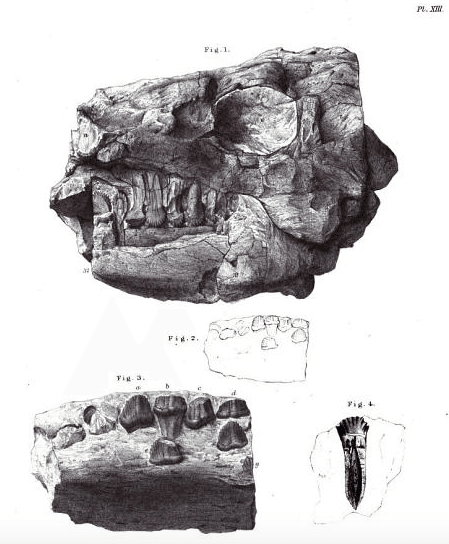
Anthodon
Anthodon was an extinct genus of parareptile that lived during the Permian period in what is now South Africa and Tanzania. Named for its distinctive flower-like teeth, which had numerous cusps, Anthodon was a relatively small herbivore, measuring about 1.2 to 1.5 meters in length.