
Anthodon
Anthodon was an extinct genus of parareptile that lived during the Permian period in what is now South Africa and Tanzania. Named for its distinctive flower-like teeth, which had numerous cusps, Anthodon was a relatively small herbivore, measuring about 1.2 to 1.5 meters in length.
Key Facts
- ›Anthodon means "flower tooth" in Ancient Greek, referring to its distinctive dentition.
- ›Fossils were discovered in South Africa and Tanzania, representing the first dinosaur finds in Africa and the Southern Hemisphere.
- ›It possessed turtle-like armor on its back and small dermal ossicles covering its body.
- ›The skull featured large quadratojugal "horns" and ventral mandibular protrusions.
- ›Anthodon was a relatively small parareptile, estimated to be about 1.2 to 1.5 meters long.
- ›Its diet was herbivorous, with teeth adapted for grinding plant material.
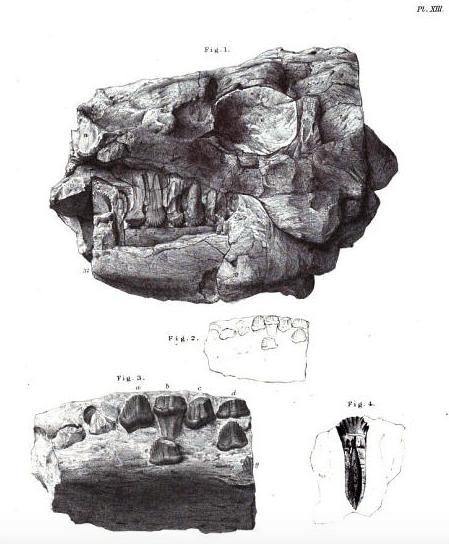
- Small skull
- Large quadratojugal "horns" on cheekbones
- Ventral protrusions on the mandible
- 11-14 pairs of overlapping teeth with 8-15 cusps each
- Turtle-like armor on the back
- Small dermal ossicles covering the body
- Shortened tail compared to less derived forms
Paranthodon, Pareiasaurus Parvus, Propappus Parvus
South Africa, Tanzania
About Anthodon
Anthodon is an extinct genus of parareptile that roamed the Earth during the Permian period. Its fossils have been discovered in both South Africa and Tanzania, marking significant paleontological finds as they were among the first dinosaur fossils unearthed in Africa and the Southern Hemisphere. The genus name, Anthodon, is derived from Ancient Greek words meaning "flower tooth," a direct reference to the distinctive appearance of its teeth.
Paleontology and Discovery
The story of Anthodon's discovery began in 1845 with amateur geologists William Guybon Atherstone and Andrew Geddes Bain, who found several fossils near Dassieklip in South Africa's Cape Province. Bain later sent some of these specimens to the renowned palaeontologist Richard Owen, who, in 1876, formally named the species Anthodon serrarius. Owen initially misidentified aspects of the fossils, even leading to its temporary association with dinosaurs due to contemporaneous finds. However, later work by paleontologists like Robert Broom and Franz Nopcsa clarified its true reptilian classification, with the dinosaurian material being separated and renamed as Paranthodon.
Description and Characteristics
Anthodon was a relatively small parareptile, typically measuring between 1.2 to 1.5 meters (3.9 to 4.9 ft) in length and weighing an estimated 80 to 100 kg (180 to 220 lb). A notable feature was its turtle-like armor, with small dermal ossicles covering the body and armor plates arranged on its back in a pattern reminiscent of a turtle shell. The tail was also proportionally shorter compared to less derived prehistoric reptiles. The skull was small and lightly built, measuring about 30 cm long. Its cheekbones bore large, downward-extending quadratojugal "horns," and similar "horns" were present on the mandible. The most striking characteristic, however, was its dentition: 11 to 14 pairs of small, uniform teeth, each equipped with 8 to 15 cusps. This arrangement gave the teeth a leaf-like or flower-like shape, which inspired the genus's name.
Diet and Classification
Anthodon was a herbivore, with its specialized teeth well-suited for processing plant matter. It belongs to the group of parareptiles, a diverse lineage of reptiles that existed alongside and predated the dinosaurs. While initially subject to some confusion in classification, Anthodon is now recognized as a distinct genus within the pareiasaur clade.
Source: Wikipedia ↗
Frequently Asked Questions
What does the name Anthodon mean?
The name Anthodon comes from Ancient Greek words. 'Anthos' means 'flower' and 'odous' means 'tooth', referring to the flower-like appearance of its teeth due to their numerous cusps.
Where were Anthodon fossils found?
Fossils of Anthodon have been discovered in South Africa and Tanzania. These discoveries marked significant paleontological milestones, being the first dinosaur finds in Africa and the Southern Hemisphere.
What did Anthodon look like?
Anthodon was characterized by its small skull, which had prominent quadratojugal "horns" and ventral mandibular protrusions. Its body was covered in small dermal ossicles and featured armor plates on its back, resembling a turtle shell.
How big was Anthodon?
Anthodon was a relatively small parareptile. Estimates suggest it was about 1.2 to 1.5 meters (3.9 to 4.9 ft) in length and weighed around 80 to 100 kg (180 to 220 lb).
What did Anthodon eat?
Anthodon was a herbivore. Its teeth were small and uniform, with 8 to 15 cusps on each, giving them a leaf-like or flower-like appearance ideal for grinding plant material.
When did Anthodon live?
Anthodon lived during the Permian period. This geological period predates the age of dinosaurs.
Related Dinosaur species

Coelurosauravus
Coelurosauravus was a genus of extinct gliding reptile that lived during the Late Permian period in Madagascar. Members of this genus are distinguished by unique, long, rod-like ossifications projecting from their bodies, which are believed to have formed folding wings for gliding flight, similar to modern Draco lizards. Its scientific name, "hollow-tailed lizard grandfather," reflects its unique anatomical features and its place in evolutionary history.

Antetonitrus
Antetonitrus is a genus of sauropodiform dinosaur that lived during the Early Jurassic period in what is now South Africa. It is considered a basal sauropod, providing important insights into the origin and early evolution of this group. While quadrupedal and herbivorous like its later relatives, Antetonitrus retained primitive adaptations in its forelimbs that allowed for grasping.

Aardonyx
Aardonyx is a genus of basal sauropodomorph dinosaur from the Early Jurassic period of South Africa. Known from disarticulated bones of two immature individuals, it exhibits a unique mix of traits, showing adaptations for both bipedal and quadrupedal locomotion and feeding. Its discovery helped fill a gap in understanding the transition towards the large, quadrupedal sauropods.