
Asian elephant
Africa·Endangered
The Asian elephant (Elephas maximus) is the largest land mammal in Asia and the second largest elephantid globally. It is distinguished by its long trunk with a single finger-like tip, large ears, and grey, wrinkled skin often with depigmented patches. Males typically possess large tusks, while females usually have smaller tusks or none at all. These intelligent and self-aware animals live in complex social structures and play a crucial role in their diverse habitats across the Indian subcontinent and Southeast Asia. Sadly, Asian elephants are listed as Endangered due to habitat loss, degradation, fragmentation, and poaching.
Key Facts
- ›The Asian elephant is the sole living species in the genus Elephas.
- ›They are characterized by a single finger-like process on their trunk, large ears, and wrinkled grey skin.
- ›Adult males weigh around 4 tons, while females average 2.7 tons.
- ›Asian elephants inhabit a variety of forests and grasslands across the Indian subcontinent and Southeast Asia.
- ›They are herbivorous, consuming up to 150 kg of vegetation daily.
- ›The species is listed as Endangered on the IUCN Red List due to significant population decline.
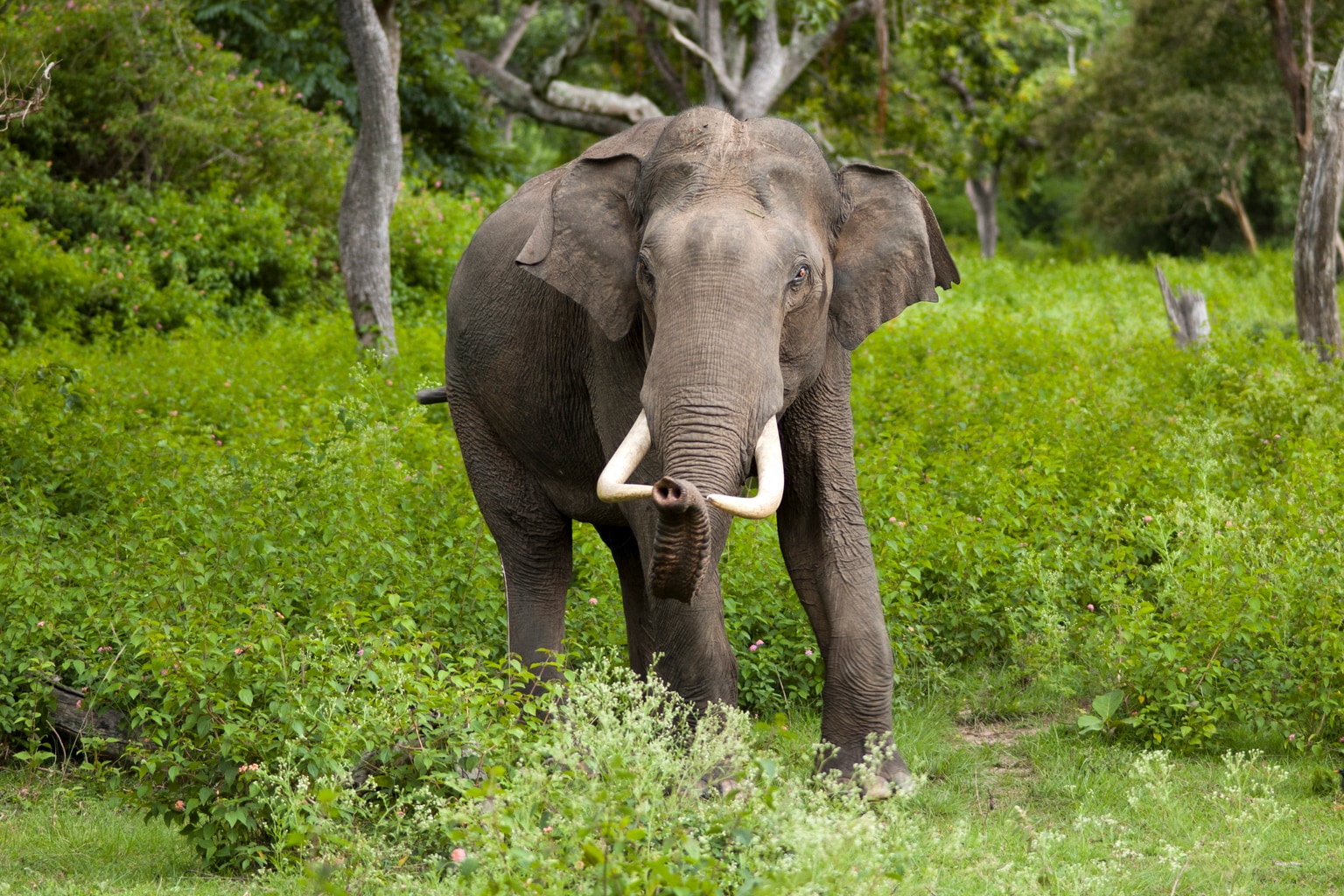
Asiatic Elephant
Genus: Elephas, Family: Elephantidae
Grasslands, Tropical Evergreen Forests, Semi-Evergreen Forests, Moist Deciduous Forests, Dry Deciduous Forests, Dry Thorn Forests, Cultivated Forests, Secondary Forests, Scrublands
- Largest Land Mammal In Asia, Second Largest Elephantid Globally.
- Long Trunk With A Single Finger-Like Process.
- Large, Laterally Folded Ears.
- Wrinkled Grey Skin, Often Partly Depigmented On Trunk, Ears, Or Neck.
- Adult Males Average 4 Tons; Females Average 2.7 Tons.
- Males Typically Have Large Tusks; Females Usually Have Small Tusks Or None.
- Forehead Has Two Hemispherical Bulges.
- Smaller Than African Bush Elephants.
- Back Is Convex Or Level.
- Up To 20 Pairs of Ribs and 34 Caudal Vertebrae.
- Five Nail-Like Structures On Each Forefoot, Four On Each Hind Foot.
- Skin Is 18 mm Thick On Average, 30 mm On the Dorsum.
Indian Subcontinent, Southeast Asia, India, Nepal, Borneo, Sumatra, Bangladesh, Malaysia, China
Habitat Loss, Habitat Degradation, Habitat Fragmentation, Poaching
- Highly Intelligent and Self-Aware.
- Capable of Displaying Grief, Learning, and Greeting Behaviors.
- Crepuscular .
- Use Their Trunks For Manipulating Objects, Wrapping Around Food and Squeezing It Into Their Mouths.
- Communicate Through Growls, Squeaks, and Snorts, With Variations For Distance and Arousal.
- Can Distinguish Low-Amplitude Sounds.
- Rarely Preyed Upon By Tigers .
- Use Pheromones For Reproductive Signaling.
- Undergo An Annual Phenomenon Called 'Musth' Where Males Become Aggressive.
- Agile At Using Their Feet In Conjunction With Their Trunk For Manipulation.
About Asian elephant
The Asian elephant (Elephas maximus), also known as the Asiatic elephant, is the sole living species within the genus Elephas and stands as the largest land animal in Asia. It is recognized as the second largest elephantid species globally. Distinctive physical traits include a long trunk equipped with a single finger-like process, large ears that fold laterally, and wrinkled grey skin that often exhibits depigmentation on the trunk, ears, or neck. Adult males typically weigh around 4 tons, while females average 2.7 tons. These elephants possess a highly developed neocortex, demonstrating significant intelligence, self-awareness, and behaviors such as grief, learning, and greeting.
Taxonomy and Subspecies
First scientifically described by Carl Linnaeus in 1758, the Asian elephant's taxonomy has evolved. Three subspecies are currently recognized: the Sri Lankan elephant (E. maximus maximus), the Indian elephant (E. maximus indicus), and the Sumatran elephant (E. maximus sumatranus). The Sri Lankan elephant is the largest subspecies, with darker skin and more pronounced depigmentation. A potential fourth subspecies, the Borneo elephant (Elephas maximus borneensis), has also been proposed but its status is debated. Extinct subspecies like the Syrian, Chinese, and Javan elephants are now considered synonymous with the Indian elephant.
Distribution and Habitat
Asian elephants inhabit a wide range across the Indian subcontinent and Southeast Asia, from India and Nepal in the west and north, to Borneo and Sumatra in the east and south. Their habitats are diverse, including grasslands, various types of forests (tropical evergreen, semi-evergreen, moist deciduous, dry deciduous, dry thorn), secondary forests, and scrublands. They can be found at elevations ranging from sea level to over 3,000 meters.
Ecology and Behavior
These megaherbivores are crepuscular, dedicating a significant portion of their day to eating, consuming up to 150 kg of vegetation daily. They are generalist feeders, acting as both grazers and browsers, and are known to eat at least 112 different plant species. Water is essential, with elephants needing 80-200 liters per day and using more for bathing. Socially, cows and calves form fluid social networks, while males are typically solitary or form temporary bachelor groups. Communication involves growls, squeaks, and snorts, with various modifications for different contexts and distances. Asian elephants are known for their intelligence and ability to manipulate objects using their trunks and feet.
Reproduction and Lifespan
The gestation period for Asian elephants lasts between 18 and 22 months, resulting in the birth of a single calf, though twins are rare. Calves weigh approximately 100 kg at birth and are suckled for up to three years. A birth interval of four to five years is common. Males undergo an annual period of 'musth,' marked by increased aggression and testosterone levels. Wild Asian elephants typically live for about 60 years, though captive elephants in semi-natural environments have been recorded living longer. Captive populations face challenges with declining numbers due to low birth and high death rates.
Conservation Status
Since 1986, the Asian elephant has been listed as Endangered on the IUCN Red List. This status reflects a population decline of at least 50% over the past three elephant generations. The primary threats include habitat loss, degradation, fragmentation, and poaching, all of which continue to challenge the survival of this iconic species.
Source: Wikipedia ↗
Frequently Asked Questions
What are the main physical characteristics of the Asian elephant?
Asian elephants are large mammals with a long trunk featuring a single finger-like process. They have large, laterally folded ears and wrinkled grey skin that may have depigmented patches on the trunk, ears, or neck. Adult males typically possess large tusks, while females usually have smaller tusks, referred to as 'tushes', or none at all.
Where are Asian elephants found?
Asian elephants are distributed across the Indian subcontinent and Southeast Asia. Their range extends from India in the west to Borneo in the east, and from Nepal in the north to Sumatra in the south.
What is the typical diet of an Asian elephant?
Asian elephants are herbivores and generalist feeders, acting as both grazers and browsers. They consume a wide variety of plant matter, including species from the Malvales order, legumes, palms, sedges, and grasses, eating up to 150 kg of vegetation daily. Bark becomes a significant part of their diet during the cooler dry season.
How do Asian elephants organize themselves socially?
Female Asian elephants and their calves form groups, typically small units of related females and their offspring, though larger groups have been observed. Adult males tend to be solitary or form temporary 'bachelor groups'. During the breeding season, males join female groups to mate.
What are the primary threats to Asian elephants?
The main threats facing Asian elephants are habitat loss, habitat degradation, fragmentation of their living spaces, and poaching. These factors have led to a significant decline in their population.
What is the gestation period for an Asian elephant?
The gestation period for an Asian elephant is between 18 and 22 months. After this period, a calf is born, usually singly, though twins are occasionally observed.
