
Ameerega flavopicta
Lutz's poison frog (Ameerega flavopicta) is a species of frog native to Bolivia and Brazil. This species inhabits a variety of moist environments, including lowland and montane forests, savannas, and shrublands, and reproduces in rocky pools and streams.
Key Facts
- ›Found in Bolivia and Brazil.
- ›Inhabits moist lowland and montane forests, savannas, and shrublands.
- ›Reproduction occurs in rocky pools and streams.
- ›Males call for females in breeding sites like rock crevices and termite nests.
- ›IUCN conservation status is 'Least Concern'.
- ›Faces localized threats from habitat loss due to agriculture and mining.

Lutz's Poison Frog
Forest, Savanna, Shrubland, Freshwater, Rocky Areas
About Ameerega flavopicta
Lutz's poison frog, scientifically designated as Ameerega flavopicta, is a species of frog native to Bolivia and Brazil. This amphibian belongs to the family Dendrobatidae and was formerly classified under the genus Epipedobates.
Habitat and Distribution
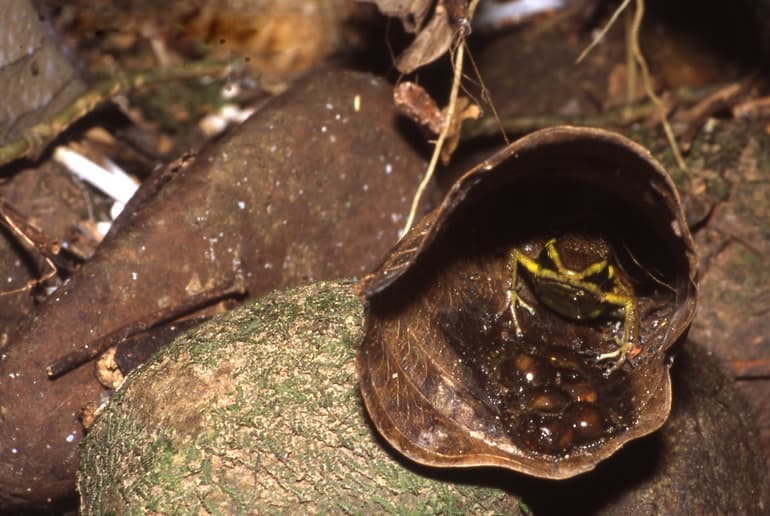
The natural environments favored by Ameerega flavopicta are varied, encompassing subtropical or tropical moist lowland forests, subtropical or tropical moist montane forests, moist savannas, subtropical or tropical moist shrublands, as well as rivers, intermittent freshwater marshes, and rocky areas. Reproduction is closely tied to aquatic and semi-aquatic environments, with breeding occurring in rocky pools and streams. Eggs are deposited on leaf litter, and adult frogs play a role in transporting tadpoles to wetter microhabitats such as trenches or small rocky pools.
The species' range includes numerous protected areas, highlighting its presence within significant conservation zones. These include Área de Preservação Ambiental da Nascente do Rio das Balsas, Área de Preservação Ambiental Lago de São Salvador do Tocantins, Paranana e Palmeirópolis, Área de Preservação Ambiental Morro da Pedreira, Área de Preservação Ambiental Pouso Alto, Área de Preservação Ambiental Serra da Jibóia, Área de Preservação Ambiental Serra do Cabral Augusto de Lima, Estação Ecológica de Pirapitinga, Floresta Nacional de Carajás, Parque Estadual Cristalino II, Parque Estadual da Serra de Caldas Novas, Parque Nacional da Chapada dos Veadeiros, Parque Nacional da Serra da Canastra, Parque Nacional da Serra do Cipo, Parque Nacional do Jamanxim, RPPN Fazenda Arruda, and RPPN Fazenda Pioneira.
Breeding Behavior
The breeding cycle of Lutz's poison frog involves males actively calling to attract females. These calls are made from various breeding sites, which can include rock crevices, termite nests, low vegetation, or trenches. The breeding period for this species typically begins with male vocalizations from October to December. Observations of tadpoles have been recorded from November to April, with froglets appearing from January to April, indicating a protracted breeding season.
Conservation Status and Threats
The International Union for Conservation of Nature (IUCN) classifies Ameerega flavopicta as a species of 'Least Concern' of extinction. Despite this favorable status, the frog faces localized threats stemming from habitat degradation. These threats are primarily associated with agricultural expansion, mining activities, logging operations, and livestock cultivation. While both captive breeding and wild capture for the international pet trade occur, current scientific assessments do not consider these activities to be a significant threat to the overall population of Lutz's poison frog.
Source: Wikipedia ↗
Frequently Asked Questions
Where does Lutz's poison frog live?
Lutz's poison frog is found in Bolivia and Brazil. Its natural habitats include subtropical or tropical moist lowland and montane forests, moist savanna, moist shrubland, rivers, intermittent freshwater marshes, and rocky areas.
What is the breeding behavior of Ameerega flavopicta?
Males of Lutz's poison frog call for females in breeding sites such as rock crevices, termite nests, low vegetation, or trenches. Breeding activity, evidenced by tadpoles, is observed from November to April, with froglets appearing from January to April.
What are the threats to Lutz's poison frog?
The primary threat to Lutz's poison frog is localized habitat loss due to farming, mining, logging, and livestock cultivation. However, the species is classified as 'Least Concern' by the IUCN, indicating it is not currently facing a significant extinction risk.
What kind of environment does Lutz's poison frog prefer?
This frog thrives in moist environments, including subtropical or tropical moist lowland and montane forests, moist savanna, and moist shrubland. It also utilizes rocky areas and freshwater marshes for habitat and reproduction.
Related Frogs

Ameerega macero
The Manú poison frog (Ameerega macero) is a frog species native to the tropical moist and montane forests of southern Peru and Brazil, particularly in the drainages of several major rivers. It is distinctive for its reproductive behavior, where adults transport hatched tadpoles to slow-moving streams.
Ameerega petersi
The Peru poison frog (Ameerega petersi) is a species of frog native to the primary premontane and subtropical or tropical forests of eastern Peru and western Brazil. It is distinguished by its habit of carrying tadpoles to water after hatching from eggs laid on leaf litter.

Ameerega picta
The spot-legged poison frog (Ameerega picta) is a species of poison dart frog native to Bolivia, Brazil, Peru, and Venezuela. This species is distinguished by its presence in a wide range of forest types, from lowland to montane, and its remarkable ability to transport tadpoles to water bodies after hatching on land.