
Ansonia albomaculata
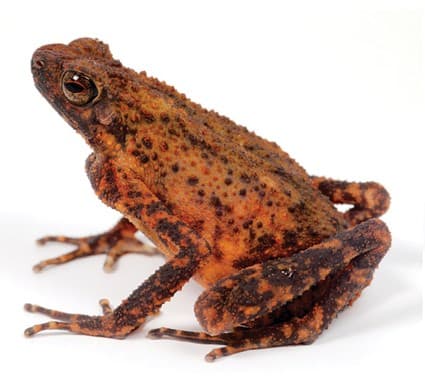
Ansonia albomaculata, also known as the white-lipped slender toad or whitebelly stream toad, is a toad species endemic to the island of Borneo. This slender toad is characterized by its dark brown, warty dorsum and is found in lowland rainforests, breeding in clear, rocky-bottomed streams where its tadpoles cling to rocks.
Key Facts
- ›Found in Sabah and Sarawak (Malaysia), Brunei, and northern Kalimantan (Indonesia).
- ›Males reach up to 30 MM, females up to 35 MM snout-vent length.
- ›Adults are terrestrial and found on the rainforest floor.
- ›Breeds in small, clear, rocky-bottomed streams.
- ›Tadpoles live in torrents and feed on lithophytes.
- ›Considered rare but can be abundant in certain locations.

White-Lipped Slender Toad, Whitebelly Stream Toad
Rainforest, Freshwater Streams
Sabah, Sarawak, Brunei, Northern Kalimantan
- Slender Body
- Dark Brown, Warty Dorsum With Low Warts
- Light Spot On the Upper Jaw Below the Eye
- Distinct Ridge Along the Inner Margin of the Tarsus
About Ansonia albomaculata
Ansonia albomaculata, commonly known as the white-lipped slender toad or whitebelly stream toad, is a species of toad endemic to the island of Borneo. This amphibian is found in the Malaysian states of Sabah and Sarawak, as well as in Brunei and northern Kalimantan, Indonesia.
Description and Characteristics
This toad exhibits a slender appearance. Adult males typically reach a snout-to-vent length of up to 30 mm (1.2 inches), while females can grow slightly larger, up to 35 mm (1.4 inches). Key physical features include a head that is wider than it is long, with a truncate snout. The tympanum is visible but partially obscured by skin. The fingers are long and possess rounded tips with rudimentary webbing, and the toes are fully webbed with small, rounded disks. A notable characteristic is a distinct ridge running along the inner margin of the tarsus. The dorsum is dark brown and warty, although the warts are low. A light-colored spot is present on the upper jaw, just below the eye.
Tadpoles, believed to belong to this species, are small, measuring between 10–14 mm (0.4–0.6 inches) in total length. They have an oval body that is flattened dorsoventrally and a bluntly rounded tail.
Habitat and Ecology
Ansonia albomaculata is a lowland species closely associated with streams, typically found at elevations between 150 and 500 meters (490 and 1,640 feet) above sea level. The adult toads are primarily terrestrial, dispersing widely across the rainforest floor. They breed in small, clear streams that have rocky bottoms. The larval stage, the tadpoles, inhabit torrents where they cling to rocks and feed on lithophytes, which are plants that grow on rocks.
Conservation Status and Threats
This species is generally considered rare, although it can be locally abundant in some areas. Ansonia albomaculata is known from widely scattered localities. It is sensitive to habitat modification and faces significant threats from forest loss and fragmentation. These issues are largely driven by the conversion of forests into rubber and oil palm plantations. These agricultural practices further degrade the larval habitat through siltation and eutrophication caused by chemical fertilizers. Despite these threats, Ansonia albomaculata is present in several protected areas.
Source: Wikipedia ↗
Frequently Asked Questions
What are the common names for Ansonia albomaculata?
Ansonia albomaculata is commonly referred to as the white-lipped slender toad and the whitebelly stream toad.
Where is Ansonia albomaculata found?
This species is endemic to the island of Borneo, with populations found in Sabah and Sarawak (Malaysia), Brunei, and northern Kalimantan (Indonesia).
What is the size of Ansonia albomaculata?
Males typically grow to about 30 mm (1.2 inches) and females to about 35 mm (1.4 inches) in snout-to-vent length. Tadpoles are small, measuring 10–14 mm (0.4–0.6 inches) in total length.
What is the habitat of Ansonia albomaculata?
Ansonia albomaculata is a lowland species associated with streams, found at elevations between 150 and 500 meters. Adults are terrestrial and inhabit the rainforest floor, while they breed in small, clear, rocky-bottomed streams.
What threatens Ansonia albomaculata?
The species is threatened by forest loss and fragmentation due to the conversion of forests to rubber and oil palm plantations. These plantations also negatively impact larval habitats through siltation and eutrophication from chemical fertilizers.
Related Frogs
Ansonia longidigita
Ansonia longidigita, also known as the long-fingered slender toad or long-fingered stream toad, is a species of toad endemic to the island of Borneo. Its specific name, "longidigita," highlights its most distinctive feature: unusually long and slender fingers, particularly in males. This toad inhabits mid-elevation forests, favoring areas near clear, rocky streams where it breeds.

Ansonia hanitschi
Ansonia hanitschi, commonly known as the Kadamaian stream toad, is a species of toad endemic to the mountains of Borneo. This amphibian is found in both Malaysian and Indonesian Borneo, inhabiting submontane and montane forests, typically on the forest floor. Its breeding is closely tied to clear, rocky mountain streams.

Ansonia inthanon
Ansonia inthanon is a small toad species belonging to the Bufonidae family, native to the subtropical forests of Thailand. It is distinctively found near torrents on sloping land and faces threats from habitat loss and invasive species. Despite its restricted known range, it is not considered rare within its specific habitat.