
Amguid
Amguid is a well-preserved impact crater situated in the Central Sahara of Algeria. Its relatively young age, estimated to be less than 100,000 years, and its pristine condition due to the arid desert environment make it a significant site for studying impact events. The crater's morphology and geological features, including shatter cones and breccia, provide insights into the low-velocity impact event.
Key Facts
- ›Located in the Central Sahara, Algeria.
- ›Diameter ranges from 500 to 530 meters.
- ›Approximately 65 meters deep.
- ›Estimated age is less than 100,000 years, likely from the Pleistocene epoch.
- ›Likely caused by a low-velocity impact from a loosely compacted asteroid.
- ›Discovered in 1948 and first scientifically described in 1969.
About Amguid
Amguid Impact Crater
Amguid is an impact crater located in the Central Sahara region of Algeria. It is a relatively young and exceptionally well-preserved structure, largely due to its arid desert environment which lacks significant vegetation cover and erosion.
Key Features and Discovery
The crater measures approximately 500 to 530 meters (0.31 to 0.33 miles) in diameter and is about 65 meters (213 feet) deep. Its age is estimated to be less than 100,000 years, placing its formation within the Pleistocene epoch. Scientific studies suggest the impact was likely a low-velocity event, possibly caused by a loosely compacted carbonaceous chondritic asteroid, rather than a hypervelocity metallic body.
Amguid was first sighted from aircraft in 1948 by Karpoff. The initial scientific description was published by Jean-Phillippe Lefranc in 1969, with further studies conducted by Lambert and Lamali in 1980 and 2009. Despite its scientific interest, Amguid remains understudied due to the difficulty of access.
Morphology and Geology
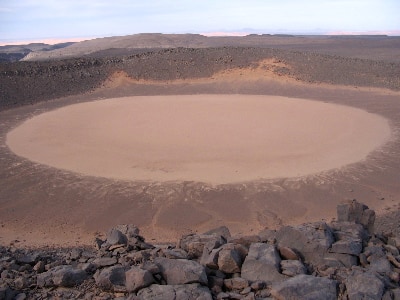
The crater exhibits a nearly perfect circular structure with a collapsed central area. The southeastern section of the rim is notably steeper than the rest of the perimeter, and the crater walls become progressively steeper towards their upper parts. Radial and fold features are clearly visible emanating from the crater. The central flat area is partially filled with fine-grained eolian compacted silt and detrital materials, including fall-back breccias. The white spot in the center is a result of rainwater evaporating. The rim is characterized by breccia and the presence of shatter cones. Distinct sandstone bed outcroppings are visible on the internal walls of the crater rim. The impact occurred in Lower Devonian sandstone rocks belonging to the extern Tassili series.
Source: Wikipedia ↗
Frequently Asked Questions
Where is the Amguid crater located?
The Amguid crater is situated in the Central Sahara region of Algeria. Its location in the arid desert environment contributes to its excellent state of preservation.
How large is the Amguid crater?
Amguid has a diameter estimated to be between 500 and 530 meters (approximately 1,640 to 1,740 feet). The crater is also approximately 65 meters deep.
What is the estimated age of the Amguid crater?
The age of the Amguid crater is estimated to be less than 100,000 years, suggesting it formed during the Pleistocene epoch. This makes it a relatively young impact structure.
What is believed to have caused the Amguid impact?
The impact event that formed Amguid is thought to have been of low velocity, likely caused by an asteroid. Studies of the crater's mineralogy have ruled out hypervelocity metallic bodies.
What is the geological setting of the Amguid crater?
The Amguid crater impacted Lower Devonian rocks, specifically sandstone from the Tassili series. The crater's rim is studded with breccia, and shatter cones are present, indicating the geological forces involved.
Why is the Amguid crater considered well-preserved?
Its pristine condition is attributed to its location in the Sahara Desert, characterized by an arid climate and lack of vegetation cover. These factors have protected the crater from significant erosion.
Related Impact Craters
Talemzane
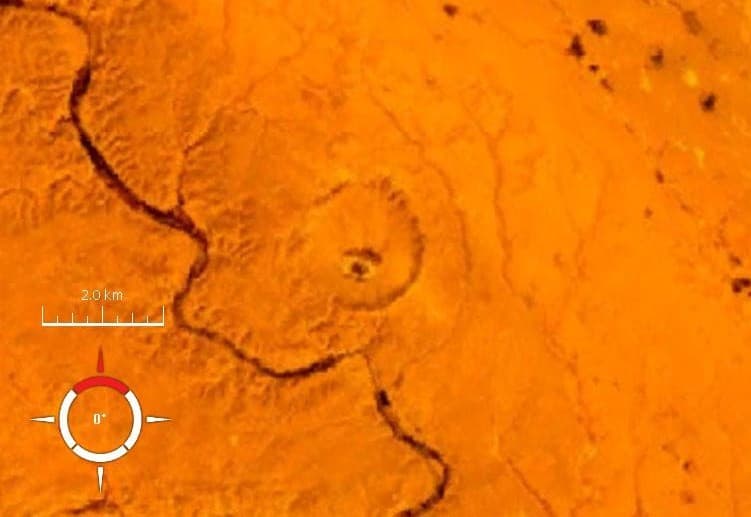
Talemzane is a simple impact crater located in Algeria, approximately 40 km southeast of Hassi Delaa. Its Arabic name, "Maadna," translates to "depression of ore," hinting at its geological significance. The crater, with a diameter of 1.75 km, formed between 203,000 and 3 million years ago and has been a subject of research since its first exploration in 1928.

Ouarkziz
Ouarkziz Crater is an impact structure located in northwestern Algeria, near the Moroccan border. This 3.5-kilometer diameter crater was formed by a meteor impact less than 70 million years ago, during the late Cretaceous Period. Despite significant erosion, its circular shape is still discernible, highlighting older sedimentary rock layers.

Wolfe Creek
Wolfe Creek Crater, also known as Kandimalal by the local Djaru people, is a remarkably well-preserved meteorite impact crater located in Western Australia. Its pristine condition makes it a significant geological site, comparable to the Barringer Crater in Arizona, and it holds deep cultural importance for Indigenous Australians.