
Wolfe Creek
Wolfe Creek Crater, also known as Kandimalal by the local Djaru people, is a remarkably well-preserved meteorite impact crater located in Western Australia. Its pristine condition makes it a significant geological site, comparable to the Barringer Crater in Arizona, and it holds deep cultural importance for Indigenous Australians.
Key Facts
- ›It is situated in Western Australia and is accessible via the Tanami Road.
- ›The crater averages approximately 875 meters (2,871 ft) in diameter.
- ›Its age is estimated to be less than 120,000 years old, dating to the Late Pleistocene.
- ›It was identified from an aerial survey in 1947 and scientifically reported in 1949.
- ›Small iron meteorites and larger 'shale-balls' have been found in the vicinity.
- ›It is considered one of the most undeformed meteorite craters known on Earth.

Iron Meteorites, Iron Oxide, Shocked Quartz
About Wolfe Creek
Wolfe Creek Crater
Wolfe Creek Crater, known to the local Djaru (Jaru) Aboriginal people as Kandimalal, is a spectacularly well-preserved impact crater situated in the Kimberley region of Western Australia. Its exceptional state of preservation has led to comparisons with the famous Barringer Crater in Arizona, solidifying its status as a site of significant geological and scientific interest.
Description and Formation
The crater is located in the Wolfe Creek Meteorite Crater National Park and is accessed via the Tanami Road. It averages approximately 875 meters (2,871 ft) in diameter and stands about 60 meters (200 ft) deep from rim to its present floor. Initial estimates placed its formation around 300,000 years ago, but more recent research in 2019 suggests an age of less than 120,000 years, dating the impact event to the Late Pleistocene epoch. The celestial object responsible for this impact is believed to have been a meteorite about 15 meters (49 ft) in diameter. Small iron meteorite fragments and larger, rounded objects composed of iron oxide, known as 'shale-balls', have been discovered in the vicinity.
Discovery and Naming
Wolfe Creek Crater was brought to scientific attention in 1947 after being identified during an aerial survey. Ground investigations followed shortly thereafter, with the first scientific publication appearing in 1949. The crater's European name originates from a nearby creek, which was named in honor of Robert Wolfe, a prospector and storekeeper active during the gold rush that led to the establishment of Halls Creek. Early reports occasionally misspelled the name as Wolf Creek.
Cultural Significance
For the Djaru people, Kandimalal is a site of deep cultural and spiritual importance, featuring prominently in their art and oral traditions. Multiple Dreaming stories recount its formation, with one narrative describing the crater as the work of a rainbow snake emerging from the earth. Another story relates that the evening star became so hot as it fell to the ground that it caused a massive explosion and dust cloud, terrifying the people until they ventured close enough to realize it was the fallen star.
Cultural References
The dramatic landscape of Wolfe Creek Crater has served as a backdrop for various cultural works. It was famously featured in the Australian horror film franchise "Wolf Creek" (2005 and 2013) and its subsequent television series. The crater also plays a role in Arthur Upfield's 1962 detective novel "The Will of the Tribe."
Source: Wikipedia ↗
Frequently Asked Questions
Where is Wolfe Creek Crater located?
Wolfe Creek Crater is located in Western Australia. It is accessed via the Tanami Road, approximately 150 kilometers south of the town of Halls Creek, and is central to the Wolfe Creek Meteorite Crater National Park.
How large is Wolfe Creek Crater?
The crater averages about 875 meters (2,871 ft) in diameter. From the rim to the present crater floor, it is approximately 60 meters (200 ft) deep.
When was Wolfe Creek Crater formed?
For many years, it was thought to have been created around 300,000 years ago. However, recent investigations have revised the estimated age to less than 120,000 years old, placing the impact event in the Late Pleistocene geological epoch.
What caused the impact at Wolfe Creek?
The crater is estimated to have been formed by a meteorite approximately 15 meters (49 ft) in diameter with a mass of about 14,000 tonnes. Small iron meteorites and larger 'shale-balls' have been found in the surrounding area.
When was Wolfe Creek Crater discovered by scientists?
Wolfe Creek Crater was brought to the attention of scientists after being spotted during an aerial survey in 1947. It was investigated on the ground two months later and first reported in publication in 1949.
What is the significance of Wolfe Creek Crater?
Wolfe Creek Crater is significant for its well-preserved state, making it one of the most undeformed meteorite craters known on Earth. It also holds considerable cultural importance for the local Djaru Aboriginal people, who refer to it as Kandimalal and have associated Dreaming stories about its formation.
Related Impact Craters

Boxhole
Boxhole is a young impact crater located in the Northern Territory, Australia, approximately 180 km northeast of Alice Springs. Discovered in 1937, it is a Holocene-era impact event, estimated to be around 5,400 years old. The crater is notable for being the second impact structure described in Australia and for the discovery of nickel-bearing metallic fragments and an 82 kg iron mass.
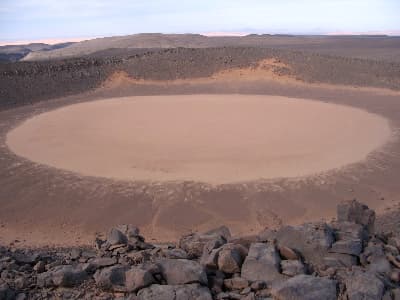
Amguid
Amguid is a well-preserved impact crater situated in the Central Sahara of Algeria. Its relatively young age, estimated to be less than 100,000 years, and its pristine condition due to the arid desert environment make it a significant site for studying impact events. The crater's morphology and geological features, including shatter cones and breccia, provide insights into the low-velocity impact event.

Dalgaranga
The Dalgaranga crater is a small, exceptionally well-preserved impact structure located in Western Australia. Discovered in 1921, it is unique as the only known impact crater formed by a mesosiderite meteorite, with fragments of the stony-iron projectile found at the site. Its small size and pristine condition suggest a relatively young age.