
Zhamanshin
The Zhamanshin crater, located in Kazakhstan, is a 14-kilometer impact structure estimated to be 900,000 years old. It is considered one of the most recent large-magnitude meteorite impact events that could have produced significant global disruption, though not a mass extinction.
Key Facts
- ›Diameter: 14 kilometers.
- ›Estimated age: 900,000 ± 100,000 years.
- ›Geological period: Pleistocene.
- ›Location: Kazakhstan.
- ›The crater is exposed at the surface.
- ›Considered the site of a recent large-magnitude impact event.

About Zhamanshin
Zhamanshin Crater
The Zhamanshin crater is an impact structure located in Kazakhstan, with a diameter of 14 kilometers. Scientific estimates place its age at approximately 900,000 years, during the Pleistocene epoch. The crater is readily visible on the Earth's surface, making it a significant geological feature.
Significance of the Impact
This impact event is notable for its potential magnitude. It is believed that the Zhamanshin impact was one of the most recent events of its kind capable of causing widespread global disruption, comparable to the effects of a nuclear winter. However, the impact was not substantial enough to have resulted in a mass extinction event.
Research and Origin
In the late 1970s, scientific papers exploring the origins of the Australasian strewnfield put forward Zhamanshin as a potential source. It was considered alongside the Elgygytgyn crater as a possible site of the impact that created this widespread distribution of ejecta.
Source: Wikipedia ↗
Frequently Asked Questions
Where is the Zhamanshin crater located?
The Zhamanshin crater is located in Kazakhstan. It is an impact structure exposed on the surface of the Earth.
How large is the Zhamanshin crater?
The Zhamanshin crater has a diameter of 14 kilometers.
How old is the Zhamanshin crater?
The age of the Zhamanshin crater is estimated to be 900,000 years, with an uncertainty of 100,000 years. This places its formation during the Pleistocene epoch.
What is the significance of the Zhamanshin impact event?
The Zhamanshin impact event is believed to be one of the most recent meteorite impacts of a magnitude that could have caused global disruption, similar to a nuclear winter. However, it was not large enough to trigger a mass extinction.
Was Zhamanshin identified as the source of the Australasian strewnfield?
Preliminary research in the late 1970s suggested either the Zhamanshin crater or the Elgygytgyn crater as the origin of the Australasian strewnfield.
Related Impact Craters
Chiyli
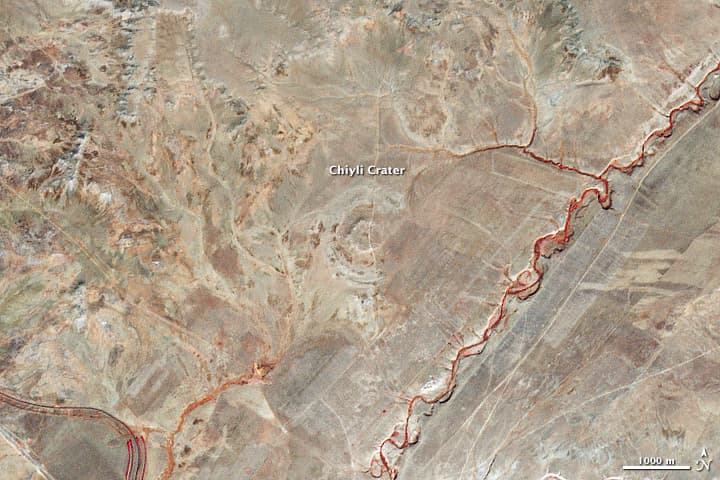
Chiyli Crater is a well-preserved impact structure located in Aktobe, Kazakhstan. With a diameter of 5.5 kilometers, its age is estimated to be around 46 million years, placing its formation in the Eocene epoch. The crater is notable for being exposed at the surface, making it accessible for geological study.
Shunak
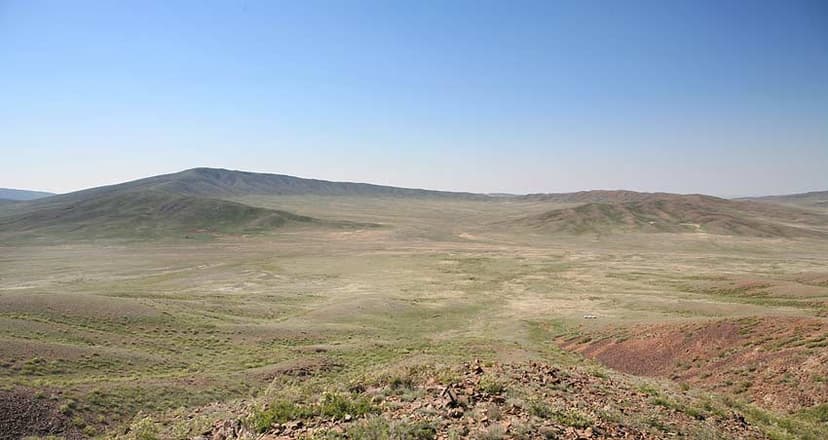
Shunak is a meteorite impact crater located in the Qaraghandy Province of Kazakhstan. With a diameter of 2.8 kilometers, its age is estimated to be between 35 and 55 million years, dating back to the Eocene epoch. The crater is currently exposed on the Earth's surface.

Bigach
The Bigach impact crater is located in Kazakhstan and measures 8 km in diameter. Its age is estimated to be between 2 and 8 million years, placing it in the Pliocene or Miocene epochs. The crater is currently exposed on the Earth's surface.